The North America Digital Thread Market would witness market growth of 19.4% CAGR during the forecast period (2025-2032).
The US market dominated the North America Digital Thread Market by Country in 2024, and would continue to be a dominant market till 2032; thereby, achieving a market value of $11,451.6 million by 2032. The Canada market is experiencing a CAGR of 21.7% during (2025 - 2032). Additionally, The Mexico market would exhibit a CAGR of 20.6% during (2025 - 2032). The US and Canada led the North America Digital Thread Market by Country with a market share of 72.2% and 13% in 2024.
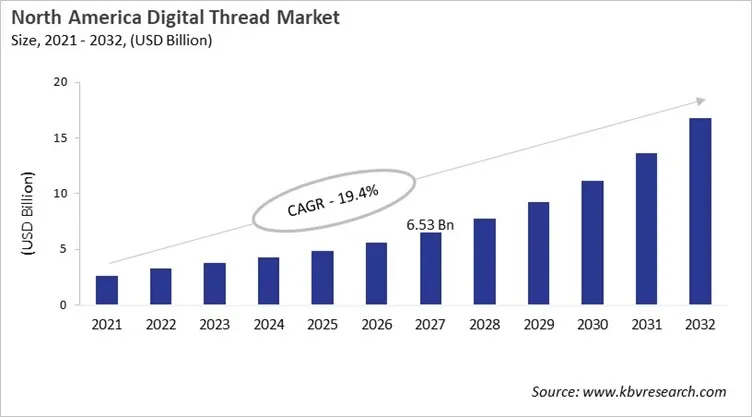
In North America, the digital thread market has gone from being used mostly in aerospace and defense to being used by many industries, including automotive, electronics, and heavy machinery. The need for seamless lifecycle data integration, engineering accuracy, real-time visibility, and supply-chain traceability has driven its evolution. Government-supported research, especially from national standards bodies, sped up the development of interoperability frameworks and made industries ready for them. As companies saw the value of having synchronized data across product design, manufacturing, and field operations, the rise of Industry 4.0, smart factories, and digital twins pushed demand even higher. More problems in the supply chain and more rules made the case for lifecycle traceability and connected engineering systems stronger.
Some of the biggest trends that are affecting market growth right now are unified lifecycle platforms that combine PLM, CAD, MES, ERP, and IoT systems; the growth of digital twins that need real-time data connectivity; and the digitalization of the supply chain to make it more resilient and transparent. Competitive dynamics show that industrial software providers, defense programs, OEMs, and specialized engineering firms are all very active. Some strategies are making platforms that can grow, working together in the supply chain, making sure that different systems can work together, training the workforce, and using AI to analyze data. As adoption speeds up, companies that can provide integrated ecosystems, flexible architectures, and measurable operational impact are likely to be at the top of the region's digital thread landscape.
Based on Module, the market is segmented into Data Collection, Data Management & Integration, Connectivity & Interoperability, Data Analysis & Visualization and Other Module. With a compound annual growth rate (CAGR) of 17.4% over the projection period, the Data Collection Market, dominate the US Digital Thread Market by Module in 2024 and would be a prominent market until 2032. The Data Analysis & Visualization market is expected to witness a CAGR of 19.5% during (2025 - 2032).
Based on Deployment, the market is segmented into On-Premises and Cloud-Based. The On-Premises market segment dominated the Mexico Digital Thread Market by Deployment is expected to grow at a CAGR of 20.1 % during the forecast period thereby continuing its dominance until 2032. Also, The Cloud-Based market is anticipated to grow as a CAGR of 21.3 % during the forecast period during (2025 - 2032).

Free Valuable Insights: The Digital Thread Market is Predicted to reach USD 49.68 Billion by 2032, at a CAGR of 20.1%
The digital thread is becoming very popular in the United States, especially in advanced manufacturing sectors where lifecycle traceability, flexibility, and supply-chain resilience are important. Government agencies like NIST are raising awareness, creating standards, and running readiness programs. Many U.S. businesses already have the automation and IT systems in place that make integration possible. Compliance rules in regulated industries and past supply chain problems that exposed data silos are making adoption happen faster. Digital twins, model-based enterprise frameworks, IoT-enabled connected factories, and AI-driven analytics that help people make decisions faster are some of the most important trends. While big companies are moving quickly, smaller suppliers still have problems with things like cost, interoperability, and digital skills. However, the overall market is getting more mature and gaining momentum.

By Deployment
By Module
By Technology
By End User
By Country
Our team of dedicated experts can provide you with attractive expansion opportunities for your business.






 Unique Offerings