The North America Digital Rights Management Market would witness market growth of 9.7% CAGR during the forecast period (2025-2032).
The US market dominated the North America Digital Rights Management Market by Country in 2024, and would continue to be a dominant market till 2032; thereby, achieving a market value of $3,318.9 million by 2032, growing at a CAGR of 8.9 % during the forecast period. The Canada market is expected to witness a CAGR of 11.6% during (2025 - 2032). Additionally, The Mexico market is expected to witness a CAGR of 10.8% during (2025 - 2032). The US and Canada led the North America Digital Rights Management Market by Country with a market share of 73.2% and 14% in 2024.
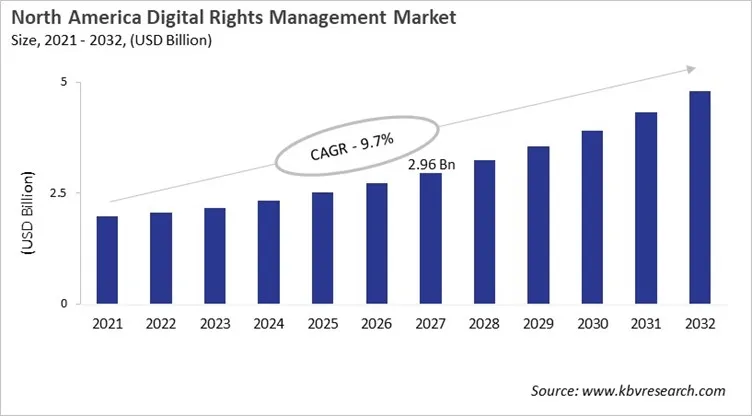
Digital Rights Management (DRM) is a set of rules and technologies that control how digital content can be accessed, used, and shared. Its goal is to protect intellectual property. DRM started when people moved from physical media to digital media. It grew in response to the rise of the internet, which made copying, sharing, and piracy easier. Over time, it grew from simple encryption to advanced systems that support streaming, e-books, cloud software, and business collaboration. Modern DRM combines legal compliance, technical safeguards, and international web standards to make sure that content can be delivered safely and in a way that works with other systems. It is now a key part of making subscription models, licensed access, and safe digital use possible on a wide range of devices and in different parts of the world.
Cloud computing, browser-based standards, and businesses using them to protect documents and data have all added to the DRM landscape. Providers improve their market position by adding DRM to platforms, taking part in the development of standards, and branching out into enterprise and institutional use cases. There are big platform providers, specialized vendors, and standards bodies in the competitive environment that try to find a balance between proprietary innovation and interoperability. All of these factors make DRM a complete system for controlling digital rights and data in consumer, business, and cloud environments.
Based on Enterprise Size, the market is segmented into Large Enterprises, and Small & Medium Enterprises. With a compound annual growth rate (CAGR) of 8.5% over the projection period, the Large Enterprises Market, dominate the US Digital Rights Management Market by Enterprise Size in 2024 and would be a prominent market until 2032. The Small & Medium Enterprises market is expected to witness a CAGR of 9.5% during (2025 - 2032).
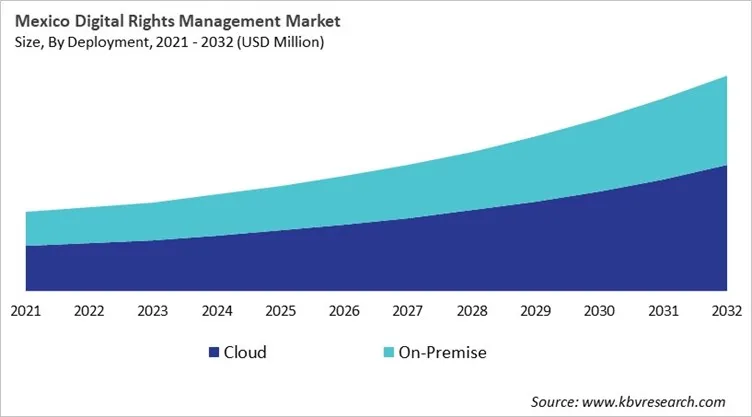
Based on Deployment, the market is segmented into Cloud, and On-Premise. The Cloud market segment dominated the Mexico Digital Rights Management Market by Deployment is expected to grow at a CAGR of 11 % during the forecast period thereby continuing its dominance until 2032. Also, The On-Premise market is anticipated to grow as a CAGR of 10.6 % during the forecast period during (2025 - 2032).
Free Valuable Insights: The Digital Rights Management Market is Predicted to reach USD 12.97 Billion by 2032, at a CAGR of 10.2%
The United States has the most advanced and powerful Digital Rights Management (DRM) market in North America. This is because it is the leader in making digital media, software, cloud computing, and intellectual property. DRM is a key technology for protecting digital assets because a lot of entertainment, business data, education, and software distribution have gone digital. Strong U.S. copyright laws and the fact that courts recognize technological protection measures make DRM widely used. Regulatory focus on data security and governance further encourages enterprises to integrate DRM into information protection strategies. DRM is being used more in business and professional settings, especially to protect content that is stored in the cloud or worked on remotely. Subscription-based and SaaS business models rely heavily on DRM for licensed access control. There are major platform providers and niche vendors competing on interoperability, scalability, compliance, and user experience in the competitive landscape.

By Enterprise Size
By Component
By Deployment
By End-user Industry
By Country
Our team of dedicated experts can provide you with attractive expansion opportunities for your business.




 Unique Offerings