The North America Desktop Virtualization Market would witness market growth of 9.6% CAGR during the forecast period (2025-2032).
The US market dominated the North America Desktop Virtualization Market by Country in 2024, and would continue to be a dominant market till 2032; thereby, achieving a market value of $7,415 million by 2032. The Canada market is experiencing a CAGR of 11.7% during (2025 - 2032). Additionally, The Mexico market would exhibit a CAGR of 11.2% during (2025 - 2032). The US and Canada led the North America Desktop Virtualization Market by Country with a market share of 76.4% and 13% in 2024.
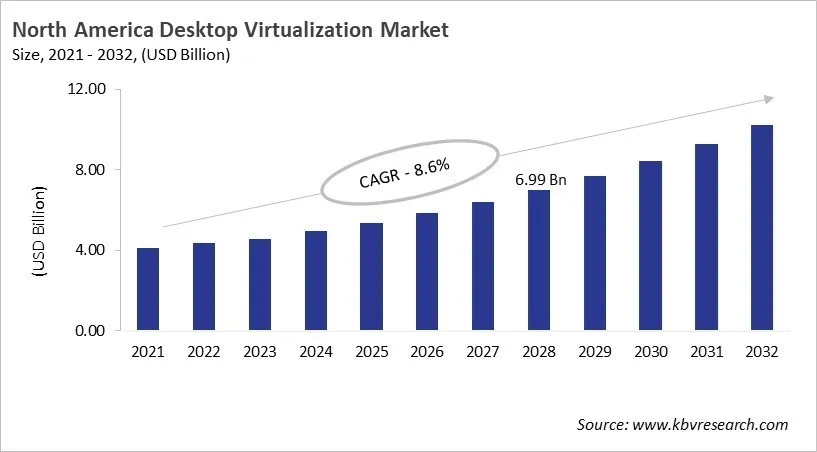
Desktop virtualization has become a crucial component of modernizing enterprise IT in North America. This is due to the early adoption of the technology, strong government support, and a well-developed cloud infrastructure. Federal programs and frameworks from organizations like NIST and the GSA accelerated the adoption of virtualization in government, healthcare, and financial services, making it a safe, compliant, and effective way to deliver desktops. The transition from on-premises VDI to cloud-based Desktop-as-a-Service gained momentum with the rise of cloud computing and accelerated further during the COVID-19 pandemic. Cloud-first architectures, hybrid deployment models, and compliance with zero-trust security principles are what define the market today. These are all ways to meet the changing needs of cybersecurity and compliance.
Established technology leaders who focus on cloud integration, security differentiation, and enabling a hybrid workforce to shape the competitive landscape. Microsoft, Citrix, VMware, and IBM all work on virtual desktop platforms that can grow with your business and support remote and hybrid work, BYOD policies, and centralized data protection. Elastic scalability, subscription-based pricing, advanced identity management, and AI-driven automation are some of the most important trends. New cloud-native companies are coming into the market, but established companies stay in charge by building deep trust with businesses, creating large ecosystems, and constantly coming up with new ideas. This keeps desktop virtualization at the center of North America's digital workplace strategies.
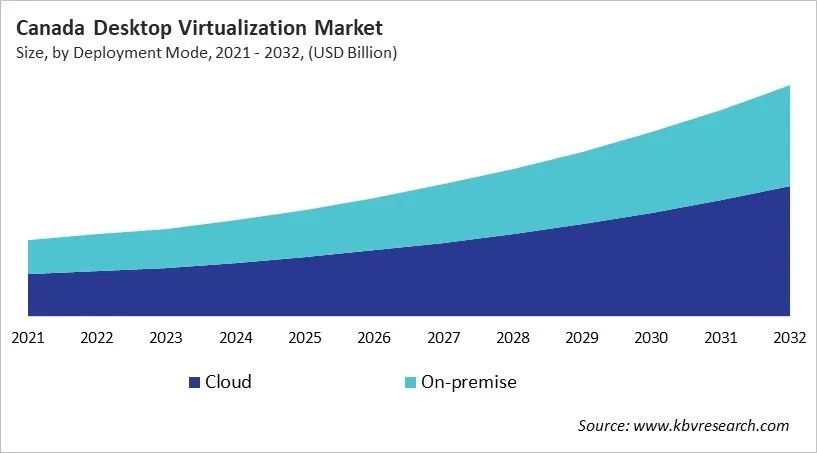
Based on Deployment Mode, the market is segmented into Cloud, and On-premise. The Cloud market segment dominated the Canada Desktop Virtualization Market by Deployment Mode is expected to grow at a CAGR of 11.9 % during the forecast period thereby continuing its dominance until 2032. Also, The On-premise market is anticipated to grow as a CAGR of 11.4 % during the forecast period during (2025 - 2032).
Based on End-User Vertical, the market is segmented into IT & Telecommunications, Financial Services, Healthcare, Manufacturing, and Other End-User Vertical. Among various US Desktop Virtualization Market by End-User Vertical; The IT & Telecommunications market achieved a market size of USD $1169.2 Million in 2024 and is expected to grow at a CAGR of 8 % during the forecast period. The Healthcare market is predicted to experience a CAGR of 9.7% throughout the forecast period from (2025 - 2032).
Free Valuable Insights: The Desktop Virtualization Market is Predicted to reach USD 29.02 Billion by 2032, at a CAGR of 10.4%
The United States is the leader in the North American desktop virtualization market. This is because it has a strong IT infrastructure, a lot of people use the cloud, and businesses are quickly going digital. Desktop virtualization is now a key tool for making work flexible in many fields, including BFSI, healthcare, retail, and education, thanks to the widespread acceptance of remote and hybrid work. Increased data security needs, compliance with regulations, centralized IT management, and cost optimization are all important factors in growth. Cloud platforms make it possible to deploy systems that can grow and be accessed easily. The market is changing quickly because more people are using Desktop-as-a-Service, AI is being used to improve performance and security, and there is a growing need for support for graphics-intensive workloads. Companies also have problems with the initial investment and moving old applications to new ones. Cloud integration, performance innovation, and flexible pricing models are all making competition even stronger.

By Deployment Mode
By Desktop Delivery Platform
By End-User Vertical
By Country
Our team of dedicated experts can provide you with attractive expansion opportunities for your business.





 Unique Offerings