The North America Container Handling Equipment Market is expected to reach $2.01 billion by 2027 and would witness market growth of 4.0% CAGR during the forecast period (2025-2032).
The US market dominated the North America Container Handling Equipment Market by Country in 2024, and would continue to be a dominant market till 2032; thereby, achieving a market value of $1,657.6 million by 2032. The Canada market is experiencing a CAGR of 5.9% during (2025 - 2032). Additionally, The Mexico market would exhibit a CAGR of 4.9% during (2025 - 2032). The US and Canada led the North America Container Handling Equipment Market by Country with a market share of 70.2% and 14% in 2024.
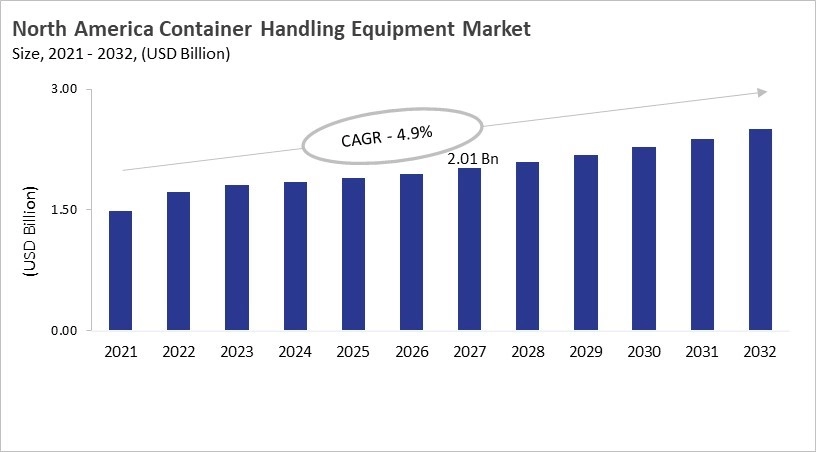
The North American container handling equipment market is very important for making trade between the U.S., Canada, and Mexico easier by making port and intermodal operations more efficient. It has ship-to-shore cranes, gantry cranes, reach stackers, and terminal tractors that are used at container terminals. As containerization grew, the market changed, and ports went from handling cargo by hand to using machines. The demand for high-capacity cranes and yard equipment went up because trade around the world grew and bigger ships came. To improve throughput and cut down on traffic, major ports spent a lot of money on modernization. Government agencies stressed the importance of efficient port equipment to make the supply chain more resilient. Over time, building up infrastructure became a key part of staying competitive in the economy.
The North American container handling equipment market is being shaped by two main trends: automation and sustainability. More ports are using automated stacking cranes, remote-controlled systems, and smart terminal software to make their operations safer and more efficient. To cut down on pollution, environmental rules are making it easier for people to use electric and hybrid equipment. Demand is also rising because bigger container ships need cranes that can reach farther and lift more. Konecranes, Kalmar, and Liebherr are some of the top OEMs that focus on new technologies and modular solutions. Localization and aftermarket services help build long-term relationships with customers. The market is somewhat consolidated, and companies compete on more than just price, such as automation, digital integration, and environmental performance.
Based on Automation Level, the market is segmented into Manual, Semi-Automated, and Fully Automated. The Manual market segment dominated the US Container Handling Equipment Market by Automation Level is expected to grow at a CAGR of 2.8 % during the forecast period thereby continuing its dominance until 2032. Also, The Fully Automated market is anticipated to grow as a CAGR of 4 % during the forecast period during (2025 - 2032).
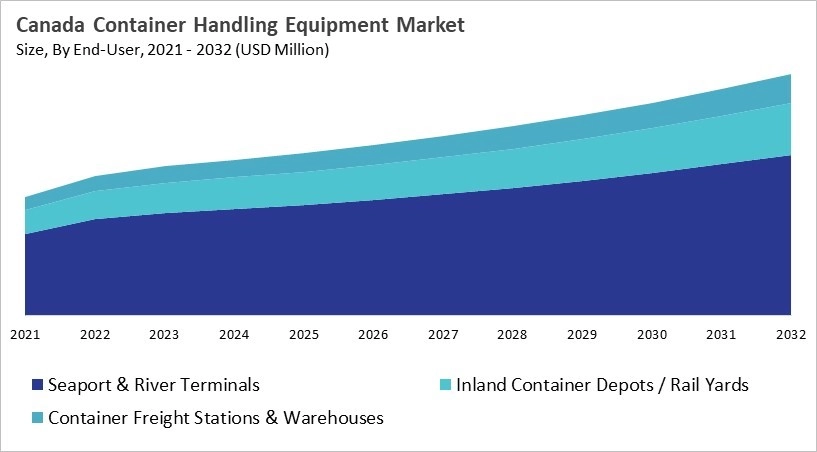
Based on End User, the market is segmented into Seaport & River Terminals, Inland Container Depots / Rail Yards, and Container Freight Stations & Warehouses. Among various Canada Container Handling Equipment Market by End-User; The Seaport & River Terminals market achieved a market size of USD $177.2 Million in 2024 and is expected to grow at a CAGR of 5.5 % during the forecast period. The Inland Container Depots / Rail Yards market is predicted to experience a CAGR of 6.4% throughout the forecast period from (2025 - 2032).
Free Valuable Insights: The Global Container Handling Equipment Market will hit USD 10.96 billion by 2032, at a CAGR of 4.3%
The United States container handling equipment market underpins the country’s extensive port and logistics infrastructure, with forklifts, container handlers, reach stackers, and terminal tractors supporting cargo movement nationwide. OEMs such as Hyster and Kalmar USA supply heavy-duty equipment designed for demanding port and intermodal operations. Large gateways like the Ports of Los Angeles and Long Beach drive demand for high-performance machinery capable of continuous, high-load duty cycles. Environmental priorities are increasing the adoption of electric and low-emission equipment. Market trends show gradual integration of electrification, automation, and digital fleet management tools. Competition is based on performance, reliability, and after-sales support across strong dealer networks. Future demand will be shaped by e-commerce growth and evolving supply chains, encouraging investment in efficient and sustainable handling solutions.

By Automation Level
By End User
By Propulsion Type
By Equipment Type
By Country
Our team of dedicated experts can provide you with attractive expansion opportunities for your business.



 Unique Offerings