The North America Computer Aided Manufacturing Software Market is expected to reach $1.21 billion by 2028 and would witness market growth of 8.5% CAGR during the forecast period (2025-2032).
The US market dominated the North America Computer Aided Manufacturing Software Market by Country in 2024, and would continue to be a dominant market till 2032; thereby, achieving a market value of $1,252.5 million by 2032. The Canada market is experiencing a CAGR of 10.7% during (2025 - 2032). Additionally, The Mexico market would exhibit a CAGR of 9.9% during (2025 - 2032). The US and Canada led the North America Computer Aided Manufacturing Software Market by Country with a market share of 76.4% and 12% in 2024.
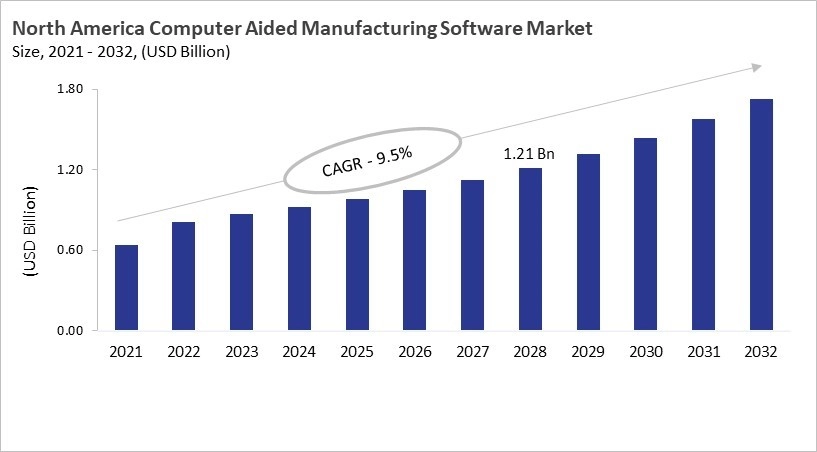
The North American CAM software market has grown in tandem with the region's robust aerospace, automotive, industrial, and medical manufacturing industries. CAM systems have changed from being separate NC programming tools to being part of larger enterprise platforms that can handle complicated aerospace parts, high-precision medical devices, and flexible automotive tooling. Early adopters use CAM and digital technologies to fill job openings and boost productivity. Advanced labs, such as ORNL, demonstrate the importance of CAM for additive manufacturing, hybrid machining, and large-format production. Industry 4.0 initiatives are also changing the market. Connected CNC ecosystems, cloud-based solutions, and subscription models are gaining popularity, particularly among small and medium-sized manufacturers seeking to collaborate, simulate processes remotely, and reduce IT costs.
Autodesk, 3D Systems (GibbsCAM), and other major global companies lead in North America. They stress platform breadth, cloud deployment, and integration with local machine-tool and robotics ecosystems. Strategic initiatives include collaborating with advanced users, providing local support, and improving workforce skills through certifications and technical partnerships. The market is competitive but organized. Large companies buy from multi-platform vendors. Niche segments select specialized tools. North America's mature CNC base and innovative manufacturing landscape enable companies to stand out. They do so through domain expertise, service quality, and seamless MES, robotics, and shop-floor automation integration.
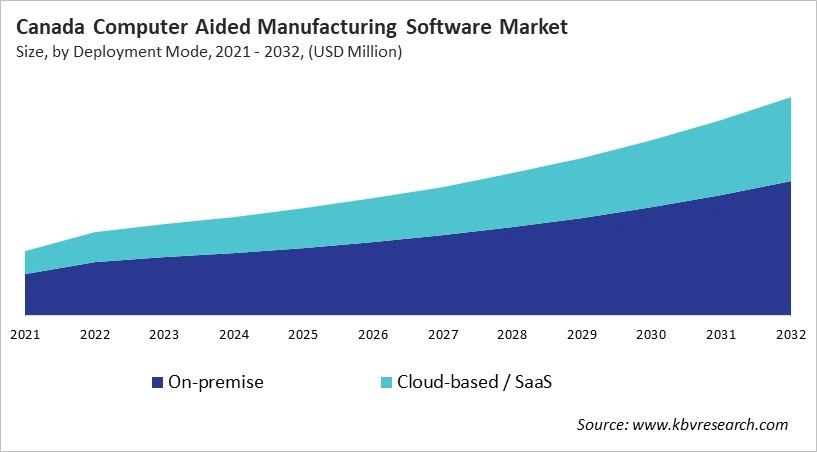
Based on Deployment Mode, the market is segmented into On-premise and Cloud-based / SaaS. With a compound annual growth rate (CAGR) of 10.2% over the projection period, the On-premise Market, dominate the Canada Computer Aided Manufacturing Software Market by Deployment Mode in 2024 and would be a prominent market until 2032. The Cloud-based / SaaS market is expected to witness a CAGR of 11.4% during (2025 - 2032).
Based on End-User Industry, the market is segmented into Automotive, Aerospace & Defence, Industrial Machinery, Electronics & Semiconductor, Medical Devices and Energy and Utilities. Among various US Computer Aided Manufacturing Software Market by End-User Industry; The Automotive market achieved a market size of USD $189.9 Million in 2024 and is expected to grow at a CAGR of 6.8 % during the forecast period. The Electronics & Semiconductor market is predicted to experience a CAGR of 8.9% throughout the forecast period from (2025 - 2032).
Free Valuable Insights: The Global Computer Aided Manufacturing Software Market will hit USD 5.49 billion by 2032, at a CAGR of 9.3%
The United States is a major center for the use of Computer-Aided Manufacturing (CAM) software because it has a strong industrial base that includes aerospace, automotive, defense, and high-precision manufacturing. CAM software turns digital designs into machine instructions for CNC and robotic systems. This makes production more efficient, accurate, and easy to integrate into existing workflows. Top companies like Autodesk and Siemens offer full CAD/CAM solutions that bring together design, simulation, and machine control. Digital manufacturing is moving faster thanks to trends like cloud-enabled platforms, AI-assisted toolpath optimization, and connections with PLM and MES systems. The growth of the market is affected by the skills of the workforce, support from regulators, and ongoing investments in advanced manufacturing. OEMs from around the world and niche providers are competitors. They focus on making solutions more accessible to small and medium-sized businesses (SMEs) through cloud deployment and flexible licensing. This encourages more widespread use and innovation across industries.

By Deployment Mode
By Software Type
By Manufacturing Process
By End-User Industry
By Country
Our team of dedicated experts can provide you with attractive expansion opportunities for your business.



 Unique Offerings