The North America Computational Fluid Dynamics Market would witness market growth of 6.9% CAGR during the forecast period (2025-2032).
The US market dominated the North America Computational Fluid Dynamics Market by Country in 2024, and would continue to be a dominant market till 2032; thereby, achieving a market value of $1,179.3 million by 2032. The Canada market is exhibiting a CAGR of 8.9% during (2025 - 2032). Additionally, The Mexico market would experience a CAGR of 8.3% during (2025 - 2032).
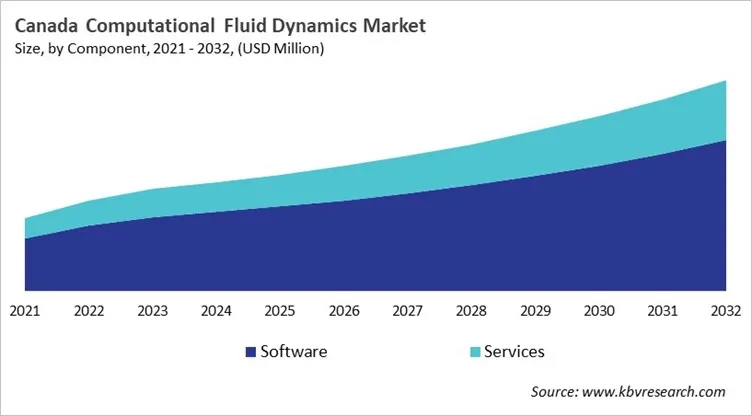
North America is the dominant region in the global Computational Fluid Dynamics (CFD) market because it has a strong industrial base and is home to cutting-edge research. The U.S. has the most engineering firms, government labs such as NASA, and software developers working in the aerospace, automobile, and energy industries. Canada is also very important, notably in the fields of clean energy and aviation. The region is strong because it focuses on digital transformation, following the rules, and coming up with new ideas. All these things lead to strong investment in CFD technologies.
CFD integration with technologies including digital twins, cloud platforms, and AI is moving quickly in the area. This makes it possible to run simulations in real time and optimize designs more easily. ANSYS, Altair, Siemens, and Autodesk are among of the biggest software companies that are improving their products by adding cloud-native capabilities, modules for specific industries, and strategic cloud collaborations. North America is still a key player in influencing the future of CFD around the world. This is because more small and medium-sized businesses are using it, the government is funding research, and platforms are becoming more user-friendly and scalable.
Free Valuable Insights: The Computational Fluid Dynamics Market is Predict to reach USD 5.12 Billion by 2032, at a CAGR of 7.5%
The US is the world leader in Computational Fluid Dynamics (CFD) because of new ideas in the aerospace, defense, automotive, energy, and healthcare fields. CFD is used by NASA and big defense companies like Boeing and Lockheed Martin for hypersonic flight, missile design, and spaceship simulations. CFD is used by the automobile industry, led by Tesla, GM, and Ford, to build electric vehicles, reduce drag, and control heat. It is also used by energy companies to perform everything from optimizing wind turbines to managing pipeline flow. This shows that the U.S. is still the leader in simulation-driven engineering.
The U.S. is also the leader in CFD software innovation. Companies like Ansys, Altair, and Autodesk offer cloud-enabled solutions that support digital twin and multiphysics modeling. MIT, Stanford, and Georgia Tech are some of the research universities that make cutting-edge tools and open-source software like SU2 and NEK5000. New technologies like AI-driven automation, machine learning integration, and real-time cloud simulations are quickly changing the way people operate. The U.S. is still at the forefront of CFD's growth and global use because of strong partnerships between schools and businesses and a strong internet infrastructure.
Based on Deployment Mode, the market is segmented into On-premises and Cloud. Based on Component, the market is segmented into Software and Services. Based on End User, the market is segmented into Aerospace, Automotive, Energy, Manufacturing, Material & Chemical Processing, and Other End User. Based on countries, the market is segmented into U.S., Mexico, Canada, and Rest of North America.

By Deployment Mode
By Component
By End User
By Country
Our team of dedicated experts can provide you with attractive expansion opportunities for your business.








 Unique Offerings