The North America Climate Tech Market is expected to reach $22.45 billion by 2027 and would witness market growth of 19.8% CAGR during the forecast period (2025-2032).
The US market dominated the North America Climate Tech Market by Country in 2024, and would continue to be a dominant market till 2032; thereby, achieving a market value of $45,109.3 million by 2032. The Canada market is experiencing a CAGR of 21.6% during (2025 - 2032). Additionally, The Mexico market would exhibit a CAGR of 21.4% during (2025 - 2032). The US and Canada led the North America Climate Tech Market by Country with a market share of 81.5% and 9.5% in 2024.
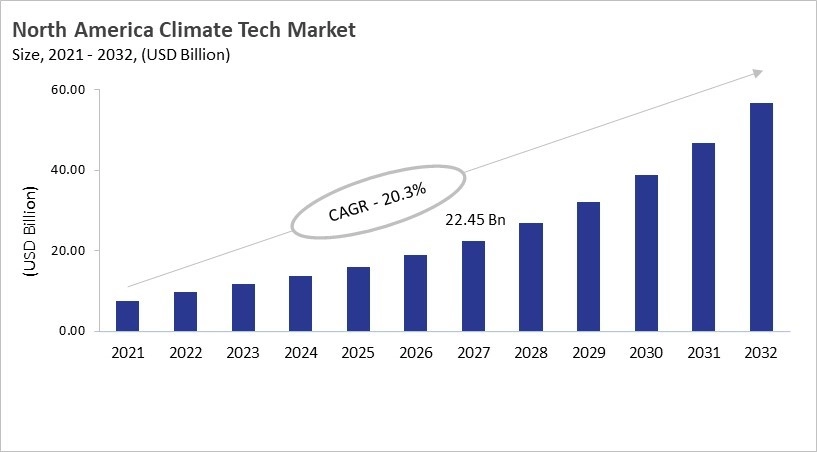
The North American climate technology scene has undergone significant changes. Ongoing support from public policy, federal research programs, and increased private-sector innovation helps reduce greenhouse gas emissions and speed the transition to low-carbon energy. In the US and Canada, agencies such as the DOE, EPA, and SDTC have played a crucial role. They provide funding for research, support pilot projects, and establish partnership frameworks. These efforts help develop technologies for renewable energy, energy efficiency, industrial decarbonization, and carbon management. Such projects move climate technologies from research to commercial stages. They also encourage governments, research institutions, OEMs, and new innovators to collaborate. This evolution shows a broader regional commitment to embedding climate solutions across energy systems, manufacturing, transportation, and infrastructure.
The market is changing due to several key trends. These include the rapid growth of renewable energy, increased use of technologies that improve energy efficiency, and new ways to reduce carbon emissions in industry. A more mature regulatory and partnership ecosystem also accelerates the adoption of new technologies. Increasingly, industry leaders align their research, development, and investment plans with federal climate goals. They use public funding, demonstration programs, and workforce development programs to scale their solutions. In a competitive environment, established companies and startups often collaborate. Public-private partnerships are crucial. There is a growing focus on scalable technologies and those that integrate with other systems. Companies that demonstrate strong performance at low cost, comply with regulations, and prepare for large-scale deployment are best positioned to lead North America's climate tech market as policy incentives and sustainability commitments increase.
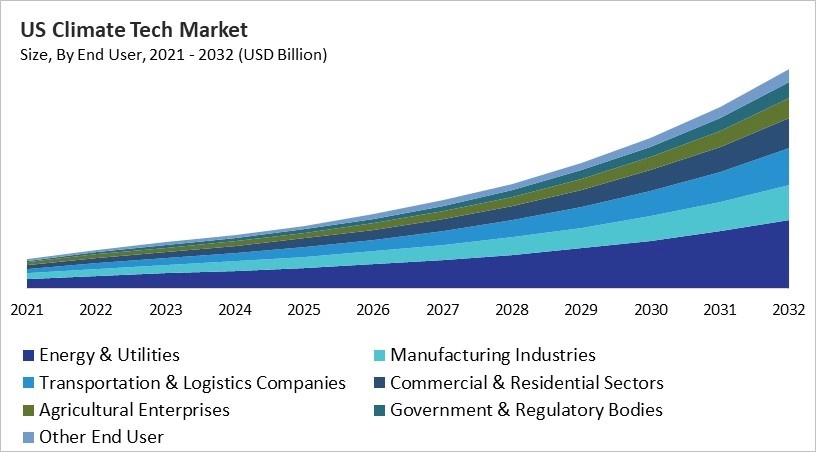
Based on End User, the market is segmented into Energy & Utilities, Manufacturing Industries, Transportation & Logistics Companies, Commercial & Residential Sectors, Agricultural Enterprises, Government & Regulatory Bodies and Other End User. Among various US Climate Tech Market by End User; The Energy & Utilities market achieved a market size of USD $3665 Million in 2024 and is expected to grow at a CAGR of 18.6 % during the forecast period. The Agricultural Enterprises market is predicted to experience a CAGR of 20.4% throughout the forecast period from (2025 - 2032).
Based on Technology, the market is segmented into Renewable Energy Technologies, Energy Storage Technologies, Climate Risk Monitoring & Data Analytics, Carbon Capture, Utilization & Storage (CCUS), Sustainable Agriculture Technologies and Other Technology. With a compound annual growth rate (CAGR) of 20.6% over the projection period, the Renewable Energy Technologies Market, dominate the Canada Climate Tech Market by Technology in 2024 and would be a prominent market until 2032. The Climate Risk Monitoring & Data Analytics market is expected to witness a CAGR of 22.5% during (2025 - 2032).
Free Valuable Insights: The Global Climate Tech Market will hit USD 166.96 billion by 2032, at a CAGR of 20.5%
The U.S. climate technology ecosystem is built on large federal programs run by the Department of Energy and backed by laws like the Inflation Reduction Act. These programs all aim to cut greenhouse gas emissions while strengthening clean energy supply chains and domestic manufacturing. The government's strategy has helped bring together public and private investment by using mature technologies on a large scale and continuing to support new ideas through programs like the Mission Innovation National Innovation Pathway. Policy incentives are still a major market driver. They speed up the use of climate technologies by businesses and make decarbonization strategies a part of many industries. U.S. companies are still the best at energy storage, grid modernization, electric vehicles, and renewable infrastructure at the technology and OEM levels. They use federal frameworks to make their businesses bigger. Market trends show that investors are more interested in climate technologies that are later in development and can be sold, thanks to strong private capital flows. Coordinated policy action and private-sector innovation work together to make the U.S. competitive in the global shift to a low-carbon energy economy.

By End User
By Technology
By Country
Our team of dedicated experts can provide you with attractive expansion opportunities for your business.





 Unique Offerings