The North America Building Information Modeling Market would witness market growth of 10.8% CAGR during the forecast period (2025-2032).
The US market dominated the North America Building Information Modeling Market by Country in 2024, and would continue to be a dominant market till 2032; thereby, achieving a market value of $5,203.5 million by 2032. The Canada market is experiencing a CAGR of 12.8% during (2025 - 2032). Additionally, The Mexico market would exhibit a CAGR of 11.8% during (2025 - 2032). The US and Canada led the North America Building Information Modeling Market by Country with a market share of 70.2% and 13.9% in 2024.
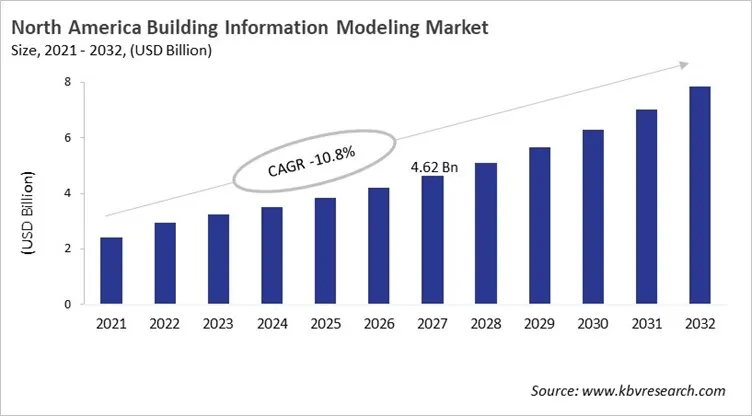
The BIM market in North America has grown from simple 3D design tools to a full-fledged digital ecosystem that includes planning, design, construction, and operations. Strong federal and public-sector mandates, big infrastructure projects, and high levels of technology maturity have sped up adoption in the U.S. and Canada. The area is now moving toward cloud-based collaboration, integrated data environments, and digital-twin workflows that help assets perform well over time. Increasingly, BIM is being used for facility management, sustainability goals, and operational efficiency, thanks to growing support from regulations, industries, and technology.
The North American BIM market is very competitive, with big platform providers and specialized companies competing on things like collaboration, lifecycle coverage, interoperability, and cloud capabilities. As BIM grows into analytics, operations, and digital-twin applications, vendors set themselves apart by forming partnerships with other companies, using standards-driven workflows, and offering advanced data-management features. Interoperability requirements and public-sector procurement models make it harder for vendors to lock in customers, which lets niche players compete. In general, having a competitive edge depends on having full-lifecycle solutions, strong cloud collaboration, and the ability to deliver data-driven value across the AECO chain.
Based on Deployment, the market is segmented into On-premises and Cloud. The On-premises market segment dominated the US Building Information Modeling Market by Deployment is expected to grow at a CAGR of 9.5 % during the forecast period thereby continuing its dominance until 2032. Also, The Cloud market is anticipated to grow as a CAGR of 10.5 % during the forecast period during (2025 - 2032).
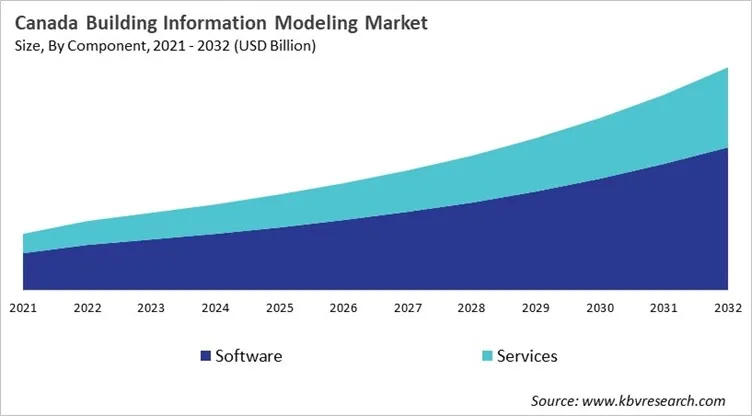
Based on Component, the market is segmented into Software and Services. With a compound annual growth rate (CAGR) of 12.4% over the projection period, the Software Market, dominate the Canada Building Information Modeling Market by Component in 2024 and would be a prominent market until 2032. The Services market is expected to witness a CAGR of 13.4% during (2025 - 2032).
Based on Application, the market is segmented into Designing, Planning & Modeling, Asset Management and Other Application. Among various Mexico Building Information Modeling Market by Application; The Designing market achieved a market size of USD $121.3 Million in 2024 and is expected to grow at a CAGR of 11 % during the forecast period. The Asset Management market is predicted to experience a CAGR of 12.6% throughout the forecast period from (2025 - 2032).
Free Valuable Insights: The Building Information Modeling Market is Predicted to reach USD 18.94 Billion by 2032, at a CAGR of 11.3%
The United States is a leader in BIM adoption because of federal programs like the GSA's 3D–4D BIM initiative and the creation of the National BIM Standard, which sped up the use of BIM in public and large-scale projects. The need for cost, schedule, and efficiency gains, as well as the growing focus on sustainability and asset lifecycle management, are driving demand. Some important trends are working together in the cloud, using AI to improve design, digital twins, and better integration of operations and maintenance. Adoption is high in the commercial, institutional, and even industrial sectors. Big software companies and big AEC firms shape the competition, but smaller firms have trouble with training and investing in technology. The U.S. market is mostly mature now, and growth is focused on advanced digital workflows and full lifecycle value.

By Component
By Deployment
By Project Lifecycle
By Building Type
By Application
By Country
Our team of dedicated experts can provide you with attractive expansion opportunities for your business.








 Unique Offerings