The North America Automotive Predictive Analytics Market would witness market growth of 26.6% CAGR during the forecast period (2025-2032).
The US market dominated the North America Automotive Predictive Analytics Market by Country in 2024, and would continue to be a dominant market till 2032; thereby, achieving a market value of $2,333.2 million by 2032. The Canada market is experiencing a CAGR of 28.6% during (2025 - 2032). Additionally, The Mexico market would exhibit a CAGR of 28.4% during (2025 - 2032). The US and Canada led the North America Automotive Predictive Analytics Market by Country with a market share of 73.2% and 16.5% in 2024.
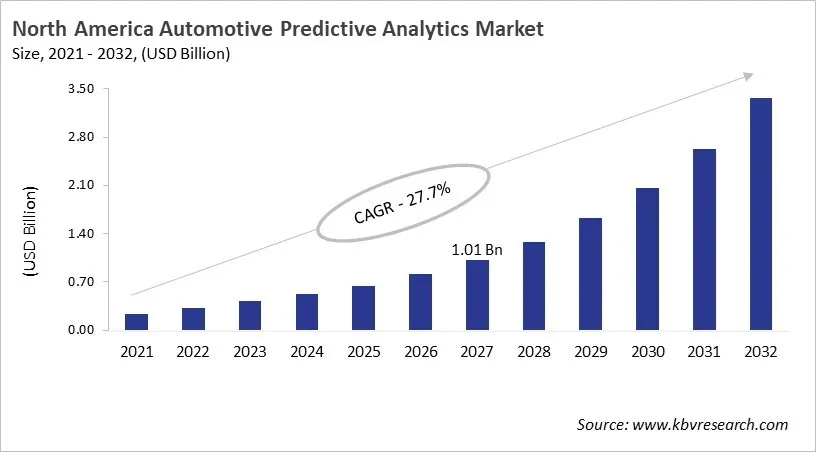
Predictive analytics is revolutionizing the North American automotive industry by shifting the focus from reactive decision-making to proactive, life-cycle planning. Automakers and fleet operators now use telematics, onboard diagnostics, and sensor data to predict part failures, refine maintenance schedules, and reduce costs. Predictive analytics has expanded to include safety, infotainment, and personalized experiences. The rise of electric and self-driving vehicles underscores its importance for battery management, range, and autonomous decisions. Government support and investment in smart transportation are driving smarter, safer, and greener mobility solutions.
Key trends shaping the market include predictive maintenance, vehicle health analytics, and their use in connected and autonomous vehicles, mobility services, insurance, and supply chain management. Leading companies prioritize strong data ecosystems, predictive features throughout a vehicle’s life, subscription-based revenues, compliance, cybersecurity, and ethical data use. Intense competition and collaboration among automakers, technology companies, and analytics firms are accelerating seamless, reliable, and valuable solutions. These developments confirm predictive analytics as central to smart mobility, customer experience, and operational efficiency in North America.
Based on Component, the market is segmented into Software, Services, and Hardware. Among various US Automotive Predictive Analytics Market by Component; The Software market achieved a market size of USD $1116.3 Million in 2024 and is expected to grow at a CAGR of 25.1 % during the forecast period. The Hardware market is predicted to experience a CAGR of 26.5% throughout the forecast period from (2025 - 2032).
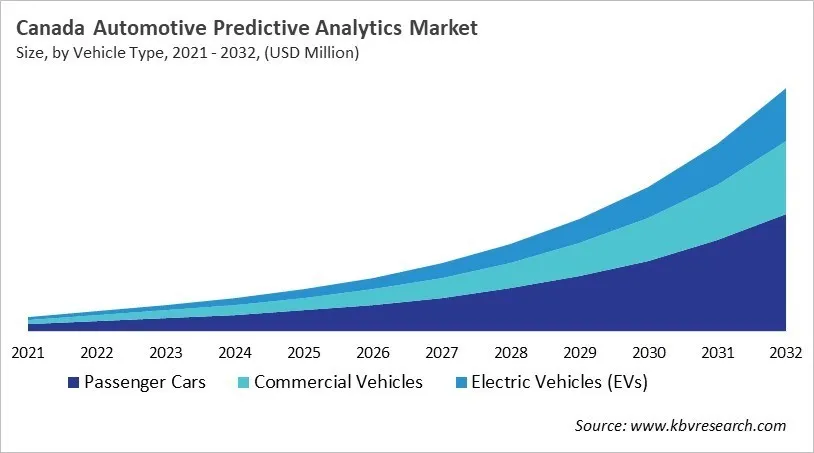
Based on Vehicle Type, the market is segmented into Passenger Cars, Commercial Vehicles, and Electric Vehicles (EVs). The Passenger Cars market segment dominated the Canada Automotive Predictive Analytics Market by Vehicle Type is expected to grow at a CAGR of 28 % during the forecast period thereby continuing its dominance until 2032. Also, The Electric Vehicles (EVs) market is anticipated to grow as a CAGR of 29.4 % during the forecast period during (2025 - 2032).
Free Valuable Insights: The Automotive Predictive Analytics Market is Predicted to reach USD 10.62 Billion by 2032, at a CAGR of 27.5%
The United States stands out as a model for scalable, data-driven automotive predictive analytics, owing to its established OEMs, extensive vehicle connectivity, and robust data infrastructure. In the U.S., predictive analytics leverages machine learning, telematics, and sensor data to improve maintenance, predict part failures, model driver behavior, and optimize fleet efficiency. Key drivers include the rise of electric and connected cars, government regulations on safety and emissions, and large-scale fleet requirements for high vehicle uptime. Emerging trends involve edge-based analytics, OTA software integration, battery health forecasting, and unified data platforms powered by 5G and digital twins. OEMs, tier-1 suppliers, and specialized analytics firms are all vying for leadership. However, adoption faces hurdles such as high costs, complex data integration, and privacy concerns.

By Component
By Vehicle Type
By End User
By Application
By Country
Our team of dedicated experts can provide you with attractive expansion opportunities for your business.



 Unique Offerings