The North America Automated Feeding Systems Market is expected to reach $2.18 billion by 2027 and would witness market growth of 16.5% CAGR during the forecast period (2025-2032).
The US market dominated the North America Automated Feeding Systems Market by Country in 2024, and would continue to be a dominant market till 2032; thereby, achieving a market value of $3,295.1 million by 2032. The Canada market is experiencing a CAGR of 18.6% during (2025 - 2032). Additionally, The Mexico market would exhibit a CAGR of 17.8% during (2025 - 2032). The US and Canada led the North America Automated Feeding Systems Market by Country with a market share of 72.8% and 14.5% in 2024.
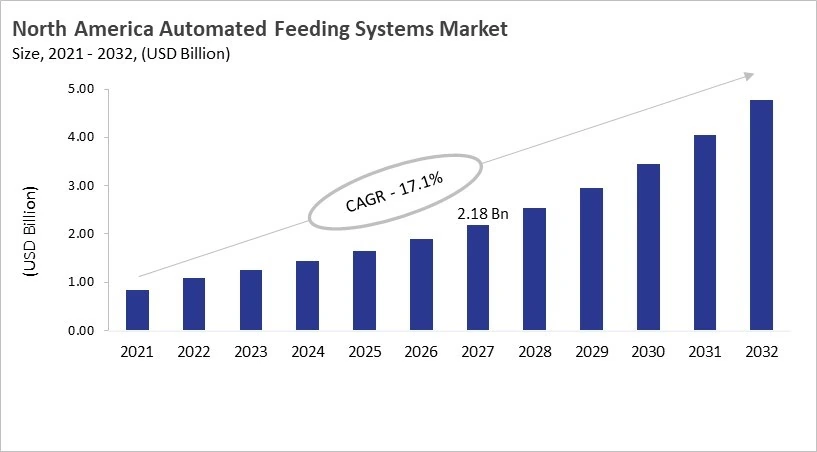
The North America Automated Feeding Systems Market has changed as large-scale livestock and dairy production has grown. This is because farms have merged, labor costs have gone up, and efficiency is needed. Programmable and sensor-based systems that work with precision agriculture tools have replaced early mechanical feeding methods. Lely, GEA, and DeLaval are some of the top OEMs that have come out with robotic and software-enabled feeding solutions that make feed more consistent, improve animal health, and boost productivity. This change shows how much the area cares about mechanization, digitalization, and taking care of animals in a way that is good for the environment.
Some important market trends are the use of precision livestock technologies, a greater focus on making work more efficient, and a greater focus on sustainability and feed optimization. Automated feeding systems can now connect to herd monitoring and farm management platforms so that you can control rations and track performance in real time. Competitive strategies focus on new technologies, product designs that can be scaled up, and strong networks for after-sales service. In a market where productivity, efficiency, and environmental responsibility are important, sustainability positioning and digital integration set suppliers apart even more.
Based on components, the automated feeding systems market is characterized into hardware, services, and software. Among various US Automated Feeding Systems Market by Component; The Hardware market achieved a market size of USD $625.3 Million in 2024 and is expected to grow at a CAGR of 15.3 % during the forecast period. The Services market is predicted to experience a CAGR of 16.3% throughout the forecast period from (2025 - 2032).
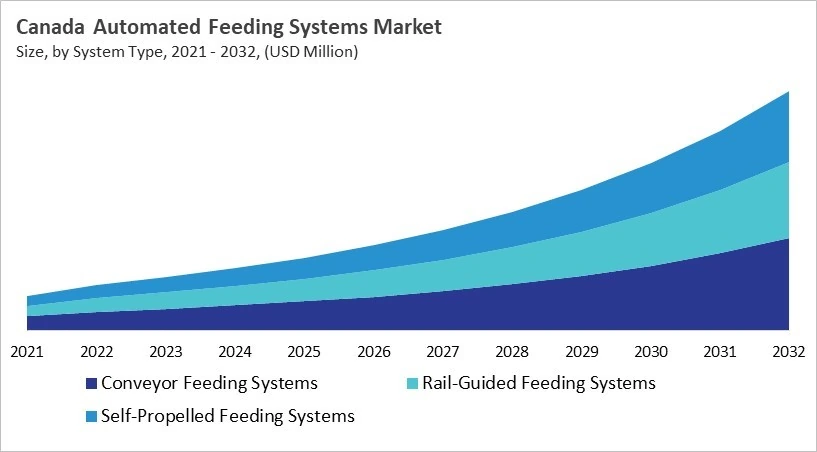
On the basis of system type, the automated feeding systems market is classified into conveyor feeding systems, rail-guided feeding systems, self-propelled feeding systems. The Conveyor Feeding Systems market segment dominated the Canada Automated Feeding Systems Market by System Type is expected to grow at a CAGR of 17.9 % during the forecast period thereby continuing its dominance until 2032. Also, The Self-Propelled Feeding Systems market is anticipated to grow as a CAGR of 19.2 % during the forecast period during (2025 - 2032).
Free Valuable Insights: The Global Automated Feeding Systems Market will hit USD 16.85 billion by 2032, at a CAGR of 16.9%
The U.S. Automated Feeding Systems Market is growing as automation is added to precision livestock farming to make it more efficient and cut down on manual labor. Automated feeders help make sure that cattle, pigs, and poultry get their food on time and in the right amount, which makes operations more consistent. Labor shortages and rising costs are two big reasons why agencies like the United States Department of Agriculture are pushing for automation to make animal care and work more productive. Market trends show that sensors, the Internet of Things (IoT), and data analytics are being used for real-time monitoring and flexible feeding plans. Competition includes both domestic and international OEMs adding robotics and AI to feeding solutions. Increasingly, these systems work with livestock monitoring platforms to improve performance. But the high cost of installation, the complexity of the system, and the need for skilled operators are still big problems, especially for smaller farms.

By Component
By System Type
By Livestock
By Country
Our team of dedicated experts can provide you with attractive expansion opportunities for your business.



 Unique Offerings