The North America AI Server Market would witness market growth of 36.8% CAGR during the forecast period (2025-2032).
The US market dominated the North America AI Server Market by Country in 2024, and would continue to be a dominant market till 2032; thereby, achieving a market value of $467,119.3 million by 2032. The Canada market is experiencing a CAGR of 41.6% during (2025 - 2032). Additionally, The Mexico market would exhibit a CAGR of 39.3% during (2025 - 2032).
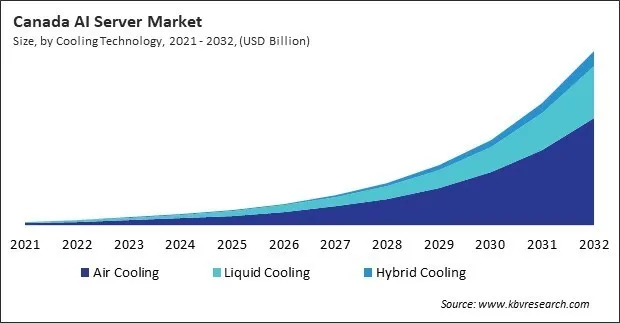
The North American AI server market has experienced remarkable growth, shaped by a combination of technological advancements, strategic investments by original equipment manufacturers (OEMs), and policy support from government institutions. Initially, AI computing was largely confined to research institutions and specialized labs due to its intensive hardware requirements. However, as artificial intelligence applications expanded into areas like natural language processing, autonomous systems, predictive analytics, and computer vision, the need for specialized server infrastructure capable of high-performance computing (HPC) became urgent.
The evolution from traditional CPU-based systems to GPU-accelerated servers significantly boosted the region’s AI capabilities. Companies such as NVIDIA revolutionized the field by introducing GPU architectures tailored to deep learning and neural networks, which subsequently formed the backbone of AI server architecture in North America. Government initiatives further propelled this transformation. The U.S. government, recognizing AI as a strategic frontier, enacted policies like the CHIPS and Science Act and funded projects under the National Artificial Intelligence Initiative.
Free Valuable Insights: The AI Server Market is Predict to reach USD 1.6 Trillion by 2032, at a CAGR of 37.5%
North America, led by the United States, stands at the forefront of the global AI server market. The region’s dominance stems from a confluence of strategic government initiatives, hyperscaler expansion, semiconductor innovation, and a robust enterprise AI adoption ecosystem. The AI server infrastructure here is the bedrock supporting generative AI breakthroughs, autonomous systems, national security computing, and large-scale digital services.
North America's AI server demand is fueled significantly by hyperscalers including Amazon Web Services (AWS), Microsoft Azure, Google Cloud, and Meta Platforms. In 2025, Amazon announced two major investments:
These investments underline how hyperscalers are deploying vast AI server farms with tens of thousands of GPUs and custom ASICs to meet the training needs of large-scale models like GPT-4, Claude, and Gemini.
North American tech giants are leading the move toward in-house silicon development, aiming to reduce dependency on traditional GPU vendors like NVIDIA. Notable examples:
This vertical integration trend reflects a desire for more cost-effective, efficient, and secure AI server deployments at scale.
The North American AI server market—anchored by the United States—is the most advanced and highly competitive globally. The region's leadership stems from a confluence of hyperscale cloud infrastructure, semiconductor innovation, government-backed compute investments, and an active AI startup ecosystem. Competition here is defined not only by technological performance but also by vertical integration, power efficiency, and compliance with evolving regulatory frameworks.
North America's AI server demand is fueled significantly by hyperscalers including Amazon Web Services (AWS), Microsoft Azure, Google Cloud, and Meta Platforms. In 2025, Amazon announced two major investments:North America’s AI server demand is dominated by Amazon Web Services (AWS), Microsoft Azure, Google Cloud, and Meta Platforms. These firms are racing to scale AI infrastructure for training and deploying large language models (LLMs) and other generative AI applications:
These companies not only compete on compute capacity but also on platform capabilities, developer tooling, pricing, and AIaaS integration.
The U.S. is at the epicenter of custom AI chip development:
This silicon arms race shapes the foundational architecture of AI servers deployed across public and private sectors.
Based on the Processor Type, the AI server market is segmented into GPU-based, FPGA-based, and ASIC-based servers. The GPU-Based Servers held the highest market share among all the processor types in 2024 in North America followed by FPGA-based Servers.
Trend: GPU-based servers continue to dominate AI training workloads, especially for large language models (LLMs) and generative AI applications.
Supporting News:
Trend: ASIC-based servers provide high efficiency for specific AI tasks, such as inference in large-scale deployments, due to their custom-designed hardware.
Supporting News:
Based on Cooling Technology, the market is segmented into Air Cooling, Liquid Cooling, and Hybrid Cooling.
Trend:Air cooling remains a foundational method for thermal management in data centers, utilizing techniques like hot/cold aisle containment and computer room air conditioning (CRAC) units. Despite the rise of high-density computing, many North American data centers continue to rely on air cooling due to its established infrastructure and cost-effectiveness.
To illustrate:
In Northern Virginia, the rapid expansion of data centers has led to significant community backlash. Residents have reported disturbances from constant noise and environmental concerns stemming from nearby data centers built by tech giants like Google and Amazon.
Trend:Liquid cooling, including direct-to-chip and immersion methods, is gaining traction for its efficiency in managing high-density computing environments. As AI workloads increase, the need for more effective cooling solutions becomes critical.
To illustrate:
Schneider Electric announced its acquisition of a 75% stake in U.S.-based Motivair Corp, a specialist in liquid cooling for high-performance computing, for $850 million. This move aims to bolster Schneider's capabilities in data center cooling, essential for accommodating the rising demand spurred by generative AI and large language models.
Based on Form Factor, the market is segmented into Rack-mounted Servers, Blade Servers, and Tower Servers.
Trend:Rack-mounted servers are widely adopted in North America due to their scalability and efficient space utilization, making them ideal for data centers and enterprise environments.
To illustrate:
Amazon's $20 Billion Investment in Pennsylvania: Amazon announced plans to invest at least $20 billion in Pennsylvania to expand its data center infrastructure, reflecting its continued commitment to artificial intelligence and cloud services. This initiative is part of Amazon's broader push to support the growth of generative AI technologies.
Trend:Blade servers are gaining traction in North America, particularly in environments requiring high-density computing and efficient resource utilization, such as virtualization and cloud computing.
To illustrate:
Dell's Integrated Rack Solutions: Dell Technologies announced additional servers and integrated rack solutions that represent the latest additions to the Dell AI Factory infrastructure portfolio. This new infrastructure enables customers to accelerate the time to value of their AI efforts and improves energy efficiency in support of sustainability goals.
Based on the End Use, the North America AI Server Market is segmented into IT & Telecommunication, BFSI, Retail & E-commerce, Healthcare & Pharmaceutical, Automotive and Other End Use. The IT & Telecommunication segment garnered the largest revenue share in North America market followed by BFSI and Retail & E-commerce among all other end use verticals.
Trend:North American telecom providers are rapidly integrating AI to enhance network operations, customer service, and infrastructure management. Companies like T-Mobile are partnering with AI leaders to develop self-optimizing networks and AI-driven solutions.
To illustrate:
Trend:The BFSI sector in North America is leveraging AI for fraud detection, personalized services, and operational efficiency. Financial institutions are investing in AI to transform their services and customer interactions.
To illustrate:
Based on Processor Type, the market is segmented into GPU-based Servers, FPGA-based Servers, and ASIC-based Servers. Based on Cooling Technology, the market is segmented into Air Cooling, Liquid Cooling, and Hybrid Cooling. Based on Form Factor, the market is segmented into Rack-mounted Servers, Blade Servers, and Tower Servers. Based on End Use, the market is segmented into IT & Telecommunication, BFSI, Retail & E-commerce, Healthcare & Pharmaceutical, Automotive, and Other End Use. Based on countries, the market is segmented into U.S., Mexico, Canada, and Rest of North America.

By Processor Type
By Cooling Technology
By Form Factor
By End Use
By Country
Our team of dedicated experts can provide you with attractive expansion opportunities for your business.



 Unique Offerings