The North America AI In Packaging Design Market would witness market growth of 11.1% CAGR during the forecast period (2025-2032).
The US market dominated the North America AI In Packaging Design Market by Country in 2024, and would continue to be a dominant market till 2032; thereby, achieving a market value of USD 1,361.2 Million by 2032. The Canada market is experiencing a CAGR of 12.9% during (2025 - 2032). Additionally, The Mexico market would exhibit a CAGR of 12.2% during (2025 - 2032). The US and Canada led the North America AI In Packaging Design Market by Country with a market share of 70.2% and 15% in 2024.
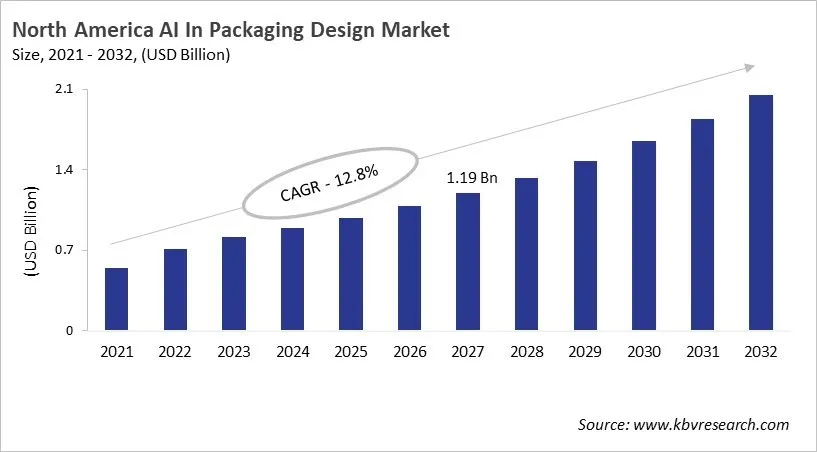
Artificial intelligence has changed North America's packaging design market from a slow, manual process into a data-driven, environmentally friendly, and customer-focused business. At first, the industry relied on basic computer-aided tools, but it changed to meet stricter environmental rules in the U.S. and Canada and the fast growth of e-commerce. Companies added sensors, cameras, and automation to their packaging machines, which let them collect data in real time and check quality with AI. Generative AI speeds up design by making multiple virtual prototypes, and predictive analytics helps figure out how recyclable, durable, and environmentally friendly something will be before it is made. Consumer feedback from loyalty programs and social media helps designers make sure their products look and work the way people want them to. Decision engines powered by AI from companies like Amazon also suggest the best packaging to protect items while keeping costs low.
Sustainable materials, personalization, and digital twin logistics are some of the most important things that are driving growth right now. Brands use AI to test and simulate bio-based polymers and recycled content. This cuts down on the need for single-use plastics and lowers the cost of development. With generative AI, you can make personalized and limited-edition packaging that fits the tastes of people in different areas. This is often done with smart QR codes that give recycling tips or let people interact with the packaging. Digital twins simulate how packaging will work in different climates and transportation conditions across North America. This cuts down on mistakes and makes sure the packaging is reliable. There is a lot of competition. Big companies use big datasets, and small businesses come up with new ideas in niche areas like optimizing recyclable materials and smart packaging for consumers. Regulatory pressure and eco-conscious customers also make companies more likely to use AI to stay in compliance, be more environmentally friendly, and get ahead of the competition.
Based on Technology, the market is segmented into Generative Design AI, Computer Vision, AI-powered Simulation and Testing, and Natural Language Processing. The Generative Design AI market segment dominated the US AI In Packaging Design Market by Technology is expected to grow at a CAGR of 9.6 % during the forecast period thereby continuing its dominance until 2032. Also, The AI-powered Simulation and Testing market is anticipated to grow as a CAGR of 11 % during the forecast period during (2025 - 2032).
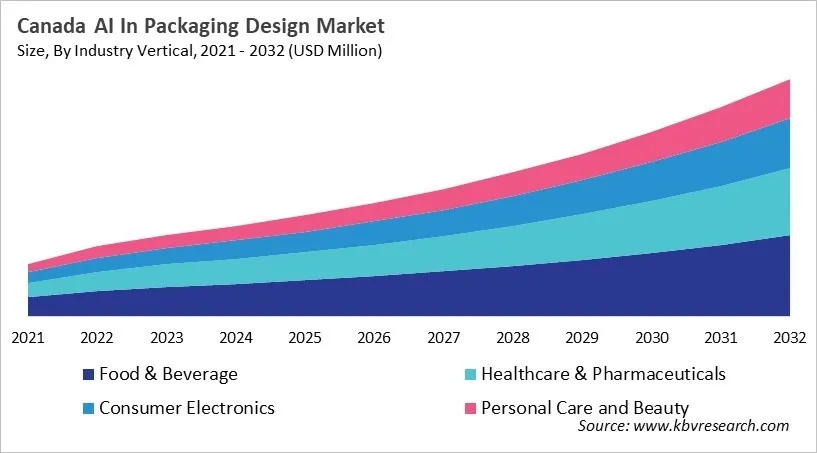
Based on Industry Vertical, the market is segmented into Food & Beverage, Healthcare & Pharmaceuticals, Consumer Electronics, and Personal Care and Beauty. Among various Canada AI In Packaging Design Market by Industry Vertical; The Food & Beverage market achieved a market size of USD 48.4 Million in 2024 and is expected to grow at a CAGR of 12.2 % during the forecast period. The Consumer Electronics market is predicted to experience a CAGR of 13.8% throughout the forecast period from (2025 - 2032).
Free Valuable Insights: The AI In Packaging Design Market is Predict to reach USD 6.48 Billion by 2032, at a CAGR of 11.9%
The US is the best at using AI in packaging design in North America. This is because it has a large consumer market, a strong tech infrastructure, and a strong packaging industry. AI is used throughout the packaging process, from choosing materials and simulating structures to checking quality with computer vision and coming up with new design ideas. Sustainability needs, government rules, the growth of online shopping, and the need to save money all push for adoption. Some of the most important trends are life-cycle assessments that use AI, smart packaging with sensors, personalized designs, and feedback on production in real time. There is a lot of competition between material suppliers, multinationals, and design firms, but problems like high costs, data availability, and following the rules still exist. The U.S. is the regional leader in AI-driven packaging innovation.

By End Use
By Technology
By Industry Vertical
By Country
Our team of dedicated experts can provide you with attractive expansion opportunities for your business.


![AI In Packaging Design Market Size, Share | Forecast [2032]](https://www.kbvresearch.com/upload/cover/ai-in-packaging-design-market.webp "AI In Packaging Design Market Size, Share | Forecast [2032]")

 Unique Offerings