“Global Next-Generation Data Storage Market to reach a market value of USD 138.73 Billion by 2032 growing at a CAGR of 9.3%”
The Global Next Generation Data Storage Market size is estimated at $74.49 billion in 2025 and is expected to reach $138.73 billion by 2032, rising at a market growth of 9.3% CAGR during the forecast period (2025-2032). This Market is justified by accelerating data generation from AI, IoT, and cloud computing, rising enterprise demand for high-performance and scalable storage, increased adoption of NVMe and SSD technologies, and growing investments in data centers and digital transformation initiatives worldwide.
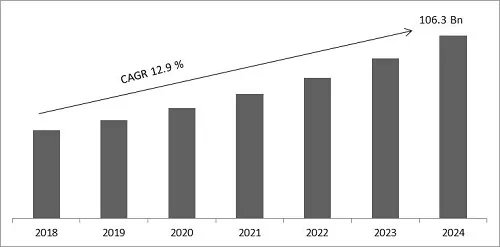
The next generation data storage outlook states a core transition from primary magnetic and optical media to smart, advance, and expandable storage systems made for the modern digital workloads. This shift has been driven by the rapid data growth across business worldwide, the demand for the low-latency access, and the implementation of cloud and hybrid architectures. Advancements like SSDs, NVMe, software-defined storage, and NVMe-over-Fabrics have validated file, unified block and object storage with automation, mandate-based management, and hassle-free data mobility. Key players such as Dell Technologies, IBM, HPE, and NetApp are strongly focusing on hybrid cloud compatibility, high-speed connection, and AI-driven optimization to boost AI, IoT, analytics, and mission-critical applications.
Furthermore, the industry is increasingly looking beyond minor hardware upgrades and focusing on future-ready storage innovations that can support the explosive growth of data. Emerging concepts such as synthetic DNA and glass-based storage are being explored for ultra-dense, long-term archival use, offering a glimpse into how massive data retention could be handled in the future, even though high costs and performance limitations remain challenges today. At the same time, competition is shifting away from price alone toward factors like intelligent software, performance reliability, security, and seamless integration across hybrid and cloud environments. Vendors that can deliver scalable, secure, and flexible storage platforms—while continuing to invest in advanced research and strong partnerships—are better positioned to meet evolving enterprise needs in an increasingly data-driven world.
The major strategies followed by the market participants are Product Launches as the key developmental strategy to keep pace with the changing demands of end users. For instance, In April, 2025, Dell Technologies, Inc. unveiled a new PowerEdge server featuring Intel Xeon 6 processors, alongside updated PowerStore and ObjectScale storage solutions, to enhance performance and energy efficiency for HPC and AI workloads. These innovations aim to streamline data center operations with improved management tools and support for modular hardware standards. Moreover, In March, 2025, Pure Storage Inc. unveiled FlashBlade//E//XA, a cutting-edge data storage platform designed for AI and high-performance computing. Touted as the world’s most powerful solution of its kind, it delivers unmatched performance, scalability, and efficiency, aiming to accelerate innovation and simplify infrastructure for enterprises handling massive data workloads.
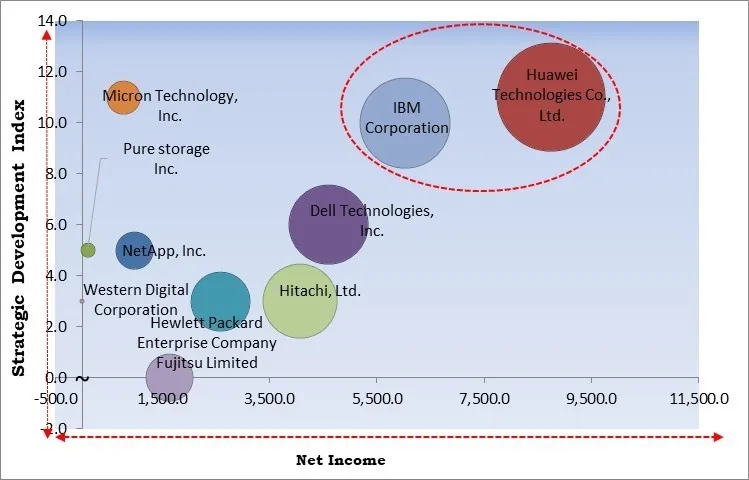
Based on the Analysis presented in the KBV Cardinal matrix; Huawei Technologies Co., Ltd. and IBM Corporation are the forerunners in the Next Generation Data Storage Market. In March, 2025, Huawei Technologies Co., Ltd. unveiled its next-generation all-flash data center solution, designed to deliver enhanced performance, reliability, and energy efficiency. The launch aims to support enterprises in accelerating digital transformation by providing high-density storage, simplified management, and lower carbon emissions, reinforcing Huawei's commitment to sustainable and intelligent data infrastructure. Companies such as Dell Technologies, Inc., Hitachi, Ltd., and Hewlett Packard Enterprise Company are some of the key innovators in Next Generation Data Storage Market.
The COVID-19 pandemic sped up the use of next-generation data storage solutions by a lot. This was because businesses had to switch to remote work and digital-first operations, which caused a huge increase in the amount of data generated by cloud apps and collaboration platforms. This surge made it necessary to have scalable, high-performance, and secure storage systems that could keep businesses running and give them access to their data at all times. The crisis sped up the use of cloud-based, software-defined, and hybrid storage architectures, which are flexible, quick to set up, and cost-effective when data centers can't run as usual. The need for real-time data processing and more digital activity in data-heavy fields like healthcare, BFSI, e-commerce, and media also drove up demand. At the same time, companies spent money on cutting-edge technologies like NVMe, flash storage, and AI-driven data management to make their systems more resilient, automated, and able to recover from disasters. So, the pandemic had a good and lasting effect on the market for next-generation data storage by showing how important it is for long-term digital transformation projects. Thus, the COVID-19 pandemic had a positive impact on the market.

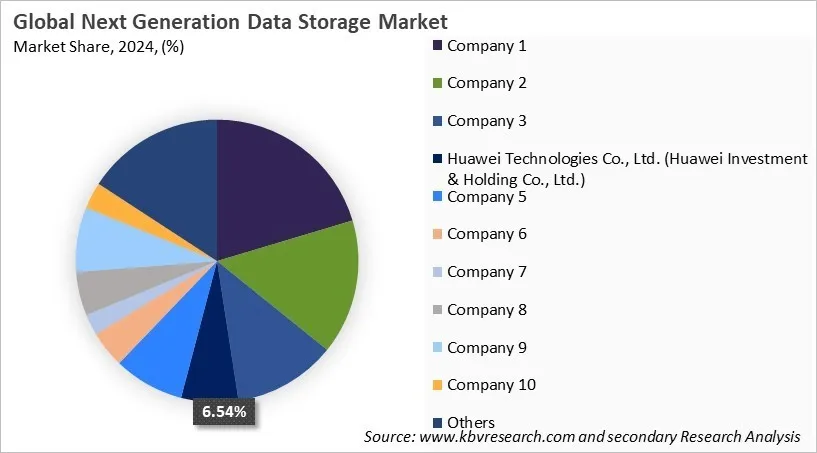
The leading players in the market are competing with diverse innovative offerings to remain competitive in the market. The above illustration shows the percentage of revenue shared by some of the leading companies in the market. The leading players of the market are adopting various strategies in order to cater demand coming from the different industries. The key developmental strategies in the market are Acquisitions, and Partnerships & Collaborations.
Free Valuable Insights: Next-Generation Data Storage Market size to reach USD 138.73 Billion by 2032
Based on End-use, the market is segmented into Business, and Home. The home end-use segment is steadily gaining traction as digital lifestyles continue to expand, and household data generation increases. Consumers are producing and storing growing amounts of data through smart home devices, personal cloud storage, high-resolution media, gaming platforms, and remote working tools. Next generation data storage solutions cater to these needs by offering higher capacity, faster access speeds, improved reliability, and enhanced data protection features.
Based on Storage Technique, the market is segmented into Magnetic Storage, SSD, and Hybrid Flash Array. The solid-state drive segment represents a critical component of the next generation data storage landscape, driven by the need for high-speed data access and low-latency performance. SSD-based storage techniques are increasingly deployed in applications that demand rapid read and write operations, such as real-time analytics, artificial intelligence workloads, virtualization, and high-performance computing.
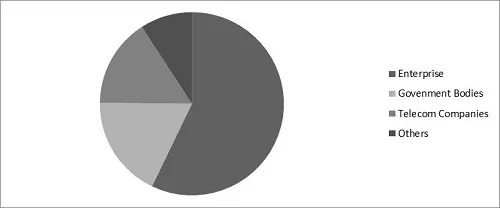
Region-wise, the Next Generation Data Storage Market is analyzed across North America, Europe, Asia Pacific, and LAMEA. The North America segment recorded 38% revenue share in the market in 2024. North America and Europe are more advanced and mature markets for next generation data storage, propelled by high datasets from various sources like analytics, cloud computing, AI, cloud computing, and regulated industries. Business in these regions progressively adopting software-defined storage, NVMe-based architectures, and hybrid cloud platforms to gain expandability, high performance, robust data security. Leading companies such as IBM, Dell technologies, HPE, and NetApp concentrate on file file, unified block, and object storage, advanced automation, malware protection, and compliance-ready solutions. Rugged R&D environment and state funded technology drives further support innovation, including initial-stage research into emerging storage media like DNA and glass.
Asia Pacific and LAMEA are emerging as high-growth potential regions for next-generation data storage, propelled by swift digitalization, growing cloud adoption, and increasing investments in data center infrastructure. Moreover, Asia Pacific is at the frontline of this growth, due to its strong need from hyperscale cloud providers, AI-enabled applications, and large-scale IT modernization efforts across enterprises. In contrast, LAMEA is progressing at a steadier pace, with advanced storage solutions increasingly adopted in sectors such as government, telecom, and energy, where reliability and scalability are critical. Across both regions, organizations are showing growing interest in software-defined storage and NVMe technologies as they prepare for sustained data growth and more performance-intensive workloads in the years ahead.
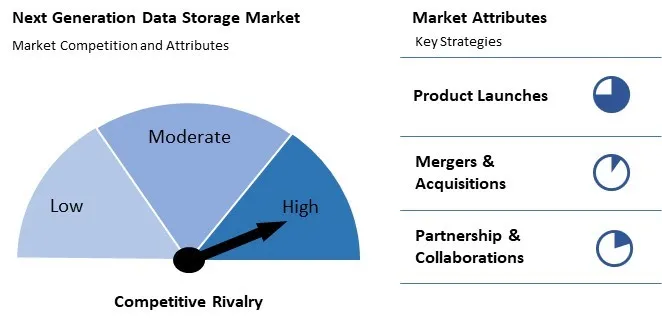
Rapid innovation, architectural differentiation, and performance optimization are what drive competition in the next-generation data storage market. To meet changing needs in the enterprise and cloud, people in the market are working to make systems more scalable, faster, safer, and more energy-efficient. Continuous upgrades to technology, integration with new digital ecosystems, and the ability to handle a wide range of workloads all affect how competitive the market is. So, differentiation is becoming more about software intelligence, flexibility, and long-term adaptability than just size.
| Report Attribute | Details |
|---|---|
| Market size value in 2025 | USD 74.49 Billion |
| Market size forecast in 2032 | USD 138.73 Billion |
| Base Year | 2024 |
| Historical Period | 2021 to 2023 |
| Forecast Period | 2025 to 2032 |
| Revenue Growth Rate | CAGR of 9.3% from 2025 to 2032 |
| Number of Pages | 701 |
| Number of Tables | 578 |
| Report coverage | Market Trends, Revenue Estimation and Forecast, Segmentation Analysis, Regional and Country Breakdown, Competitive Landscape, Market Share Analysis, Porter’s 5 Forces Analysis, Company Profiling, Companies Strategic Developments, SWOT Analysis, Winning Imperatives |
| Segments covered | End-use, Storage Technique, Storage Type, Storage System, Business Type, Region |
| Country scope |
|
| Companies Included | Dell Technologies, Inc., Hewlett Packard Enterprise Company, NetApp, Inc., Huawei Technologies Co., Ltd. (Huawei Investment & Holding Co., Ltd.), IBM Corporation, Micron Technology, Inc., Fujitsu Limited, Western Digital Corporation, Pure storage Inc., and Hitachi, Ltd. |
By End-use
By Storage Technique
By Storage Type
By Storage System
By Geography
This Market size is expected to reach USD 138.73 Billion by 2032.
The next-generation data storage market is projected to grow at a CAGR of 9.3% between 2025 and 2032.
The explosion of data across digital ecosystems, coupled with accelerating artificial intelligence and advanced analytics, is driving market growth.
Dell Technologies, Inc., Hewlett Packard Enterprise Company, NetApp, Inc., Huawei Technologies Co., Ltd. (Huawei Investment & Holding Co., Ltd.), IBM Corporation, Micron Technology, Inc., Fujitsu Limited, Western Digital Corporation, Pure storage Inc., and Hitachi, Ltd.
The Business segment captured the maximum revenue in the Global Next Generation Data Storage Market by End-use in 2024, thereby, achieving a market value of $96.7 billion by 2032.
The North America region dominated the Global Next Generation Data Storage Market by Region in 2024, and would continue to be a dominant market till 2032; thereby, achieving a market value of $49.5 billion by 2032.
Our team of dedicated experts can provide you with attractive expansion opportunities for your business.









 Unique Offerings