“Global Network Optimization Services Market to reach a market value of USD 15.07 Billion by 2032 growing at a CAGR of 12.9%”
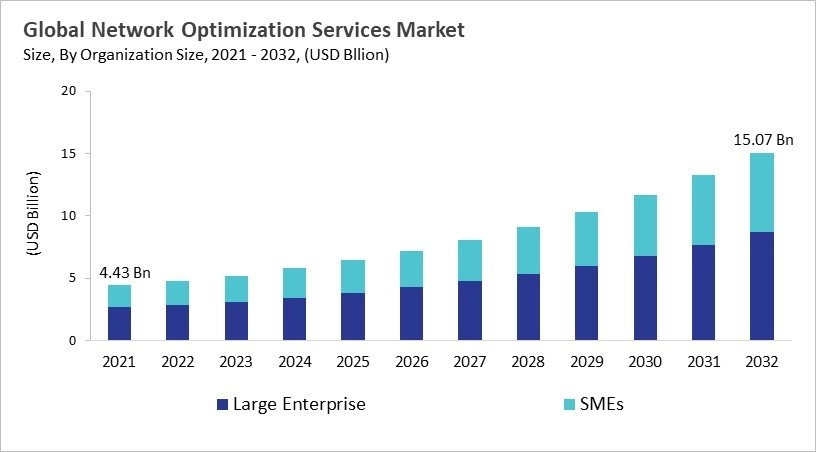
The Global Network Optimization Services Market size is estimated at $6.45 billion in 2025 and is expected to reach $15.07 billion by 2032, rising at a market growth of 12.9% CAGR during the forecast period (2025-2032). The growth of the market is supported by increasing data traffic, widespread cloud adoption, and rising deployment of 5G networks. Enterprises require optimized network performance to ensure low latency, security, and reliability, while AI-driven analytics and automation further enhance efficiency and stimulate sustained market expansion.
The network optimization services market has developed along with the shift from static, hardware-based networks to software-defined, cloud-first and AI-based architectures across enterprises, telecom, and public sector environments. Early efforts focused on performance tuning, and WAN acceleration, but increasing IP traffic, mobile network evolution, and cloud adoption, have expanded optimization into a lifecycle-oriented discipline covering automation, planning, design, and assurance. Optimization services support multi-cloud and hybrid network, SASE, SD-WAN, and application-aware routing, while deploying digital twins, advanced analytics, and AI to meet rising demands for low latency, bandwidth, cost efficiency, and resilience. Telecom advancements and government modernization initiatives reinforce optimized connectivity as a crucial foundation for digital transformation.
The key trends driving the network optimization services market include convergence with cloud security, sustainability-driven optimization, and edge architectures. And deep integration of automation and AI. Service providers and vendors largely deliver optimization as a subscription-based service, using AI-native platforms to allow predictive assurance, self-optimizing networks, and energy efficiency across multi-vendor environments. Strategies focus on ecosystem partnerships, industrial specialization, and alignment with sustainability and regulatory goals. The network optimization services market is intensely competitive among cloud hyperscalers, telecom OEMs, managed service providers, and integrators, with differentiation driven by software-centric automation, AI capabilities, and the capability to deliver measurable performance and energy improvements as networks progress toward future 6G architectures.
The major strategies followed by the market participants are Partnerships as the key developmental strategy to keep pace with the changing demands of end users. For instance, In April, 2025, Nokia Corporation announced the partnership with Fibrus, an internet service provider to deploy Nokia’s Deepfield solution, enhancing cybersecurity and network analytics. The partnership supports Fibrus’ rapid growth, enabling cost-effective expansion and high-performance broadband for over 100,000 customers. Deepfield ensures scalability, traffic visibility, DDoS protection, and future-ready infrastructure across Fibrus’ expanding FTTH network. Additionally, In March, 2025, ZTE Corporation teamed up with Telkomsel, a telecommunications company, focusing on AI-driven technologies, 5G-LAN, and ultra-compact private network solutions. The collaboration aims to boost broadband quality, enhance enterprise connectivity, and accelerate Indonesia's digital transformation across industries through intelligent, efficient, and scalable network innovations.
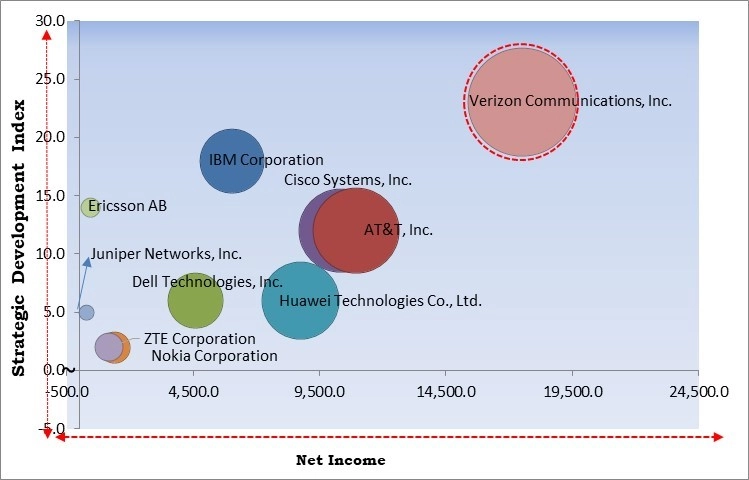
Based on the Analysis presented in the KBV Cardinal matrix; Verizon Communications, Inc. is the forerunner in the Network Optimization Services Market. Companies such as AT&T, Inc., Cisco Systems, Inc., and Huawei Technologies Co., Ltd. are some of the key innovators in Network Optimization Services Market. In December, 2024, Verizon Communications, Inc. announced the partnership with NVIDIA, a computer manufacturer corporation to integrate AI workloads into Verizon’s 5G private network with Mobile Edge Compute (MEC). This solution enhances real-time AI processing, security, and scalability, supporting Generative AI, AR/VR, IoT, and robotics. Verizon aims to drive enterprise AI adoption with ultra-low latency, high bandwidth, and edge computing innovation.
During the COVID-19 pandemic, the rapid shift to remote work, online education, and cloud-based applications caused a sharp rise in internet and IP traffic, with volumes increasing by around 30–40% in the first year. To sustain network performance and reliability, organizations accelerated investments in WAN/LAN optimization, SD-WAN, application acceleration, and network monitoring tools. Market studies found that demand for network optimization services exceeded expectations due to the need for resilient digital infrastructure. Although short-term project delays and capex freezes in 2020 slowed some deployments, this was offset by later catch-up spending. The long-term move toward hybrid work and cloud connectivity strengthened growth prospects. As a result, service providers emerged with stronger pipelines and improved market outlooks. Thus, the COVID-19 pandemic had a positive impact on the global network optimization services market.

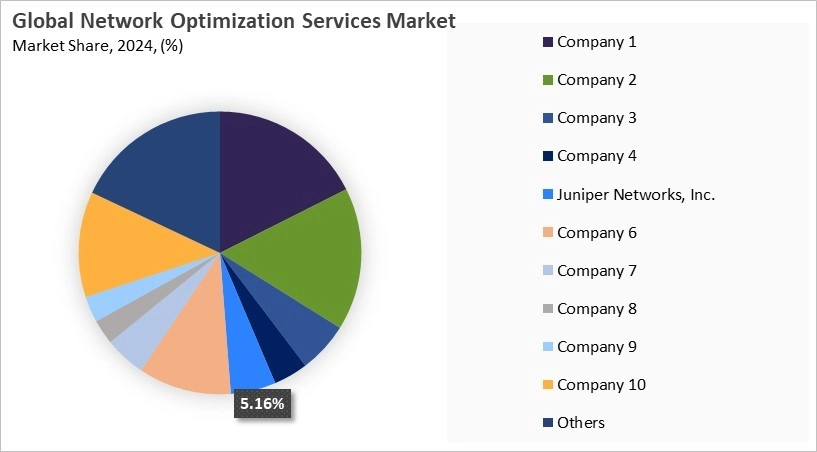
The leading players in the market are competing with diverse innovative offerings to remain competitive in the market. The above illustration shows the percentage of revenue shared by some of the leading companies in the market. The leading players of the market are adopting various strategies to cater demand coming from the different industries. The key developmental strategies in the market are Acquisitions, and Partnerships & Collaborations.
Based on Organization Size, the Network Optimization Services Market is segmented into Large Enterprise, and SMEs. The SMEs segment acquired 40% revenue share in the market in 2024. The SMEs segment in the Network Optimization Services Market encompasses small and medium-sized organizations that increasingly depend on reliable and efficient network performance to support daily operations, digital collaboration, and customer-facing applications. These organizations typically operate with limited IT resources, making network optimization services essential for maintaining stable connectivity without the burden of managing complex infrastructure internally.
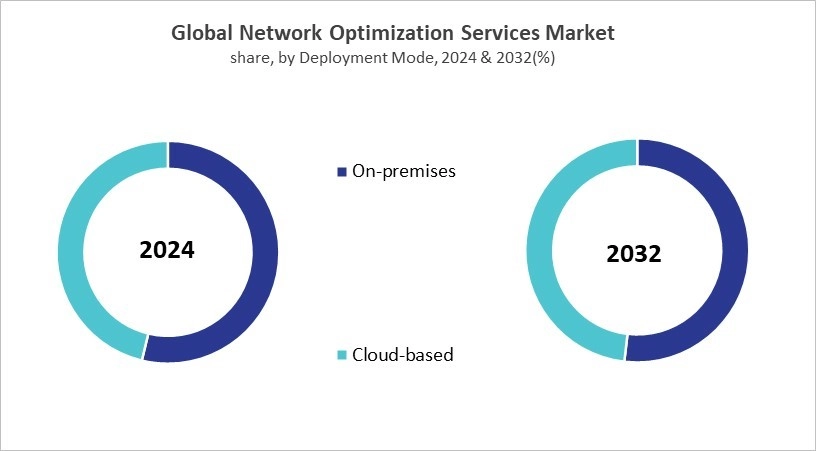
Based on Deployment Mode, the Network Optimization Services Market is segmented into On-premises, and Cloud-based. The Cloud-based segment acquired 46% revenue share in the market in 2024. The Cloud-based deployment mode in the Network Optimization Services Market focuses on delivering optimization capabilities through cloud platforms, enabling organizations to manage and enhance network performance without relying heavily on physical infrastructure. Cloud-based network optimization services are designed to support dynamic, distributed, and hybrid network environments that connect users, applications, and data across multiple locations.
Based on Service Type, the Network Optimization Services Market is segmented into Support & Maintenance, Implementation, and Consulting. The Support & Maintenance segment attained 29% revenue share in the market in 2024. The Support & Maintenance service type in the Network Optimization Services Market is centered on ensuring continuous, reliable, and efficient operation of deployed network optimization solutions. These services address the ongoing needs of organizations by providing proactive monitoring, performance tuning, troubleshooting, and regular system updates.
Free Valuable Insights: Network Optimization Services Market Size to reach $15.07 by 2032
Region-wise, the Network Optimization Services Market is analyzed across North America, Europe, Asia Pacific, and LAMEA. The North America segment recorded 36% revenue share in the market in 2024. The network optimization services market is anticipated to grow at a rapid rate in North America and Europe region. The market is driven by widespread 5G deployment, advanced IT infrastructure, AI-powered networking technologies and early cloud adoption, and large investment in digital transformation across telecom sector. The region dominates because of strong ecosystem of major technology companies, rising needs for resilient hybrid and multi-cloud connectivity, and high-performance requirement for data-intensive industries. The market growth is supported by robust demand for RAN optimization, and AIOps capabilities, helping enterprises reduce latency and enhance user experience across distributed networks. Moreover, Europe network optimization services market is predicted to capture prominent growth. The market is propelled by strict regulatory networks, digital transformation initiatives, and investment in 5G and infrastructure modernization. Leading European nations like France, the UK, and Germany are key contributors with organizations across finance, manufacturing, and public sector prioritizing security, performance, and compliance in their optimization strategies.
In Asia Pacific and LAMEA region, the network optimization services market is estimated to experience growth in the forecast period. The market is supported by rapid 5G rollout in Japan, India, China, and South Korea, large-scale digitalization, significant investment in IoT infrastructure and smart city, and expanding mobile internet penetration. Telecom and enterprises in the region largely adopt cloud-native and AI-driven optimization tools to handle accelerating data traffic and connectivity demands. Furthermore, LAMEA network optimization services market is predicted to expand at a substantial rate, driven by mobile adoption, government digital initiatives, telecom infrastructure upgrades accelerating demand. The region focuses on mobile network optimization, and cloud-first strategies supporting expansion. Also, region invest in connectivity and data center build-outs that require advanced optimization services.
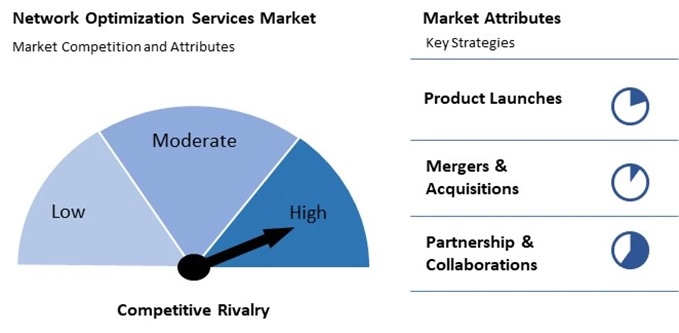
The Network Optimization Services market is highly competitive, driven by rapid digital transformation and rising demand for efficient, high-performance networks. Global IT service providers, telecom vendors, and specialized managed service firms compete by offering AI-driven optimization, automation, and cloud-native solutions. Competition is based on service quality, scalability, cybersecurity integration, and cost efficiency. Strategic partnerships, continuous innovation, and customized enterprise solutions are key tactics, as vendors seek to differentiate themselves in a crowded market with evolving customer expectations.
| Report Attribute | Details |
|---|---|
| Market size value in 2025 | USD 6.45 Billion |
| Market size forecast in 2032 | USD 15.07 Billion |
| Base Year | 2024 |
| Historical period | 2021 to 2023 |
| Forecast Period | 2025 to 2032 |
| Revenue Growth Rate | CAGR of 12.9% from 2025 to 2032 |
| Number of Pages | 694 |
| Tables | 588 |
| Report Coverage | Market Trends, Revenue Estimation and Forecast, Segmentation Analysis, Regional and Country Breakdown, Competitive Landscape, Market Share Analysis, Porter’s 5 Forces Analysis, Company Profiling, Companies Strategic Developments, SWOT Analysis, Winning Imperatives |
| Segments Covered | Component, Technology, Deployment, Device, Vertical, Region |
| Country Scope |
|
| Companies Included | Cisco Systems, Inc., Huawei Technologies Co., Ltd. (Huawei Investment & Holding Co., Ltd.), IBM Corporation, AT&T, Inc., Juniper Networks, Inc., Nokia Corporation, ZTE Corporation, Verizon Communications, Inc., Dell Technologies, Inc. and Ericsson AB |
By Organization Size
By Deployment Mode
By Service Type
By Application
By Industry Vertical
By Geography
Our team of dedicated experts can provide you with attractive expansion opportunities for your business.








 Unique Offerings