“Global Navigation Lighting Market to reach a market value of USD 4.96 Billion by 2032 growing at a CAGR of 5%”
The Global Navigation Lighting Market size is expected to reach USD 4.96 billion by 2032, rising at a market growth of 5.0% CAGR during the forecast period.
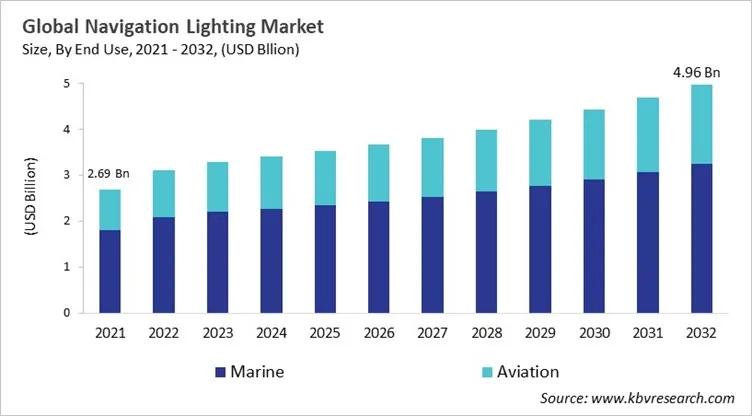
The global navigation lighting market has become an important part of keeping people safe while they travel by sea, air, or in an unmanned vehicle. In the 19th century, navigation lights were required for ships. In the early 20th century, they were also required for airplanes, and the ICAO and FAA set standards for them. These lights have changed from incandescent to halogen to LEDs over time. LEDs are now the most common type of light because they last longer, use less energy, and are accepted by the government. In addition to lighting, digital monitoring and smart systems now let operators keep an eye on performance in real time. This is in line with larger trends in predictive maintenance, automation, and unmanned operations.
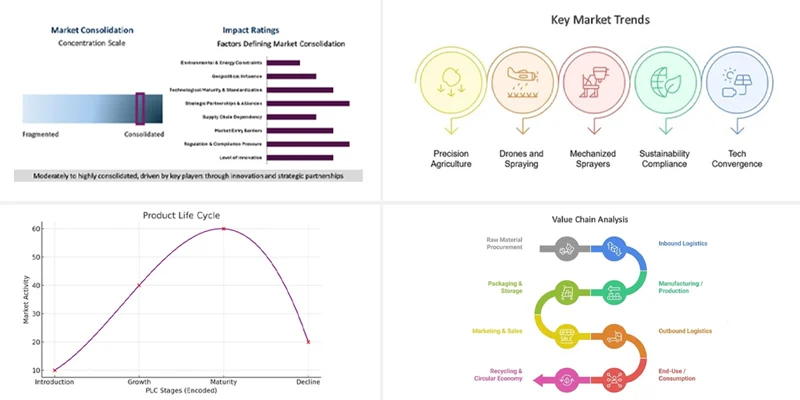
Three primary trends are important in current market: using LEDs, smart integration, and being eco-friendly. LEDs are easier to see and last longer, and digital integration connects navigation lights with avionics and bridge systems for automated control and diagnostics. Sustainability, on the other hand, encourages the use of recyclable materials and energy-efficient designs, which are in line with global ESG frameworks and operator carbon-reduction goals. Compliance, reliability, and lifecycle management are more important than price in competition. Companies focus on innovation, working with regulators, and forming global partnerships. Market leaders also build customer loyalty through retrofit services, long-term contracts, and product differentiation based on environmental, social, and governance (ESG) factors. This makes it hard for new companies to enter the market and creates a technology-driven competitive landscape.
The COVID-19 pandemic had a very bad effect on the navigation lighting market, stopping production, supply chains, and demand. Lockdowns and travel bans stopped factories from making things, and a lack of raw materials and delays in shipping slowed down deliveries. Less trade around the world, grounded airlines, and delayed shipbuilding projects all made people want marine and aviation navigation lights a lot less. Governments also moved money away from infrastructure and modernization projects to focus on health priorities. Cash flow problems and uncertainty about contracts made it hard for small and medium-sized businesses to make money, which hurts the market. Thus, the COVID-19 pandemic had a negative effect on the navigation lighting market.

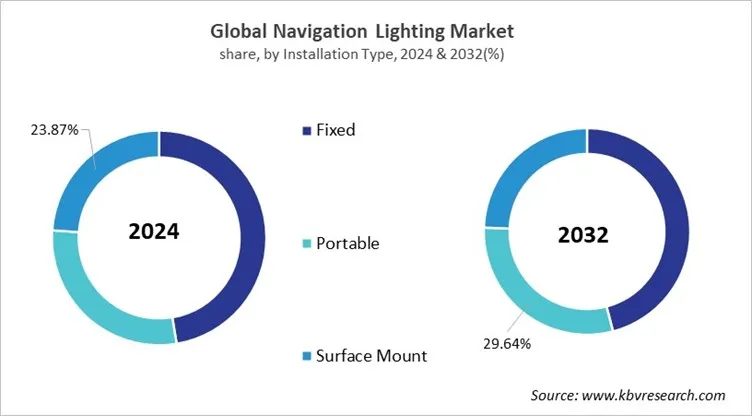
By installation type, the navigation lighting market is divided into fixed, portable, and surface mount. The portable segment recorded 29% revenue share in the navigation lighting market in 2024. Portable navigation lights are widely used in fishing boats, leisure crafts, and rescue operations, where mobility and quick installation are critical. Their growing popularity is also tied to advancements in lightweight, energy-efficient LED and solar-powered designs, which enhance convenience while reducing maintenance.
Based on end use, the navigation lighting market is segmented into marine and aviation. The aviation held 33% revenue share in the navigation lighting market in 2024. These systems are vital for ensuring aircraft visibility during night flights, low-visibility conditions, and airport ground movements. Both commercial and defense aviation rely heavily on navigation lighting to enhance safety, with increasing air travel and fleet expansions across major airlines fueling demand. The segment has also benefitted from advancements in LED and solar-powered lighting technologies, which offer energy efficiency and improved durability.
Free Valuable Insights: Global Navigation Lighting Market size to reach USD 4.96 Billion by 2032
Region-wise, the navigation lighting market is analyzed across North America, Europe, Asia Pacific, and LAMEA. The Asia Pacific segment gained 37% revenue share in the Navigation Lighting Market in 2024. Strict government oversight and the widespread use of cutting-edge technologies are driving the navigation lighting market in North America and Europe. The FAA, ICAO, and European Aviation Safety Agency (EASA) set rules for aviation, while the International Maritime Organization (IMO) sets rules for shipping. Because they are reliable, use less energy, and cost less to maintain, airlines, navies, and commercial shipping companies in these areas are quickly switching to LED-based systems. A lot of people are combining navigation lights with smart monitoring and diagnostic systems, and this is possible because of strong digital infrastructure. In addition, sustainability policies in Europe and the U.S. are making manufacturers use eco-friendly materials and designs, which is in line with ESG priorities and government incentives.
In the Asia-Pacific and LAMEA regions, growth is driven by more commercial aviation, modernization of naval ships, and more trade by sea. China, Japan, South Korea, and India are all investing a lot of money in aviation and shipping fleets in the Asia-Pacific region. OEMs and governments are speeding up LED retrofits and smart system integration. Shipyards and drone makers in the area are also increasing the need for navigation lighting. In LAMEA, infrastructure development, growing airline fleets, and port modernization projects help the market grow, but adoption rates vary because of cost sensitivity and a lack of suppliers. Still, more money is going into defense, and shipping routes across the Middle East and Africa are opening new opportunities for global suppliers looking for local partners and service hubs.
| Report Attribute | Details |
|---|---|
| Market size value in 2025 | USD 3.52 Billion |
| Market size forecast in 2032 | USD 4.96 Billion |
| Base Year | 2024 |
| Historical Period | 2021 to 2023 |
| Forecast Period | 2025 to 2032 |
| Revenue Growth Rate | CAGR of 5.0% from 2025 to 2032 |
| Number of Pages | 459 |
| Number of Tables | 470 |
| Report coverage | Market Trends, Revenue Estimation and Forecast, Segmentation Analysis, Regional and Country Breakdown, Porter’s 5 Forces Analysis, Company Profiling, Companies Strategic Developments, SWOT Analysis, Winning Imperatives |
| Segments covered | End Use, Installation Type, Type, Technology, Region |
| Country scope |
|
| Companies Included | Accon Marine, LLC, Lopolight ApS, Mantagua, Glamox AS, R. STAHL TRANBERG AS, Perko Inc., Den Haan Rotterdam, Navisafe AS, Sabik Marine and Sealite Pty Ltd |
By End Use
By Installation Type
By Type
By Technology
By Geography
This Market size is expected to reach USD 4.96 Billion billion by 2032.
The navigation lighting market is projected to grow at a CAGR of 5.0% between 2025 and 2032.
Expansion of maritime trade and shipping activities coupled with rising demand for air travel and aviation safety requirements.
Accon Marine, LLC, Lopolight ApS, Mantagua, Glamox AS, R. STAHL TRANBERG AS, Perko Inc., Den Haan Rotterdam, Navisafe AS, Sabik Marine and Sealite Pty Ltd
The Marine segment is leading the Global Navigation Lighting Market by End Use in 2024; thereby, achieving a market value of $3.24 billion by 2032.
The Asia Pacific region dominated the Global Navigation Lighting Market by Region in 2024, and would continue to be a dominant market till 2032; thereby, achieving a market value of $1.89 Billion by 2032.
Our team of dedicated experts can provide you with attractive expansion opportunities for your business.







 Unique Offerings