“Global Native Advertising Market to reach a market value of USD 263.84 Billion by 2032 growing at a CAGR of 13%”
The Global Native Advertising Market size is expected to reach $263.84 billion by 2032, rising at a market growth of 13.0% CAGR during the forecast period.
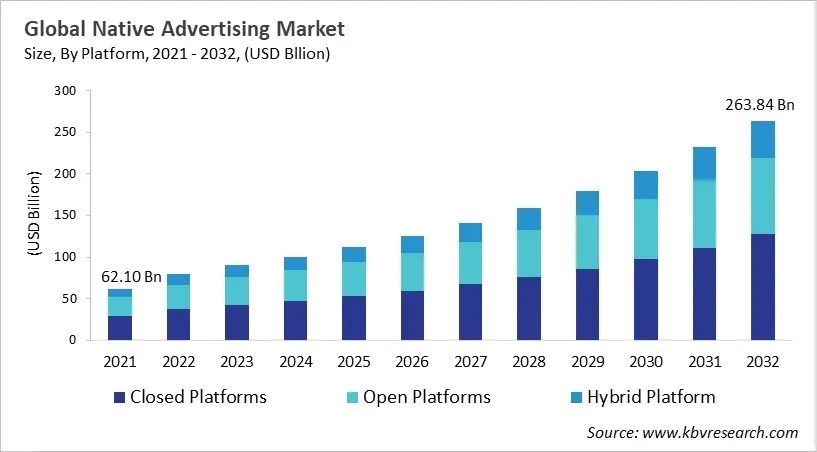
Recently, native advertising has evolved as a core digital marketing strategy shaped by platform integration, programmatic technology, and the requirement for story-driven, seamless promotion. With the digital environment getting more expanded, advertisers and publishers embraced native formats, such as promoted listings, in-feed ads, recommendation widgets, branded content, and native video for delivering relevant messages that fit seamlessly into editorial content. Advances in tracking, targeting, and programmatic delivery allow scalable and contextually appropriate and scalable placements, while key platforms embedded native units directly into their ecosystems, surging acceptance, and standardizing measurement. The native advertising market has evolved from simple sponsored posts to content hubs, podcast integration, attention-based measurement frameworks, and long-form storytelling.
Transparency and regulation have become crucial to native’s development, with regulators requiring clear labeling and publishers improving disclosure to safeguard user trust. This has encouraged editorial standards, ad-tech workflows, and creative approaches, elaborating that effective native advertising must balance compliance, authenticity, and scale. The market is witnessing intensive competition among concentrated platform ecosystems that offer data driven precision, massive reach, and a fragmented landscape of creative studios and publishers offering trust-based storytelling. Industrial bodies and technology providers continue to encourage advanced measurement tools and standardization, enabling advertisers pair programmatic efficiency with high-quality content collaborations. The market growth majorly depends upon measurement sophistication, transparency, and the capability to deliver non-disruptive narratives within regulatory boundaries.
At first, the COVID-19 pandemic impacted the global native advertising market because businesses cut their marketing budgets and stopped running campaigns, especially in the travel, entertainment, and retail sectors. This was because of economic uncertainty. Lockdowns and social distancing made it harder to make content and work together creatively, which pushed back campaigns and lowered the quality of creative work. Changes in how people act and a greater awareness of safety, empathy, and community forced advertisers to change their messages, which made things take even longer. Publishers, especially smaller ones, lost money because demand went down and they didn't have enough resources. Larger digital platforms, on the other hand, kept their traffic and automation advantages. Also, changes in how users interacted with and were skeptical of branded content impact campaign effectiveness and ROI, which shows how the market shrank at first during the pandemic. Thus, the COVID -19 pandemic had a Negative/Positive impact on the market.

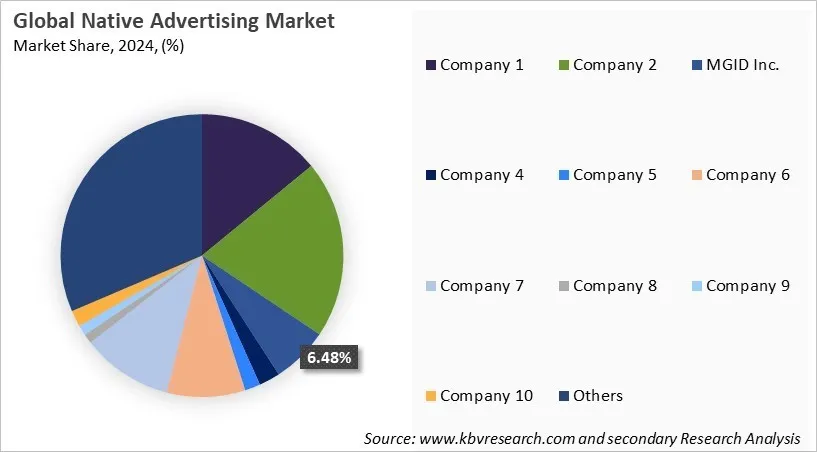
The leading players in the market are competing with diverse innovative offerings to remain competitive in the market. The above illustration shows the percentage of revenue shared by some of the leading companies in the market. The leading players of the market are adopting various strategies in order to cater demand coming from the different industries. The key developmental strategies in the market are Acquisitions, and Partnerships & Collaborations.
Based on Platform, the market is segmented into Closed Platforms, Open Platforms and Hybrid Platform. The Open Platforms segment attained 36.80% revenue share in the market in 2024. This segment represented another important area within the native advertising ecosystem. Open platforms offered more flexible and accessible opportunities for advertisers to reach diverse audiences across multiple digital channels. These platforms emphasized reach and scalability, enabling campaigns to extend beyond a single controlled environment and connect with users across websites, social media, and content networks.
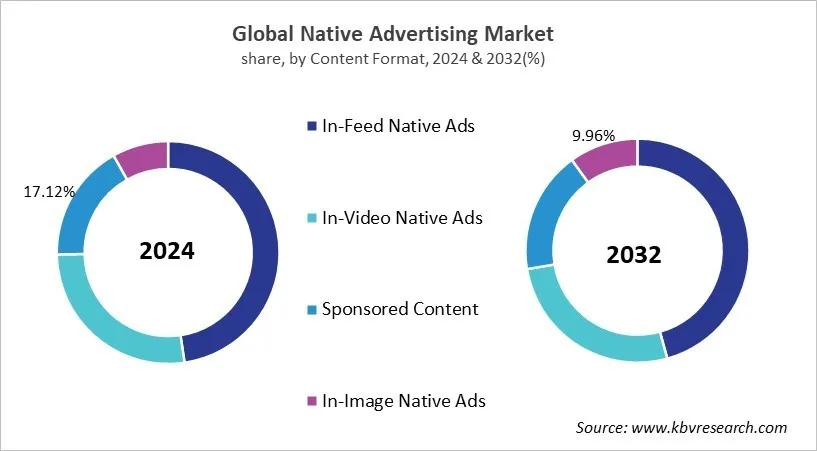
Based on Content Format, the market is segmented into In-Feed Native Ads, In-Video Native Ads, Sponsored Content and In-Image Native Ads. The In-Video Native Ads segment attained 27.07% revenue share in the market in 2024. This segment emerged as another prominent format within the market, offering immersive and visually compelling opportunities for brand communication. This format involved embedding promotional content directly into video streams, including pre-roll, mid-roll, and integrated video segments, capturing audience attention during high-engagement media consumption.
Free Valuable Insights: Native Advertising Market size to reach USD 263.84 Billion by 2032
Region-wise, the Native Advertising Market is analyzed across North America, Europe, Asia Pacific, and LAMEA. The North America segment recorded 36.20% revenue share in the market in 2024. The native advertising market is anticipated to grow at a significant rate in the North America and Europe region. This is because of the shift of US advertisers from substantial display budgets into in-content and feed-style formats. Brands in the region prioritize measurement tied to first-party data strategies, performance, and AI-based creative optimisation, and publishers are rolling native into omnichannel suites to protect yield. Further, Europe represents prominent expansion driven by stronger publisher controls, measurement workarounds on brand safety, and contextual relevance, thus programmatic native grows along with strengthened consent flow and private marketplaces.
In Asia Pacific and LAMEA, the native advertising market is predicted to capture prominent market. The expansion is supported by nations including India, China, and Southeast Asia-where social commerce, livestream/influencer formats, and mobile-first consumption make native advertising highly integrated with short-form video and shopping experiences. Advertisers are scaling native within platform ecosystems and investing in regional creative and commerce-linked formats. Moreover, the LAMEA native advertising market is also showcasing positive opportunities with surging native use as measurement and programmatic infrastructure enhances, and mobile penetration accelerates reach.
| Report Attribute | Details |
|---|---|
| Market size value in 2025 | USD 112.22 Billion |
| Market size forecast in 2032 | USD 263.84 Billion |
| Base Year | 2024 |
| Historical Period | 2021 to 2023 |
| Forecast Period | 2025 to 2032 |
| Revenue Growth Rate | CAGR of 13.0% from 2025 to 2032 |
| Number of Pages | 502 |
| Number of Tables | 421 |
| Report coverage | Market Trends, Revenue Estimation and Forecast, Segmentation Analysis, Regional and Country Breakdown, Market Share Analysis, Porter’s 5 Forces Analysis, Company Profiling, Companies Strategic Developments, SWOT Analysis, Winning Imperatives |
| Segments covered | Platform, Content Format, End Use, Region |
| Country scope |
|
| Companies Included | Teads Holding Co. (Outbrain Inc.), TABOOLA.COM LTD., MGID Inc., RevContent, LLC (Star Mountain Fund Management, LLC), Nativo, Inc., Yahoo Inc., Triple Lift, Inc. (Vista Equity Partners Management, LLC), adMarketplace Inc., ADYOULIKE SA (Open Web Technologies Ltd.), and Sharethrough Inc. |
By Platform
By Content Format
By End Use
By Geography
This Market size is expected to reach USD 263.84 Billion by 2032.
The native advertising market is projected to grow at a CAGR of 13% between 2025 and 2032.
Increasing digital media consumption fueling demand for enhanced and more precise targeting capabilities.
Teads Holding Co. (Outbrain Inc.), TABOOLA.COM LTD., MGID Inc., RevContent, LLC (Star Mountain Fund Management, LLC), Nativo, Inc., Yahoo Inc., Triple Lift, Inc. (Vista Equity Partners Management, LLC), adMarketplace Inc., ADYOULIKE SA (Open Web Technologies Ltd.), and Sharethrough Inc.
The In-Feed Native Ads segment led the maximum revenue in the Global Native Advertising Market by Content Format in 2024, thereby, achieving a market value of $120.6 billion by 2032.
The North America region dominated the Global Native Advertising Market by Region in 2024, and would continue to be a dominant market till 2032; thereby, achieving a market value of $91.7 billion by 2032.
Our team of dedicated experts can provide you with attractive expansion opportunities for your business.







 Unique Offerings