“Global Multi-access Edge Computing Market to reach a market value of USD 104.46 Billion by 2032 growing at a CAGR of 46.6%”
The Global Multi-access Edge Computing Market size is expected to reach $104.46 billion by 2032, rising at a market growth of 46.6% CAGR during the forecast period.
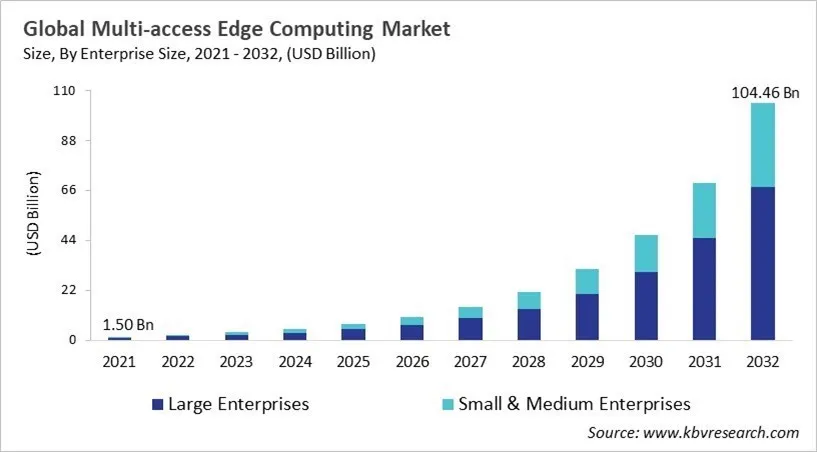
Multi access edge computing has developed from a telco-centric concept to a crucial component of modern distributed architectures. Initially supported by the requirement for ultra-low latency, context-aware services, and data locality, multi access edge computing developed through standardization by ETSI and coordination with 3GPP, allowing interoperable APIs, scalable deployment models, and multi-vendor orchestration. With expanding 5G networks, multi-access edge computing market shifted from proofs of concept to commercial architectures, driving containerized workloads, caching, AI inference, and real-time applications across an extended edge continuum that include on-premises, device, telco edge, and cloud edge environments.
Multi access edge computing market is witnessing accelerated adoption because of elements such as the expansion of hybrid and private MEC in enterprise and industrial settings, industry-wide efforts to standardize APIs and interoperability, and the growth of latency-sensitive AI workloads. Hyperscalers, telecom vendors, and system integrators are shaping the competitive landscape by deploying edge compute into 5G infrastructure, delivering vertical-specific solutions, and extending cloud services to operator sites. With increasing global investments, evolving deployment patterns, and multi-stakeholder partnerships, multi access edge computing market is shifting decisively from early pilots to scaled commercial rollouts across transportation, logistics, manufacturing, immersive media, and smart cities.
The major strategies followed by the market participants are Partnerships as the key developmental strategy to keep pace with the changing demands of end users. For instance, In May, 2025, IBM Corporation teamed up with Lumen Technologies, a telecommunications company to deliver enterprise AI solutions at the edge by combining IBM’s watsonx AI portfolio with Lumen’s Edge Cloud network. This collaboration aims to enable real-time AI inferencing near data sources, lowering latency, costs, and security risks while scaling AI across industries. Moreover, In June, 2025, Ericsson AB announced the partnership with Supermicro to deliver bundled solutions combining Ericsson’s 5G enterprise wireless technology with Supermicro’s Edge AI platforms. This partnership aims to simplify deployment of low-latency AI applications at the network edge for industries like retail, factories, traffic management, and healthcare, enabling faster, more flexible edge intelligence.
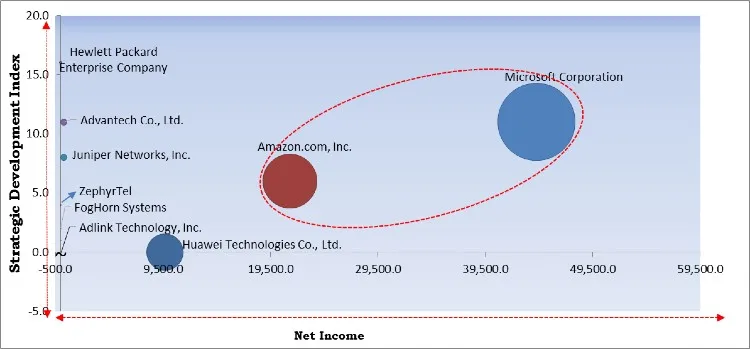
Based on the Analysis presented in the KBV Cardinal matrix; Microsoft Corporation and Amazon Web Services, Inc. are the forerunners in the Multi-access Edge Computing Market. In May, 2025, Microsoft Corporation announced the partnership with Kyndryl, an IT company to help businesses manage hybrid, multicloud, edge, and IoT systems using tools like Azure Arc. The new services support retail, manufacturing, energy, and healthcare use cases, focusing on unified data, faster app scaling, and centralized security operations. Companies such as Cisco Systems, Inc., IBM Corporation, and Dell Technologies, Inc. are some of the key innovators in Multi-access Edge Computing Market.
The COVID-19 pandemic had a big impact on the Multi-access Edge Computing (MEC) market. Deployments were delayed because of problems with the global supply chain, a lack of hardware, and slower manufacturing. Telecom companies and businesses shifted their budgets to focus on important operations and infrastructure for remote work, putting off capital-intensive MEC projects for a while. Key early-adopting sectors like automotive, aviation, travel, and retail saw downturns that stopped pilot deployments and innovation programs. Skill shortages and limited site access also slowed down installation, integration, and testing activities. Limited access to testbeds and research and development (R&D) facilities made it harder to create new edge applications, AI models, and low-latency services. So, even though MEC has a lot of long-term potential, the pandemic made it harder for people to use and grow. Thus, the COVID -19 pandemic had a Negative impact on the market.

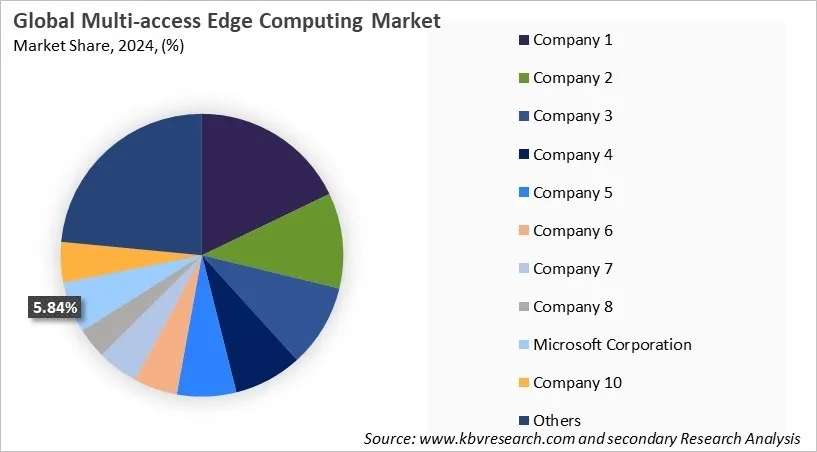
The leading players in the market are competing with diverse innovative offerings to remain competitive in the market. The above illustration shows the percentage of revenue shared by some of the leading companies in the market. The leading players of the market are adopting various strategies in order to cater demand coming from the different industries. The key developmental strategies in the market are Acquisitions, and Partnerships & Collaborations.
Free Valuable Insights: Multi-access Edge Computing Market size to reach USD 104.46 Billion by 2032
Based on Enterprise Size, the market is segmented into Large Enterprises and Small & Medium Enterprises. The small & medium enterprises segment attained 33% revenue share in the Multi-access Edge Computing Market in 2024. While typically lacking the extensive capital or specialized in-house IT expertise of their larger counterparts, SMEs are increasingly adopting MEC solutions to gain crucial competitive advantages. This adoption is primarily driven by the growing availability of managed edge services and MEC-as-a-Service offerings from telecom carriers and cloud providers, which offer lower upfront costs and simplified management.
Based on Solution Type, the market is segmented into Hardware, Software and Services. The software segment recorded 35% revenue share in the Multi-access Edge Computing Market in 2024. er that orchestrates and manages the complex, decentralized hardware infrastructure. Revenue in this segment is generated through licensing and subscription fees for MEC platforms, orchestration and automation tools, and virtualization software (such as container management solutions like Kubernetes).
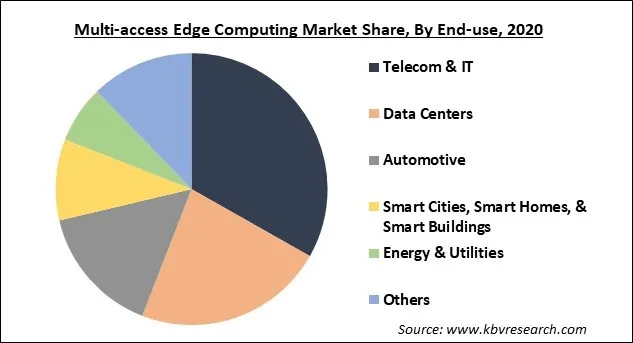
Region-wise, the Multi-access Edge Computing Market is analyzed across North America, Europe, Asia Pacific, and LAMEA. The North America segment recorded 38% revenue share in the Multi-access Edge Computing Market in 2024. In North America and Europe, the multi access edge computing market is projected to capture prominent growth. The market is driven by early 5G rollouts, major cloud and CDN players, and strong telecom/enterprise investment in public and private edge deployments. Hyperscalers, operators and system integrators are turning multi access into production for VR/AR, low latency B2B services, and industrial automation. In addition to this, the European market is anticipated to witness expansion during the forecast period, with regulatory emphasis on Industry 4.0 programmers, data locality, and smart city/automotive pilots are encouraging operator-enterprise multi-access edge computing collaborations.
The multi-access edge computing market is estimated to experience substantial expansion in the Asia Pacific and LAMEA region. This is because of massive 5G network rollouts across Japan, China, and India, government supported digitalisation (smart cities, industrial IoT, and urban mobility), and high mobile data demand. Moreover, the LAMEA multi-access edge computing market is showcasing positive growth opportunities. The growth is backed by oil & gas, mining ports, and selected smart city projects, alongside recent telecom modernisation deals are creating edge pockets of demand.
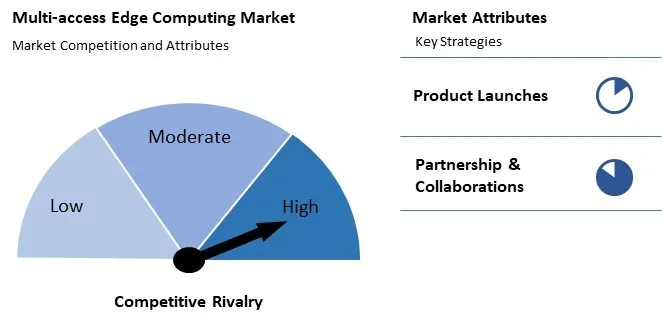
The Multi-access Edge Computing (MEC) market is very competitive because technology changes quickly and new ideas are always coming up. Players are trying to stand out by offering better service, solutions with low latency, and easy integration with cloud and IoT ecosystems. There is also a race in the market to make edge computing platforms that are scalable, secure, and flexible enough to meet the needs of many different industries. Strategic partnerships, collaborations, and ecosystem growth are important ways to stay competitive in this changing and dynamic market.
| Report Attribute | Details |
|---|---|
| Market size value in 2025 | USD 7.18 Billion |
| Market size forecast in 2032 | USD 104.46 Billion |
| Base Year | 2024 |
| Historical Period | 2021 to 2023 |
| Forecast Period | 2025 to 2032 |
| Revenue Growth Rate | CAGR of 46.6% from 2025 to 2032 |
| Number of Pages | 555 |
| Number of Tables | 473 |
| Report coverage | Market Trends, Revenue Estimation and Forecast, Segmentation Analysis, Regional and Country Breakdown, Competitive Landscape, Market Share Analysis, Porter’s 5 Forces Analysis, Company Profiling, Companies Strategic Developments, SWOT Analysis, Winning Imperatives |
| Segments covered | Enterprise Size, Solution Type, Network Type, End-Use, Region |
| Country scope |
|
| Companies Included | Amazon Web Services, Inc. (Amazon.com, Inc.), Hewlett Packard Enterprise Company, Cisco Systems, Inc., Huawei Technologies Co., Ltd. (Huawei Investment & Holding Co., Ltd.), Nokia Corporation, Intel Corporation, Dell Technologies, Inc., IBM Corporation, Microsoft Corporation, and Ericsson AB |
By Enterprise Size
By Solution Type
By Network Type
By End-Use
By Geography
The market size is projected to reach USD 104.46 Billion by 2032.
The multi-access edge computing market is projected to grow at a CAGR of 46.6% between 2025 and 2032.
Rising demand for ultra-low latency applications driven by the explosive growth of IoT devices and decentralized data generation.
Amazon Web Services, Inc. (Amazon.com, Inc.), Hewlett Packard Enterprise Company, Cisco Systems, Inc., Huawei Technologies Co., Ltd. (Huawei Investment & Holding Co., Ltd.), Nokia Corporation, Intel Corporation, Dell Technologies, Inc., IBM Corporation, Microsoft Corporation, and Ericsson AB
The Wireless MEC segment led the maximum revenue in the Global Multi-access Edge Computing Market by Network Type in 2024, thereby, achieving a market value of $74.7 billion by 2032.
The North America region dominated the Global Multi-access Edge Computing Market by Region in 2024, and would continue to be a dominant market till 2032; thereby, achieving a market value of $38.6 billion by 2032.
Our team of dedicated experts can provide you with attractive expansion opportunities for your business.






 Unique Offerings