“Global Mobile Business Process Management Market to reach a market value of USD 13.35 Billion by 2032 growing at a CAGR of 13.1%”
The Global Mobile Business Process Management Market size is estimated at $5.64 billion in 2025 and is expected to reach $13.35 billion by 2032, rising at a market growth of 13.1% CAGR during the forecast period (2025-2032). The projected growth of the global Mobile BPM market is driven by rising enterprise digital transformation, increasing mobile workforce adoption, and growing demand for real-time workflow automation. Cloud-based deployment, integration with low-code and AI tools, and the need for remote process management further support sustained expansion and justify the forecasted CAGR.
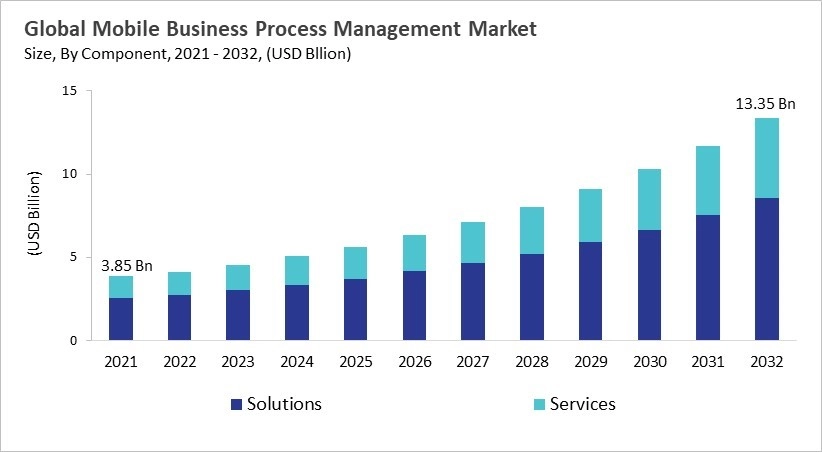
Mobile Business Process management has modernized traditional BPM by allowing enterprises to automate, monitor, design, and optimize end-to-end business processes through mobile devices. As organization mobility expanded, BPM platforms developed from desktop-centric systems to mobile-based solutions that enable real-time workflows, alerts, approvals, and collaboration on tablets and smartphones. Further, cloud adoption has surged during this transition by allowing globally accessible, scalable, and rapidly deployable mobile BPM platforms. Mobile BPM has evolved from basic task notifications to full process monitoring and execution, supporting frontline and distributed workforces across industries like healthcare, finance, logistics, and field services with traceable, compliant, and auditable workflows.
Some of the key elements supporting the growth of the mobile BPM market include cloud-native delivery, mobility-enabled business execution, and integration with core enterprise systems and advanced technologies. Modern mobile business process management platforms prioritize low-code/no-code development, mobile-first user experiences, and seamless integration with CRM, ERP, and AI-driven decision engines to deliver smart, context-aware automation. Key market players like Microsoft, IBM, Oracle, SAP, Appian, and Kissflow compete by strengthening hybrid and cloud deployment models, improving governance and security, and expanding ecosystem partnerships. Competition focuses on innovation in mobile accessibility, AI-assisted automation, real-time insights, and scalable cloud architectures to support operational agility and enterprise digital transformation.

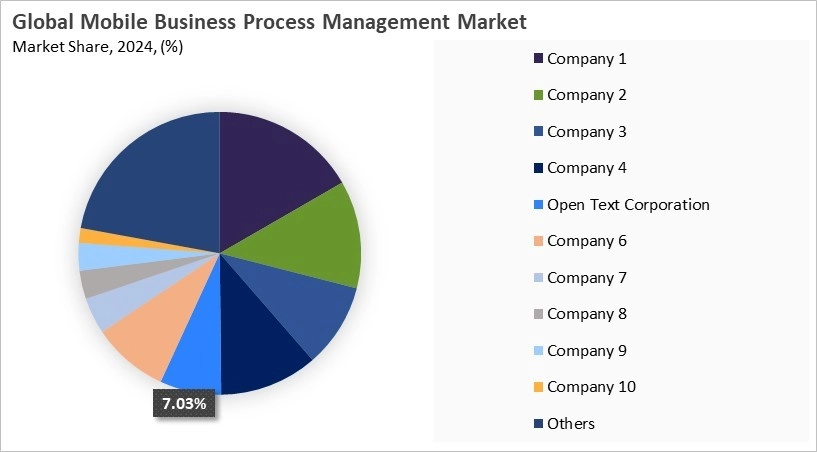
The leading players in the market are competing with diverse innovative offerings to remain competitive in the market. The above illustration shows the percentage of revenue shared by some of the leading companies in the market. The leading players of the market are adopting various strategies to cater demand coming from the different industries. The key developmental strategies in the market are Acquisitions, and Partnerships & Collaborations.
The COVID-19 pandemic hurt the Mobile BPM market, especially during the early lockdown phases, when businesses put off or canceled digital transformation projects to focus on staying in business. Limited investments in mobile BPM solutions were due to budget constraints and lower IT spending. Remote work problems and workforce disruptions slowed down projects to implement and integrate. Key industries that adopted workflow automation tools, like manufacturing, retail, and logistics, saw slowdowns, which cut down on demand for these tools. Disruptions in the supply chain hurt software development, onboarding, and support services for vendors. Small and medium-sized providers were hit harder because they didn't have as much financial strength. Also, uncertainty slowed down decision-making in businesses, which held back short-term market growth even though there was a growing interest in remote process management. Thus, the COVID-19 pandemic had a negative impact on the market.
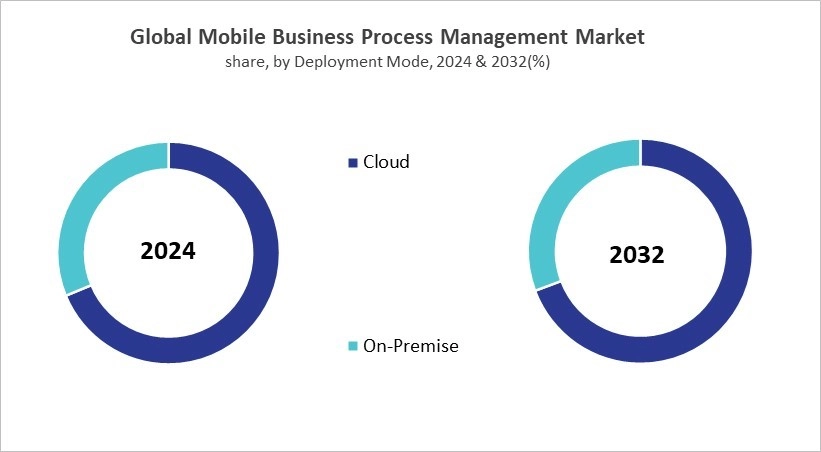
Based on Deployment Mode, the Mobile Business Process Management Market is segmented into Cloud, and On-Premise. The On-Premise segment acquired 31.27% revenue share in the market in 2024. The On-Premise deployment mode in the Mobile Business Process Management Market involves hosting BPM solutions within an organization’s own IT infrastructure, providing full control over data, security, and customization. This mode is preferred by enterprises with strict regulatory requirements or sensitive operational data, as it ensures complete oversight and protection against external vulnerabilities.
Based on Enterprise Size, the Mobile Business Process Management Market is segmented into Large Enterprises, and Small & Medium Enterprises. The Small & Medium Enterprises segment acquired 30.09% revenue share in the market in 2024. The Small & Medium Enterprises (SMEs) segment in the Mobile Business Process Management Market includes organizations with relatively smaller operational scales but significant growth potential and dynamic process requirements. SMEs adopt mobile BPM solutions to improve efficiency, manage resources effectively, and scale operations without the overhead of extensive IT infrastructure.
Free Valuable Insights: Mobile Business Process Management Market Size to reach $13.35 by 2032
Region-wise, the Mobile Business Process Management Market is analyzed across North America, Europe, Asia Pacific, and LAMEA. The mobile business process management market is anticipated to grow significantly in North America and Europe. The market is driven by early enterprise adoption, advanced technological infrastructure, and heavy investment in digital transformation. Canada and the US market is leading regional expansion with strong demand in various industries, including healthcare, IT, and financial services, that seek real-time mobile workflow automation and process optimization. The regional market is further driven by the presence of major BPM vendors and widespread cloud adoption that continuously innovate with AI-enabled and mobile features. Additionally, Europe is showcasing strong growth in the mobile business process management market, supported by regulatory compliance requirements, digital transformation initiatives, and a well-established industrial base in nations like France, Germany, and the UK. The well-established corporate mobile ecosystem alongside high enterprise IT spending results in the prominent growth of market.
In the Asia Pacific and LAMEA region, the mobile business process management market is projected to procure prominent expansion during the projection period. The market is backed by digital infrastructure expansion, rapid mobile adoption, and rising demand from developing nations such as Japan, China, and India, as well as cloud-first and mobile-first strategies. Moreover, the LAMEA mobile business process management market is estimated to expand at a steady pace. The demand for cloud-enabled, cost-effective mobile BPM solutions is accelerating, especially in government digitalization efforts and SMEs, thereby showcasing long-term growth opportunities across the region.
| Report Attribute | Details |
|---|---|
| Market size value in 2025 | USD 5.64 Billion |
| Market size forecast in 2032 | USD 13.35 Billion |
| Base Year | 2024 |
| Historical period | 2021 to 2023 |
| Forecast Period | 2025 to 2032 |
| Revenue Growth Rate | CAGR of 13.1% from 2025 to 2032 |
| Number of Pages | 606 |
| Tables | 456 |
| Report Coverage | Market Trends, Revenue Estimation and Forecast, Segmentation Analysis, Regional and Country Breakdown, Market Share Analysis, Porter’s 5 Forces Analysis, Company Profiling, Companies Strategic Developments, SWOT Analysis, Winning Imperatives |
| Segments Covered | Component, Deployment Mode, Enterprise Size, End-User Industry, Region |
| Country Scope |
|
| Companies Included | IBM Corporation, Oracle Corporation, Software AG, Pegasystems, Inc., Open Text Corporation, Appian Corporation, Fujitsu Limited, Microsoft Corporation, TIBCO Software, Inc. and Nintex, Inc. |
By Component
By Deployment Mode
By Enterprise Size
By End-User Industry
By Geography
Our team of dedicated experts can provide you with attractive expansion opportunities for your business.







 Unique Offerings