“Global Microgrid As A Service Market to reach a market value of USD 7.90 Billion by 2032 growing at a CAGR of 14.3%”
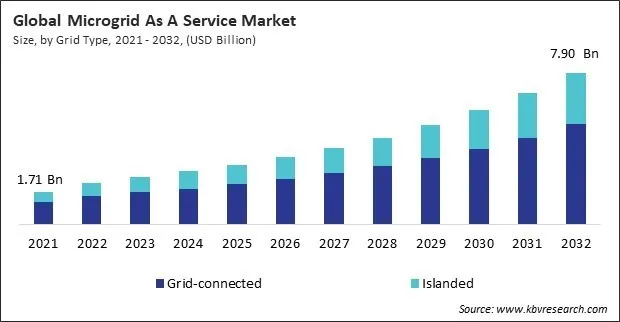
The Global Microgrid As A Service Market size is expected to reach $7.90 billion by 2032, rising at a market growth of 14.3% CAGR during the forecast period.
Grid-connected microgrids support peak shaving, load balancing, and offer backup power during grid disturbances. Their compatibility with existing infrastructure and regulatory support makes them a popular choice for institutions, commercial setups, and even residential communities seeking enhanced energy control and cost efficiency.
During the COVID-19 pandemic, the Microgrid as a Service market experienced significant setbacks due to widespread supply chain disruptions. Manufacturers and service providers faced delays in procuring essential components such as inverters, control systems, and energy storage units. Global restrictions on transport and industrial shutdowns in key supplier countries severely impacted production timelines, leading to project delays and cost overruns. Thus, the COVID-19 pandemic had negative impact on the market.

The global surge in electricity consumption—driven by rapid urbanization, digital transformation, and electrification of transportation and industry—has outpaced the capacity of many existing grid infrastructures. In both developed and emerging economies, aging grid systems are under strain, increasingly vulnerable to overload, outages, and extreme weather events exacerbated by climate change. Microgrids provide a decentralized, localized, and highly resilient solution capable of maintaining energy supply independently or in coordination with the main grid. In summary, the growing urgency around uninterrupted, reliable energy supply amid grid instability and rising demand makes MaaS an essential model for ensuring energy security without massive capital expenditure.
Additionally, the dramatic reduction in the cost of distributed energy resources—particularly solar photovoltaics (PV), energy storage systems, and smart inverters—has been a game-changer for the microgrid sector. Over the past decade, solar PV module prices have plummeted by more than 80%, while lithium-ion battery prices have declined by over 85%. These trends have significantly lowered the economic barrier to microgrid deployment.
However, for many smaller businesses, municipalities, or campuses, even reduced costs do not eliminate the complexity of procurement, integration, and operations. Ultimately, the falling costs and growing efficiency of DERs have made microgrids more accessible than ever before, and MaaS is the model unlocking that accessibility for clients who need turnkey, flexible energy solutions.
The global energy transition is being driven not just by governments but also by corporate and community-level commitments to sustainability. Net-zero targets, science-based carbon reduction goals, ESG mandates, and investor pressure are compelling organizations to adopt low-carbon, decentralized energy solutions. Microgrid as a Service offers an attractive path to meet these goals without requiring clients to become energy experts or divert large pools of capital. In summary, the MaaS model is a crucial enabler for organizations and communities striving to decarbonize their energy footprint, meet regulatory mandates, and build future-proof energy strategies with minimal upfront investment.
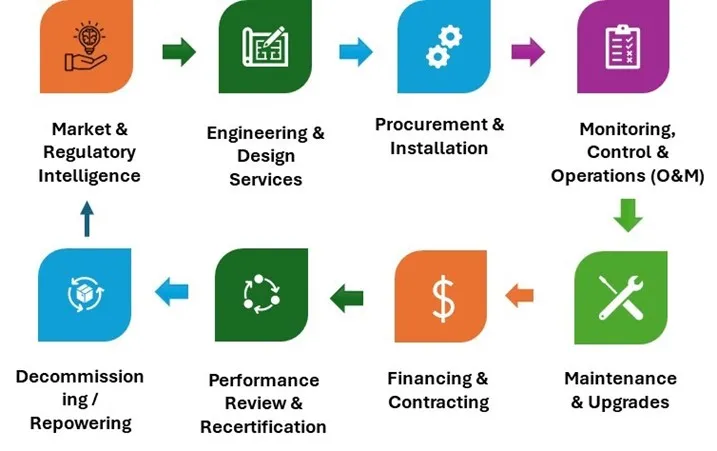
The value chain of the market involves a comprehensive lifecycle approach. It starts with Market & Regulatory Intelligence to understand policy and demand drivers, followed by Engineering & Design Services to develop customized microgrid solutions. Then comes Procurement & Installation of necessary components, and Monitoring, Control & Operations (O&M) to ensure system reliability. Maintenance & Upgrades support longevity, while Financing & Contracting provides viable funding models. The cycle continues with Performance Review & Recertification, and finally, Decommissioning or Repowering based on system viability, feeding back into market intelligence for future improvements.
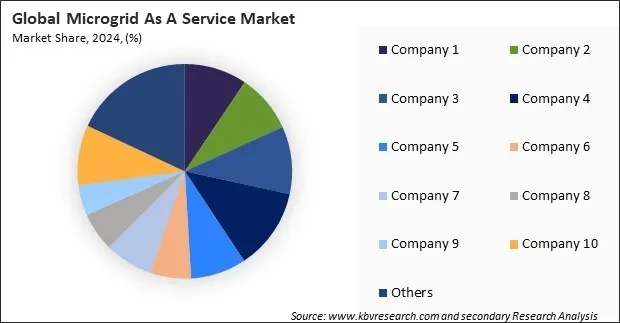
The leading players in the market are competing with diverse innovative offerings to remain competitive in the market. The above illustration shows the percentage of revenue shared by some of the leading companies in the market. The leading players of the market are adopting various strategies in order to cater demand coming from the different industries. The key developmental strategies in the market are Acquisitions, and Partnerships & Collaborations.
Based on grid type, the microgrid as a service market is characterized into grid-connected and islanded. An islanded microgrid operates independently of the main utility grid. It is a self-sufficient energy system that generates, stores, and distributes electricity within a localized area. These microgrids are crucial in remote or isolated locations where connecting to a central grid is either impractical or too expensive.
| Category | Details |
|---|---|
| Use Case Title | Confidential |
| Date | 2025 |
| Entities Involved | Confidential |
| Objective | To establish a fully autonomous, islanded microgrid for uninterrupted electricity access in a remote archipelago community previously dependent on diesel generators. |
| Context and Background | Many off-grid regions lack reliable power and depend heavily on fossil fuels. MaaS enables governments and utilities to provide 24/7 power without burdening communities with capital costs or maintenance obligations. |
| Description | In 2025, Siemens led a project to deploy a 1.8 MW hybrid microgrid on a remote Indonesian island of 1,200 people. The system featured:
|
| Key Capabilities Deployed |
|
| Benefits |
|
| Source | Confidential |
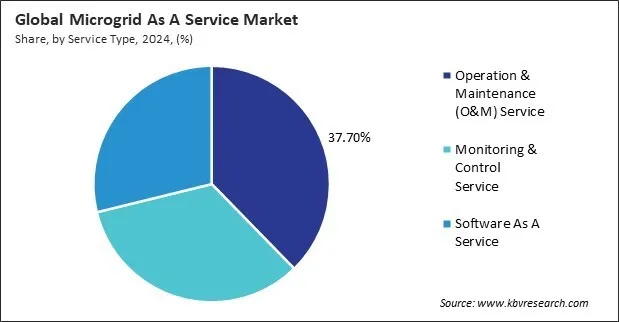
On the basis of service type, the microgrid as a service market is classified into operation & maintenance (O&M) service, monitoring & control service, and software as a service. Monitoring and control services are essential for real-time oversight and dynamic management of microgrid operations. These services provide visibility into system performance, energy flows, and load demands through dashboards and analytics platforms. They enable predictive analytics, remote diagnostics, and immediate response to fluctuations or anomalies in the system.
Free Valuable Insights: Global Microgrid As A Service Market size to reach USD 7.90 Billion by 2032
Region-wise, the microgrid as a service market is analyzed across North America, Europe, Asia Pacific, and LAMEA. The North America segment recorded 35% revenue share in the microgrid as a service market in 2024. North America stands as a prominent region in the microgrid as a service market, driven by advanced energy infrastructure, strong regulatory support, and increasing investments in renewable energy integration. The region is characterized by a high rate of microgrid deployment across commercial, military, and utility sectors.
| Report Attribute | Details |
|---|---|
| Market size value in 2024 | USD 2.76 Billion |
| Market size forecast in 2032 | USD 7.90 Billion |
| Base Year | 2024 |
| Historical Period | 2021 to 2023 |
| Forecast Period | 2025 to 2032 |
| Revenue Growth Rate | CAGR of 14.3% from 2025 to 2032 |
| Number of Pages | 259 |
| Number of Tables | 256 |
| Report coverage | Market Trends, Revenue Estimation and Forecast, Segmentation Analysis, Regional and Country Breakdown, Market Share Analysis, Porter’s 5 Forces Analysis, Company Profiling, Companies Strategic Developments, SWOT Analysis, Winning Imperatives |
| Segments covered | Grid Type, Service Type, Region |
| Country scope |
|
| Companies Included | Eaton Corporation plc, GE Vernova Group, Siemens AG, Schneider Electric SE, Engie SA, NRG Energy, Inc., Hitachi Energy Ltd. (Hitachi, Ltd.), S&C Electric Company, Bloom Energy Corporation, and ABB Ltd. |
By Grid Type
By Service Type
By Geography
This Market size is expected to reach $7.90 billion by 2032.
Rising Energy Demand and Grid Reliability Concerns are driving the Market in coming years, however, Complex Regulatory and Utility Interfacing Challenges restraints the growth of the Market.
Eaton Corporation plc, GE Vernova Group, Siemens AG, Schneider Electric SE, Engie SA, NRG Energy, Inc., Hitachi Energy Ltd. (Hitachi, Ltd.), S&C Electric Company, Bloom Energy Corporation, and ABB Ltd.
The expected CAGR of this Market is 14.3% from 2023 to 2032.
The Grid-connected segment dominated the Market by Grid Type in 2024, thereby, achieving a market value of $5.21 billion by 2032.
The North America region dominated the Market by Region in 2024, thereby, achieving a market value of $2.59 billion by 2032.
Our team of dedicated experts can provide you with attractive expansion opportunities for your business.






 Unique Offerings