“Global Marketing Automation Market to reach a market value of USD 82.14 Billion by 2032 growing at a CAGR of 11.2%”
The Global Marketing Automation Market size is expected to reach USD 82.14 billion by 2032, rising at a market growth of 11.2% CAGR during the forecast period.
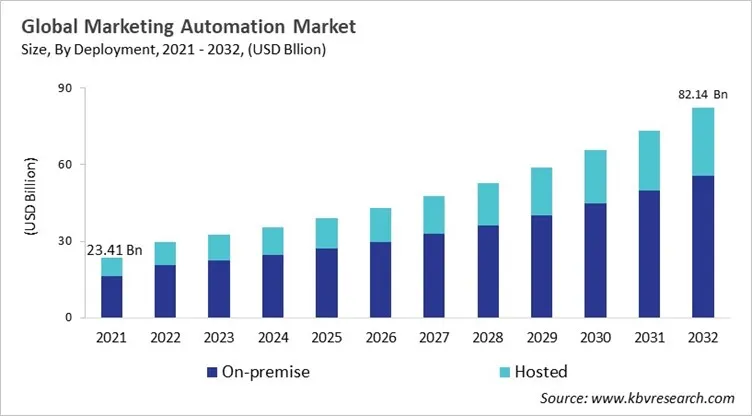
The marketing automation market has become an advanced ecosystem that incorporates artificial intelligence, data, compliance, and customization. Early adoption of call centers and direct mail resulted in the popularity of cloud-based email marketing, multi-channel digital campaigns, and CRM systems. The deployment of machine learning and big data has enabled omnichannel learning customer journey, large-scale customization, and predictive insights. Further, marketing automation is majorly defined by workflow orchestration, generative content tools, and artificial intelligence, which reduces manual work while improving customization and compliance because of stringent data privacy regulations.
The marketing automation market is predicted to be driven by ecosystem integration, compliance, and AI-driven intelligence. Further, companies are now looking for integrated platforms that combine marketing with customer service, productivity tools, and analytics, thereby enhancing speed to market. Regulatory compliance and data privacy have become crucial as providers are integrating content management and government frameworks to build trust. Also, the marketing automation market seems to be highly competitive, with large corporations providing full-scale omnichannel platforms and SMEs offering flexible and affordable tools. Key market players are largely emphasizing customer experience, partnerships, and innovation to position themselves in the market.
The major strategies followed by the market participants are Product Launches as the key developmental strategy to keep pace with the changing demands of end users. For instance, In September, 2025, HubSpot, Inc. unveiled 200+ features, including enhanced Breeze Agents, upgraded Marketing Hub Enterprise, and AI-powered Workspaces. These tools empower SMBs to streamline sales, marketing, and customer support. With AI embedded across its platform, HubSpot helps teams move faster, improve efficiency, and deliver immediate value without large budgets. Additionally, In June, 2025, Salesforce, Inc. unveiled Marketing Cloud Next, integrating Agentforce AI agents across the customer journey. The platform autonomously creates campaigns, manages leads, personalizes engagement, and optimizes performance. Features include campaign creation, real-time two-way communication, lead qualification, and performance monitoring. Available now, with additional tools and SKUs releasing throughout 2025.
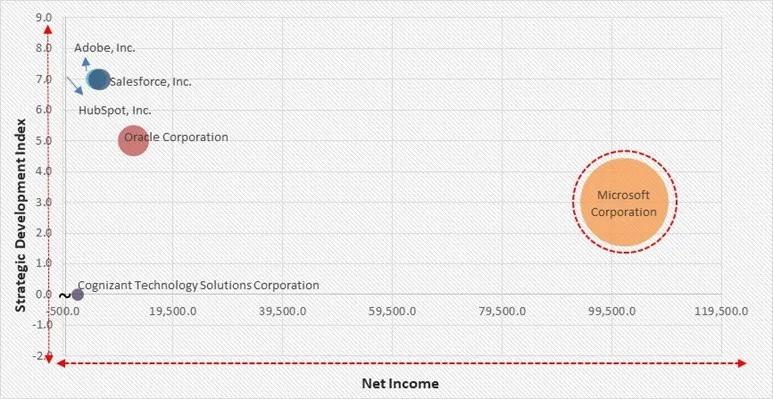
Based on the Analysis presented in the KBV Cardinal matrix; Microsoft Corporation is the forerunner in the Marketing Automation Market. Companies such as Oracle Corporation, Salesforce, Inc., Adobe, Inc. are some of the key innovators in Marketing Automation Market. In March, 2025, Microsoft Corporation unveiled two AI sales agents—Sales Agent and Sales Chat—integrated with Dynamics 365 and Salesforce. These tools automate lead qualification, customer outreach, and insights using natural language, enhancing productivity. Alongside the AI Accelerator for Sales program, Microsoft aims to transform sales processes, competing directly with Salesforce’s Agentforce platform.
At first, the COVID-19 pandemic had only a small negative effect on the marketing automation market. Lockdowns and economic uncertainty led businesses, especially small and medium-sized enterprises, to cut marketing budgets and delay new investments. Companies put off their digital transformation plans so they could focus on the most important tasks. Industries like travel, hospitality, and retail cut back on marketing, which made automation tools less in demand. But the downturn didn't last long. As companies got used to remote work and saw how important it was to connect with customers online, they slowly started to invest in automation again. The market began to recover as companies shifted to digital-first strategies, regaining growth momentum despite earlier setbacks. Thus, the COVID-19 pandemic had a mild negative impact on the market.

Free Valuable Insights: Global Marketing Automation Market size to reach USD 82.14 Billion by 2032
Based on deployment, the marketing automation market is characterized into on-premise and hosted. The hosted segment attained 30% revenue share in the marketing automation market in 2024. The growth is supported by its cost-efficiency and ease of deployment. Cloud-based solutions appeal to businesses of all sizes, especially small and medium enterprises, by eliminating the need for heavy upfront investment and reducing maintenance burdens. The scalability and remote accessibility of hosted platforms make them attractive in today’s digital-first environment, where agility and real-time customer engagement are critical.
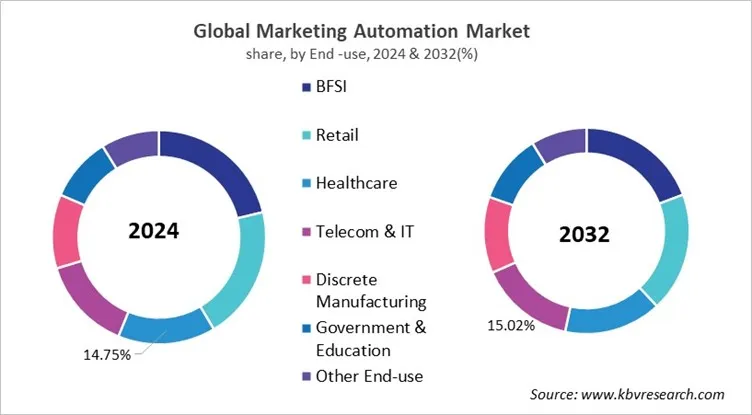
By end-use, the marketing automation market is divided into BFSI, retail, healthcare, telecom & IT, discrete manufacturing, government & education, and others. The retail segment recorded 20% revenue share in the marketing automation market in 2024. Retailers are increasingly using automation to analyze consumer behavior, segment audiences, and create highly targeted campaigns. This not only improves shopping experiences across physical and online channels but also boosts conversion rates and customer loyalty. The rise of e-commerce has further accelerated adoption, as retailers seek scalable solutions to manage high transaction volumes and ensure consistent engagement.
Region-wise, the Marketing Automation Market is analyzed across North America, Europe, Asia Pacific, and LAMEA. In North America and Europe, the marketing automation market is anticipated to grow at a significant rate. This is due to high internet penetration, strong acceptance of data-driven marketing, and improved digital infrastructure. Companies across various sectors like BFSI, retail, technology, and healthcare are widely investing in automation tools to enhance lead nurturing, ROI optimization, and customer engagement. Also, the US has a widespread usage of predictive analytics, omnichannel platforms, and AI. Additionally, the marketing automation market is experiencing positive opportunities. The region benefits from the strict regulations, such as GDPR, which are encouraging businesses to adopt efficient automation solutions. Regional nations like Germany, France, and the UK are largely adapting with the growing demand for SMEs as well as large enterprises seeking to optimize customer journeys.
The Asia Pacific and LAMEA regions are expanding at a high rate in the marketing automation market. This expansion is supported by the growing e-commerce ecosystems, rapid digital transformation, and increasing penetration of smartphones. The regional nations such as Japan, South Korea, India, and China are experiencing significant adoption as companies integrate automation to manage with rising online consumer bases and social media engagement. Also, the growth of tech-driven SMEs and government-supported digitalization initiatives is raising the demand. Moreover, the LAMEA marketing automation market is expected to experience high growth. The corporations in telecom, BFSI, and retail are widely investing in advanced customer engagement platforms. In addition, the growth of e-commerce and the requirement for cost-effective marketing solutions are supporting the marketing automation market.
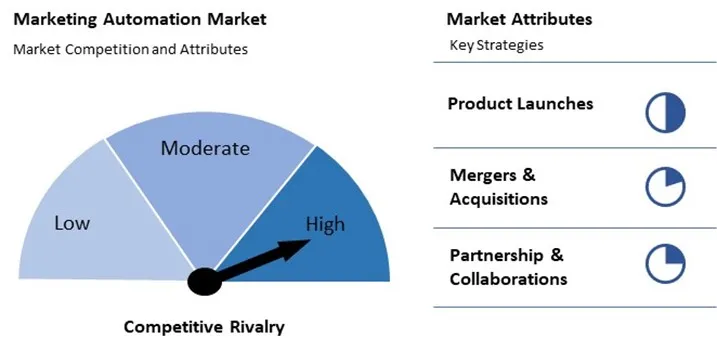
The marketing automation market is highly competitive, driven by rapid technological advancements and increasing demand for personalized customer experiences. Companies are focusing on innovation, AI integration, and data-driven strategies to enhance campaign effectiveness. The market sees continuous entry of new players offering niche solutions, while established providers expand their capabilities. Pricing strategies, ease of integration, and scalability are key differentiators. As businesses across sectors adopt automation tools, competition intensifies, pushing providers to constantly evolve and meet diverse customer needs.
| Report Attribute | Details |
|---|---|
| Market size value in 2025 | USD 38.96 Billion |
| Market size forecast in 2032 | USD 82.14 Billion |
| Base Year | 2024 |
| Historical Period | 2021 to 2023 |
| Forecast Period | 2025 to 2032 |
| Revenue Growth Rate | CAGR of 11.2% from 2025 to 2032 |
| Number of Pages | 587 |
| Number of Tables | 514 |
| Report coverage | Market Trends, Revenue Estimation and Forecast, Segmentation Analysis, Regional and Country Breakdown, Competitive Landscape, Porter’s 5 Forces Analysis, Company Profiling, Companies Strategic Developments, SWOT Analysis, Winning Imperatives |
| Segments covered | Deployment, Enterprise Size, Enterprise Size, Solution, Region |
| Country scope |
|
| Companies Included | HubSpot, Inc., Adobe, Inc., Zoho Corporation Pvt. Ltd., Oracle Corporation, Salesforce, Inc., Microsoft Corporation, Cognizant Technology Solutions Corporation, SAS Institute Inc., Brevo and Keap, Inc. |
By Deployment
By Enterprise Size
By End-use
By Solution
By Geography
The market size is projected to reach USD 82.14 Billion by 2032.
The marketing automation market is projected to grow at a CAGR of 11.2% between 2025 and 2032.
Rising demand for personalized, data-driven customer engagement is fueling the growing adoption of omnichannel marketing strategies.
HubSpot, Inc., Adobe, Inc., Zoho Corporation Pvt. Ltd., Oracle Corporation, Salesforce, Inc., Microsoft Corporation, Cognizant Technology Solutions Corporation, SAS Institute Inc., Brevo and Keap, Inc.
The BFSI segment is generating the Global Marketing Automation Market by End-use in 2024, and would continue to be a dominant market till 2032; thereby, achieving a market value of $15.84 billion by 2032.
The North America region dominated the Global Marketing Automation Market by Region in 2024, and would continue to be a dominant market till 2032; thereby, achieving a market value of $33.20 billion by 2032.
Our team of dedicated experts can provide you with attractive expansion opportunities for your business.







 Unique Offerings