“Global Maritime Safety System Market to reach a market value of USD 60.49 Billion by 2032 growing at a CAGR of 9.7%”
The Global Maritime Safety System Market is expected to reach $60.49 billion by 2032, rising at a market growth of 9.7% CAGR during the forecast period.
The core reasons behind the upgradation of the Maritime Safety System (MSS) are the need for digital transformation and evolving demands of marine operations. The International Maritime Organization (IMO) has started the upgradation of the GMSS. The concept is to surge the new satellite service providers and increase the worldwide coverage. The Combination of MSS with advanced technology like electronic chart, bridge alert system, and meteorological data streams is very crucial for e-navigation and it is changing marine safety into a data backed model.
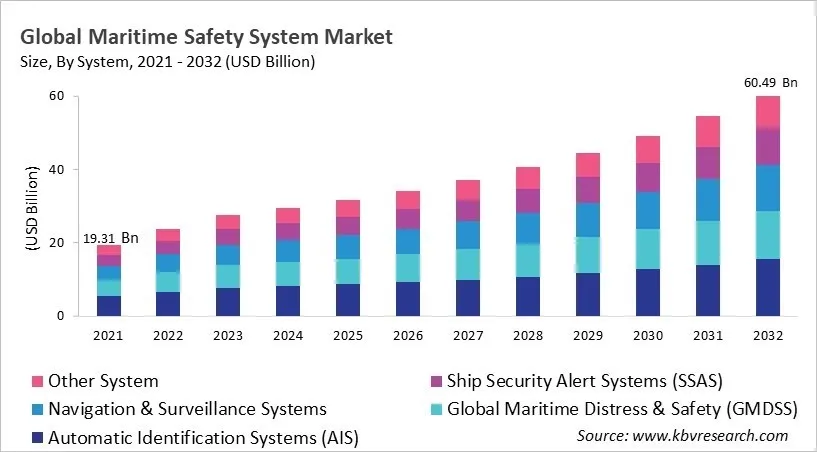
Global marine operations were totally shut down and the market was severely disrupted due to the peak of the COVID-19 pandemic. Ship movements were delayed or cancelled due to port closure, reduced ship traffic, and supply chain breakdown. Many projects were delayed or abandoned which hampered the demand of the maritime safety tools. Declined revenues hampered the installation and innovation of the safety systems. The pandemic also declined the financial support from the government and authorities and the resources were relocated towards public health emergencies. Thus, the COVID-19 pandemic had negative impact on the market.

The expansion of the international marine trade is increasing the demand for the affective safety measures. As per the UN Trade & development (UNCTAD), maritime transport moves over 80% of goods traded worldwide. Also, the share of oil, raw materials, and manufactured goods in global marine freight rose 38% in 2000 to 54% in 2023. As the globalization grows and countries become more & more connected, the demand for the MSS is increasing because of high commercial ship traffic. This rising traffic is making operation complicated, creating choke points on the main on sea routes like Suez Canal, Panama Canal, and Strait of Malacca, increasing the risk of the accidents, product damage, and environment hazards.
Global organizations like international Maritime Organization (IMO) and other regulatory bodies are reviewing and analyzing the maritime industry very diligently. IMO has framed some rules such as the International Convention for the Safety of Life at Sea (SOLAS) which implies that every shipowner and managerial staff of the port should maintain some safety measures. Communication system, Automatic Identification System (AIS) and navigation protocols must be properly installed on both ship and port. Furthermore, the evolving rules and regulations are speeding up the demand for the MSS.
Many stakeholders in the marine industry are concerned about the high costs associated with adopting new marine safety technologies. Radar arrays, AIS transponders, GMDSS, VDRs (voyage data recorder), ECDIS, and integrated surveillance networks are some of the high-cost technologies and tools. Each one requires specific hardware, software and trained operator. Installing all the safety tool and instruments can raise costs hundreds and thousands of dollars up front. This is the reason investors step away and hesitate to fund the innovation.
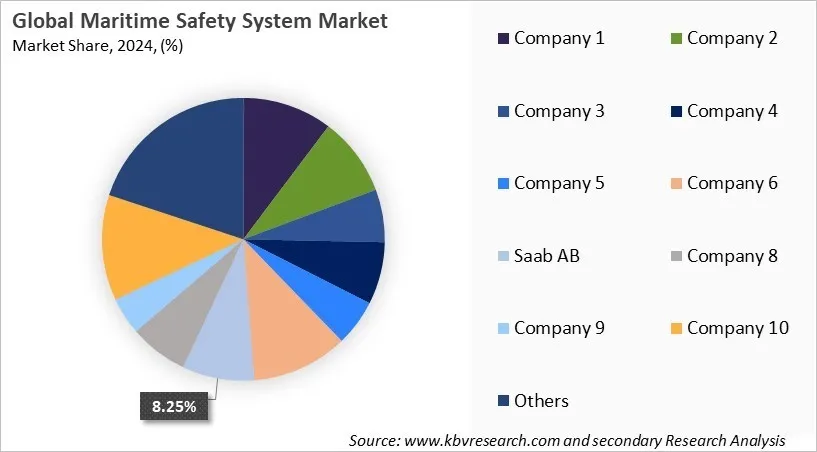
The leading players in the market are competing with diverse innovative offerings to remain competitive in the market. The above illustration shows the percentage of revenue shared by some of the leading companies in the market. The leading players of the market are adopting various strategies to cater to demand coming from the different industries. The key developmental strategies in the market are Acquisitions, and Partnerships & Collaborations.
Based on system, the maritime safety system market is characterized into automatic identification systems (AIS), global maritime distress & safety (GMDSS), navigation & surveillance systems, ship security alert systems (SSAS), and others. The global maritime distress & safety (GMDSS) segment procured 22% revenue share in the maritime safety system market in 2024. Globally maritime distress and safety protocols were set up to make sure that communication is quick and effective during maritime situations. These systems utilize a combination of satellite and land-based technologies to support alerting, coordinate search and rescue efforts, and deliver critical marine safety information to the appropriate personnel.
| Category | Details |
|---|---|
| Use Case Title | Confidential |
| Date | 2025 |
| Entities Involved | Confidential |
| Objective | Reduce delay and improve coordination in maritime distress signaling and response. |
| Context and Background | Legacy radio-based systems lacked coverage and resilience in the Pacific; need arose for satellite-based augmentation. |
| Description | In 2025, Japan Coast Guard and Mitsui OSK Lines modernized GMDSS with satellite failover systems across the Pacific. Automated alerts were linked to AI decision trees for incident classification. The system could dispatch SAR units in real time and eliminate false alerts through smart filtering. |
| Key Capabilities Deployed |
|
| Regions Covered |
|
| Benefits |
|
| Source | Confidential |
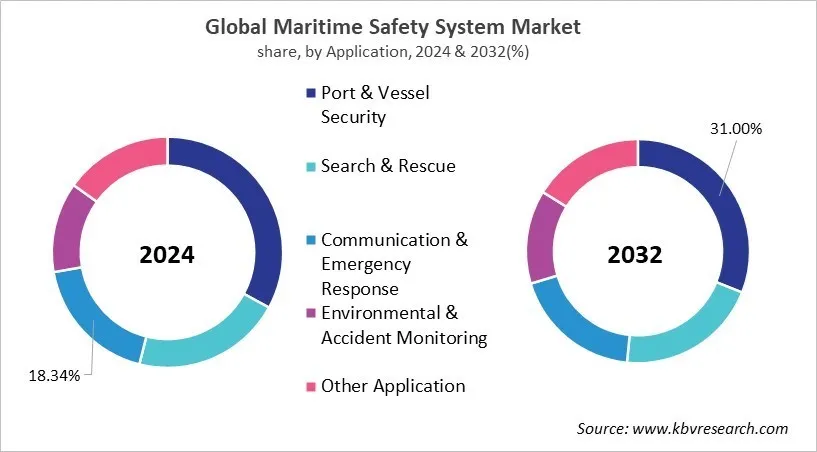
On the basis of application, the maritime safety system market is classified into port & vessel security, search & rescue, communication & emergency response, environmental & accident monitoring, and others. The search & rescue segment recorded 21% revenue share in the maritime safety system market in 2024. The motive of the search & rescue is to discover and provide aid to all those who are in the sea or stuck in an emergency. Satellite communication and position monitoring are the example of the search & rescue segment. They are crucial for minimizing the amount of the accidents and deaths caused by the bad weather, ship problems and human error.
By end use, the maritime safety system market is divided into commercial shipping, naval forces & coast guards, oil & gas (offshore), port authorities, and others. The naval forces & coast guards segment garnered 23% revenue share in the maritime safety system market in 2024. Coast guards and naval forces use marine safety systems to do things like patrol, defend, and search and rescue. These units use the latest surveillance, communication, and threat detection techniques to safeguard national security and marine sovereignty. New safety gear helps detect threats, coordinate emergency responses, and keep an eye on territorial waters.
Based on component, the maritime safety system market is segmented into hardware, hardware, and services. The software segment acquired 25% revenue share in the maritime safety system market in 2024. Software can do centralized monitoring, automation, and data analysis. This makes marine security features work better and fit together better. Some of them are used for predictive maintenance, rescue operations, and tracking ships. Software helps you make better decisions in important situations, speeds up work, and cuts down on mistakes that people make by hand.
Free Valuable Insights: Global Maritime Safety System Market size to reach USD 60.49 Billion by 2032
Region-wise, the maritime safety system market is analyzed across North America, Europe, Asia Pacific, and LAMEA. The North America segment recorded 35% revenue share in the maritime safety system market in 2024. North America has the biggest demand for marine safety systems because it has a lot of money to spend on technology, a strong maritime infrastructure, and better naval capabilities. The area has a strong commercial shipping industry and works hard to keep the seas safe. Government programs, strict rules, and the presence of big companies in the business all contribute to market dominance.
| Report Attribute | Details |
|---|---|
| Market size value in 2024 | USD 29.52 Billion |
| Market size forecast in 2032 | USD 60.49 Billion |
| Base Year | 2024 |
| Historical Period | 2021 to 2023 |
| Forecast Period | 2025 to 2032 |
| Revenue Growth Rate | CAGR of 9.7% from 2025 to 2032 |
| Number of Pages | 464 |
| Number of Tables | 514 |
| Report coverage | Market Trends, Revenue Estimation and Forecast, Segmentation Analysis, Regional and Country Breakdown, Market Share Analysis, Porter’s 5 Forces Analysis, Company Profiling, Companies Strategic Developments, SWOT Analysis, Winning Imperatives |
| Segments covered | System, Application, End Use, Component, Region |
| Country scope |
|
| Companies Included | BAE Systems PLC, L3Harris Technologies, Inc., Elbit Systems Ltd., Honeywell International, Inc., ABB Ltd., Northrop Grumman Corporation, Saab AB, Kongsberg Group, Smiths Group PLC, and Thales Group S.A. |
By System
By Application
By End Use
By Component
By Geography
This Market size is expected to reach $60.49 Billion by 2032.
Increasing Maritime Traffic And Global Trade are driving the Market in coming years, however, High Capital And Maintenance Costs restraints the growth of the Market.
BAE Systems PLC, L3Harris Technologies, Inc., Elbit Systems Ltd., Honeywell International, Inc., ABB Ltd., Northrop Grumman Corporation, Saab AB, Kongsberg Group, Smiths Group PLC, and Thales Group S.A.
The expected CAGR of this Market is 9.7% from 2023 to 2032.
The Commercial Shipping segment led the maximum revenue in the Market by End Use in 2024, thereby, achieving a market value of $22.0 billion by 2032
The North America region dominated the Market by Region in 2024, and would continue to be a dominant market till 2032; thereby, achieving a market value of $20.2 billion by 2032.
Our team of dedicated experts can provide you with attractive expansion opportunities for your business.







 Unique Offerings