“Global Manufacturing Operations Management Software Market to reach a market value of USD 63.22 Billion by 2032 growing at a CAGR of 18.7%”
The Global Manufacturing Operations Management Software Market size is expected to reach $63.22 billion by 2032, rising at a market growth of 18.7% CAGR during the forecast period.
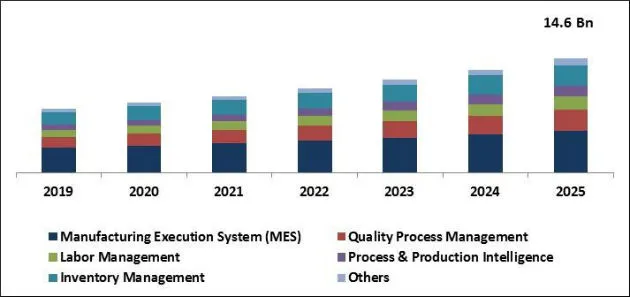
Manufacturing Operations Management software market has developed into integrated, data-driven platforms focused on modern smart-factory strategies. As manufacturers pursue Industry 4.0 initiatives, MOM solutions connect factory-floor data with IoT infrastructure, enterprise systems, digital twins and analytics to allow predictive maintenance, quality assurance, agile decision-making, and predictive maintenance. The manufacturing operations management software market is being driven by accelerating shift toward hybrid and cloud deployments, AI/ML-enabled optimisation, continuous data streams, and demand for compliance, traceability and sustainability. With manufacturers facing globalised operations, regulatory pressures, and supply-chain volatility, MOM platforms have become a strategic enabler of resilience, efficiency, and digital-first operational excellence.
Concurrently, competitive dynamics are intensifying as enterprise software giants, specialised MES/MOM vendors and digital-native providers expand their capabilities through modular platforms, vertical-specific solutions and ecosystem partnerships. Vendors differentiate through industrial domain expertise, strength of IoT and AI integration, deployment flexibility and global scalability. Key strategies include offering scalable, plug-and-play architectures, industry-tailored features for regulated sectors, collaboration with cloud and IoT partners, and subscription-based service models. As manufacturers increasingly prioritise end-to-end connected operations, real-time insight and adaptive production ecosystems, MOM providers that deliver deeply integrated, intelligent and future-ready solutions are best positioned, while those limited to basic execution functionality risk losing relevance.
The major strategies followed by the market participants are Partnerships as the key developmental strategy to keep pace with the changing demands of end users. For instance, In May, 2025, ABB extended its collaboration with Red Hat to enhance process automation systems using Red Hat's open-source platforms. This supports secure, modular deployment of control applications, bridging IT/OT, and advancing capabilities in AI, edge computing, and real-time manufacturing operations management. Moreover, In May, 2025, Schneider Electric partnered with Microsoft to launch an AI-powered industrial copilot and showcased open, software-defined automation, robotics, and motion systems at Automate 2025, enhancing manufacturing flexibility, workforce productivity, and integration with digital factory ecosystems through its EcoStruxure Automation Expert platform.
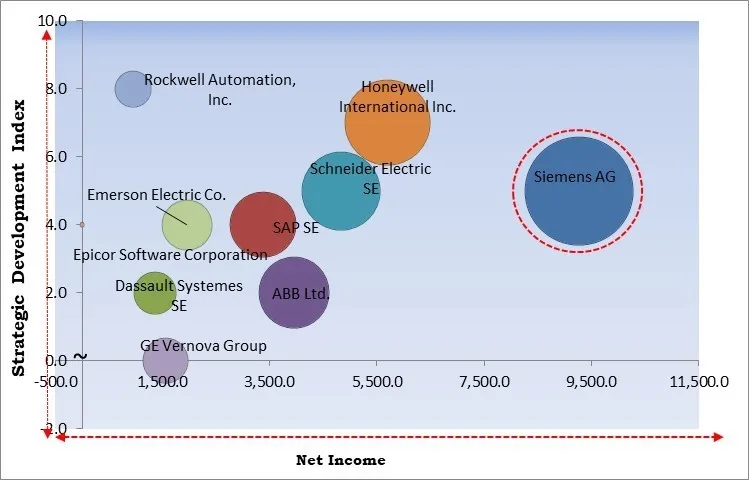
Based on the Analysis presented in the KBV Cardinal matrix; Siemens AG is the forerunners in the Manufacturing Operations Management Software Market. In June, 2025, Siemens and NVIDIA expanded their partnership to integrate AI and accelerated computing into manufacturing. Leveraging Siemens Xcelerator, the collaboration enhances shopfloor automation, predictive maintenance, and digital twins, aligning with the Manufacturing Operations Management Software Market to boost industrial efficiency and innovation. Companies such as Honeywell International Inc., Schneider Electric SE, and ABB Ltd. are some of the key innovators in the Manufacturing Operations Management Software Market.
The COVID-19 pandemic had a negative effect on the Manufacturing Operations Management (MOM) software market. Because many factories had to close and operations slowed down, manufacturers had to focus on short-term crisis management instead of long-term digital transformation projects. System integration, deployments, and training programs were delayed because of problems with the supply chain, a lack of workers, and limits on travel and on-site activities. Declining revenues and reduced IT budgets further constrained investments in software, cloud migration, and infrastructure upgrades, particularly among SMEs. Also, demand for MOM solutions went down because of problems in important end-use industries like automotive, aerospace, and industrial equipment. The pandemic had an immediate effect on market growth that was negative because it caused projects to be delayed, spending to go down, and operations to become more difficult. However, digital transformation will eventually speed up. Thus, the COVID-19 pandemic had a negative impact on the market.

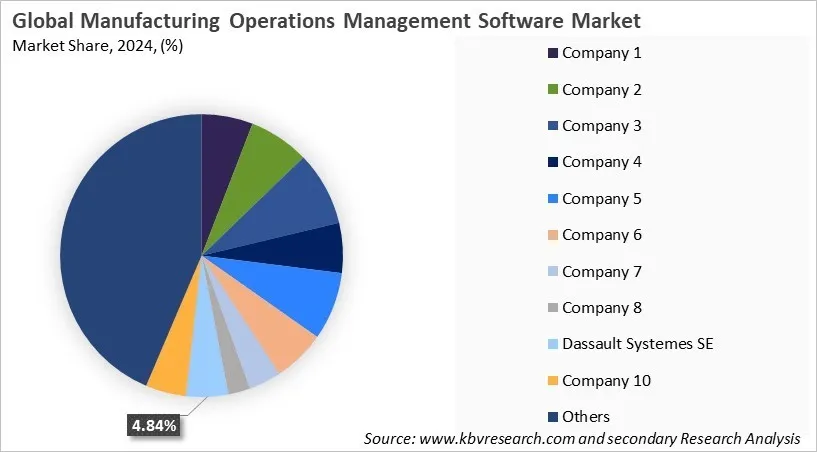
The leading players in the market are competing with diverse innovative offerings to remain competitive in the market. The above illustration shows the percentage of revenue shared by some of the leading companies in the market. The leading players of the market are adopting various strategies in order to cater demand coming from the different industries. The key developmental strategies in the market are Acquisitions, and Partnerships & Collaborations.
Free Valuable Insights: Manufacturing Operations Management Software Market size to reach USD 63.22 Billion by 2032
Based on Deployment, the market is segmented into Cloud and On-Premise. The On-Premise segment acquired 35% revenue share in the market in 2024. This segment reflects the continued need for locally installed manufacturing operations management systems among organizations that prioritize full data control, customized configurations, and tightly secured operational environments. Manufacturers choosing on-premise deployments often operate in highly regulated sectors or manage sensitive production processes requiring strict governance over system access and information storage.
Based on Application, the market is segmented into Quality Management, Manufacturing Execution Systems (MES), Advanced Planning & Scheduling, Inventory Management, Labor Management, Laboratory Management and Other Application. The Manufacturing Execution Systems (MES) segment attained 28% revenue share in the market in 2024. This segment encompasses solutions that manage, monitor, and synchronize shop-floor activities from order release to final product completion. MES applications bridge the gap between enterprise planning tools and real-time manufacturing operations, enabling organizations to oversee production scheduling, equipment utilization, material tracking, and workflow execution with accuracy.
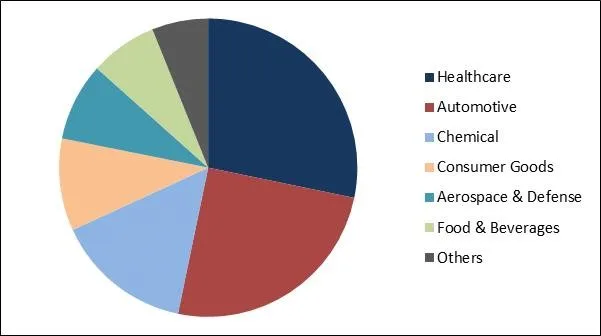
Region-wise, the manufacturing operations management software market is analyzed across North America, Europe, Asia Pacific, and LAMEA. The North America segment recorded 33% revenue share in the market in 2024. The manufacturing operations management software market is predicted to experience prominent growth in North America and Europe. The market is driven by advanced automation, strong adoption of Industry 4.0, and regulatory needs for traceability and quality. In North America, especially the US, manufacturers in industries like pharmaceuticals, food & beverages, automotive, and aerospace are investing in AI-supported analytics, cloud-based MOM platforms, and digital-twin technologies to modernize ageing production systems and improve resilience against supply-chain disruptions. Moreover, Europe market is expanding, supported by sustainability mandates, stringent compliance standards, and large-scale government-supported digitalization initiatives such as those in the Nordics, Germany, the UK, and France. The regions are characterised by high penetration of integrated MOM-ERP-IoT ecosystems, strong demand for hybrid cloud architectures, multi-site deployment that supports cybersecurity, operational visibility, and continuous advancements.
In the Asia Pacific and LAMEA regions, the manufacturing operations management software market is anticipated to witness substantial growth. This is because of competitiveness and labour productivity, and digital transformation to enhance efficiency. Asia Pacific-supported by South Korea, Japan, China, and India-gets advantages from strong investments in smart factories, widespread adoption of IoT-enabled production systems, and rapid industrial expansion. The region’s diverse landscape, ranging from automotive to high-tech electronics and consumer goods, is driving demand for cloud-ready, scalable MOM solutions suitable for both SMEs as well as large enterprises. Additionally, LAMEA is experiencing gradual growth with increasing adoption in sectors like oil & gas, food processing, automotive, and developing manufacturing clusters prioritizing automation and operational visibility. Rising interest in cloud deployments, demand for traceability, government industrial diversification programs, and compliance are creating growth opportunities for MOM vendors across the emerging economies.
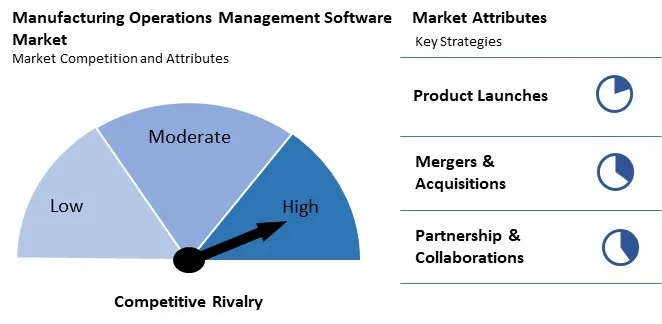
There is a lot of competition in the Manufacturing Operations Management (MOM) software market, and it changes quickly because of new technologies and changing needs in the industry. Key players are trying to stand out by offering innovative, integrated, and user-friendly solutions. Market competition stresses improving operational efficiency, real-time visibility, and scalability. To get ahead, companies put money into strategic partnerships, advanced analytics, and automation tools. Overall, the market is always changing, smart manufacturing technologies are quickly adopted, and there is a strong focus on products that put customers first.
| Report Attribute | Details |
|---|---|
| Market size value in 2025 | USD 19.04 Billion |
| Market size forecast in 2032 | USD 63.22 Billion |
| Base Year | 2024 |
| Historical Period | 2021 to 2023 |
| Forecast Period | 2025 to 2032 |
| Revenue Growth Rate | CAGR of 18.7% from 2025 to 2032 |
| Number of Pages | 713 |
| Number of Tables | 584 |
| Report coverage | Market Trends, Revenue Estimation and Forecast, Segmentation Analysis, Regional and Country Breakdown, Competitive Landscape, Market Share Analysis, Porter’s 5 Forces Analysis, Company Profiling, Companies Strategic Developments, SWOT Analysis, Winning Imperatives |
| Segments covered | Enterprise Size, Component, Deployment, Application, End Use, Region |
| Country scope |
|
| Companies Included | ABB Ltd., Schneider Electric SE, Siemens AG, SAP SE, Rockwell Automation, Inc., Honeywell International Inc., GE Vernova Group, Epicor Software Corporation, Dassault Systemes SE, and Emerson Electric Co. |
By Enterprise Size
By Component
By Deployment
By Application
By End User
By Geography
The market size is projected to reach USD 63.22 Billion by 2032.
The manufacturing operations management software market is projected to grow at a CAGR of 18.7% between 2025 and 2032.
Industrial digital transformation and smart manufacturing adoption are driven by a rising emphasis on quality, compliance, and traceability.
ABB Ltd., Schneider Electric SE, Siemens AG, SAP SE, Rockwell Automation, Inc., Honeywell International Inc., GE Vernova Group, Epicor Software Corporation, Dassault Systemes SE, and Emerson Electric Co.
The Quality Management segment led the maximum revenue in the Global Manufacturing Operations Management Software Market by Application in 2024, thereby, achieving a market value of $17.9 billion by 2032.
The North America region dominated the Global Manufacturing Operations Management Software Market by Region in 2024, and would continue to be a dominant market till 2032; thereby, achieving a market value of $20.2 billion by 2032.
Our team of dedicated experts can provide you with attractive expansion opportunities for your business.







 Unique Offerings