“Global Legacy IT System Modernization Market to reach a market value of USD 50.32 Billion by 2032 growing at a CAGR of 17.2%”
The Global Legacy IT System Modernization Market size is estimated at $16.58 billion in 2025 and is expected to reach $50.32 billion by 2032, rising at a market growth of 17.2% CAGR during the forecast period (2025-2032). This Growth is being fueled by faster digital transformation projects, more cyber threats, the move to the cloud, and the need to cut costs on operations that come with old infrastructure. Businesses in banking, healthcare, government, and manufacturing are putting agile, scalable platforms at the top of their lists.
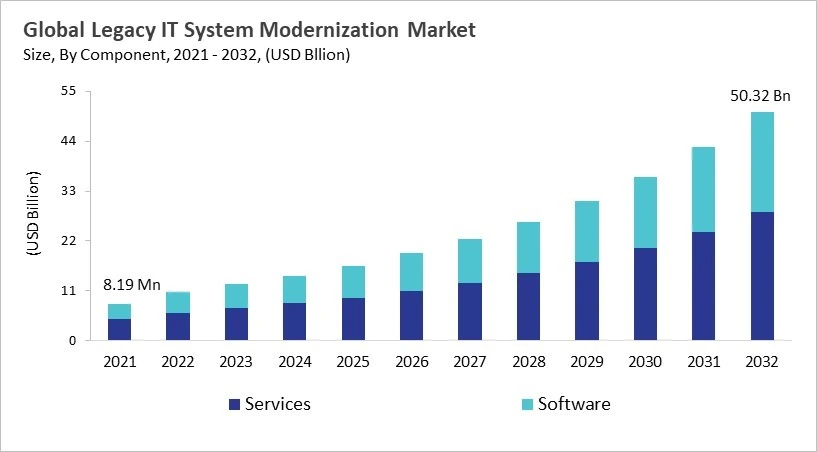
Legacy IT system modernization has developed from reactive maintenance of outdated systems into an organization-wide transformation aligned with digital business goals. It involves rethinking workflows and technologies like decomposing monolithic systems into microservices, migrating to cloud platforms, and adopting API-first designs-to enhance scalability, agility, cost-efficiency, and security. In both enterprise and government sectors, modernization is backed by high maintenance costs, increasing security risks, and talent shortages in legacy technologies, and the requirement to integrate advanced capabilities such as analytics and AI.
Recent modernization trends prioritize incremental transformation, cloud-native adoption, and intelligent automation. Enterprises largely favor phased approaches like refactoring, encapsulation, and hybrid migrations-to maintain business continuity and reduce risk, often using patterns like gradual system replacement. Cloud platforms provide modern development toolchains, scalable infrastructure, and security controls, while automation and AI surge code analysis, discovery, testing, refactoring, and CI/CD pipelines. Key market providers like IBM and Google Cloud promote cloud-centric strategies that align modernization with long-term business value. The legacy IT systems modernization market is defined by competition around advisory expertise, platform innovation, and AI-driven automation that allow safer, faster, and more business-aligned legacy transformation.
The major strategies followed by the market participants are Partnerships as the key developmental strategy to keep pace with the changing demands of end users. For instance, In October, 2025, Infosys Limited teamed up with Telenor Shared Services to implement Oracle Fusion Cloud HCM, replacing outdated HR systems with a unified cloud platform. This transformation enhances workforce management, automation, and compliance, showcasing the growing trend of modernizing legacy HR infrastructures to achieve greater scalability and operational agility. Moreover, In August, 2025, Cognizant Technology Solutions Corporation announced the partnership with Temenos to modernize Australia’s banking sector through Temenos’ cloud-native Country Model Bank. This initiative focuses on replacing outdated core systems with scalable digital infrastructure, enhancing operational efficiency, compliance, and customer experience while accelerating digital transformation in financial institutions.
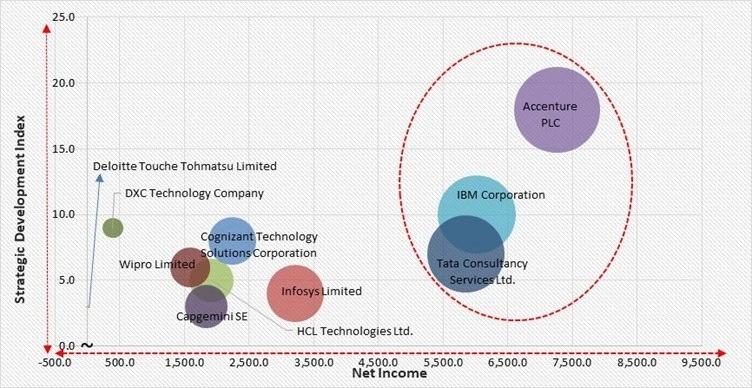
Based on the Analysis presented in the KBV Cardinal matrix; Accenture PLC, IBM Corporation, and Tata Consultancy Services Ltd. are the forerunners in the Legacy IT System Modernization Market. In October, 2025, Accenture PLC teamed up with AWS to transform public sector services using AI and cloud technologies. Their solutions aim to enhance workforce productivity, improve citizen services, and modernize defense capabilities, addressing challenges associated with legacy systems through secure, scalable cloud infrastructures. Companies such as Infosys Limited, Cognizant Technology Solutions Corporation, HCL Technologies Ltd. are some of the key innovators in Legacy IT System Modernization Market.
The COVID-19 pandemic had short-term adverse impacts on the market for modernizing legacy IT systems because businesses shifted their focus to things like business continuity, enabling remote work, and getting ready for cyberattacks. Due to budget reallocations and cost-cutting measures, large-scale transformation projects, especially those requiring significant upfront investment, were put on hold. Lockdowns, limited site access, and supply chain problems caused delays in upgrading infrastructure and moving systems. Small and medium-sized businesses were hit the hardest because they were under significant financial stress. Larger companies, on the other hand, were careful about investing because the economy was unstable. As a result, modernization efforts slowed down for a while because companies put off making strategic decisions until the market became more stable. Thus, the COVID-19 pandemic had a negative impact on the market.

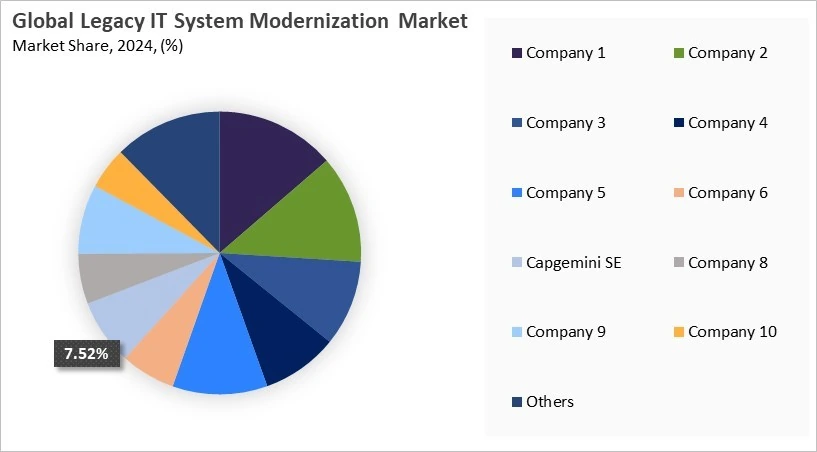
The leading players in the market are competing with diverse innovative offerings to remain competitive in the market. The above illustration shows the percentage of revenue shared by some of the leading companies in the market. The leading players of the market are adopting various strategies in order to cater demand coming from the different industries. The key developmental strategies in the market are Acquisitions, and Partnerships & Collaborations.
Based on Component, the market is segmented into Services and Software. The Software segment acquired 42.54% revenue share in the market in 2024. The software segment in the Legacy IT System Modernization Market focuses on tools and platforms designed to automate, accelerate, and simplify the modernization of outdated systems. This segment includes application modernization platforms, middleware, integration software, cloud migration tools, API management solutions, and DevOps-enabling technologies.
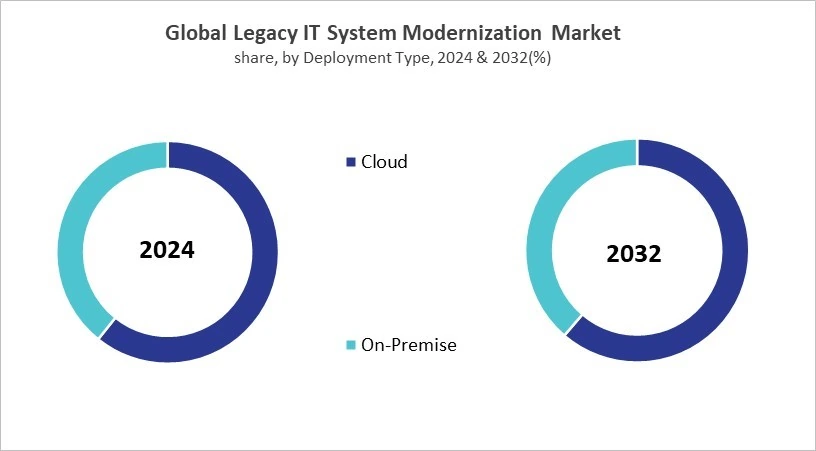
Based on Deployment Type, the market is segmented into Cloud and On-Premise. The On-Premise segment acquired 39.27% revenue share in the market in 2024. The on-premise segment in the Legacy IT System Modernization Market remains significant for organizations that require greater control over their IT environments and data assets. On-premise deployment is commonly adopted by enterprises operating in highly regulated industries or those with strict data sovereignty, security, and compliance requirements.
Based on Enterprise Size, the market is segmented into Large Enterprises and Small & Medium Enterprises. The Small & Medium Enterprises segment acquired 34.07% revenue share in the market in 2024. The small and medium enterprises segment in the Legacy IT System Modernization Market reflects the growing need for agility, cost efficiency, and digital enablement among organizations with limited IT resources. SMEs often rely on legacy systems that were implemented to support basic operational needs but now hinder scalability, performance, and integration with modern digital tools.
Free Valuable Insights: Legacy IT System Modernization Market Size to reach $50.32 by 2032
Region-wise, the Legacy IT System Modernization Market is analyzed across North America, Europe, Asia Pacific, and LAMEA. The North America segment recorded 36.90% revenue share in the market in 2024. The legacy IT systems modernization market is estimated to expand at a significant rate in the North America and Europe regions. The market is driven by a dense concentration of large enterprises with complex legacy estates, widespread cloud adoption, significant public sector IT modernization mandates and funding, and strong private-sector digital transformation initiatives, particularly in Canada and the United States. Government, healthcare, and financial services drive the market, with advanced technologies like hybrid cloud deployments, AI-assisted tools, and API-centric architectures surging modernization efforts. Moreover, Europe legacy IT systems modernization market is expected to grow at a rapid rate. The market is propelled by regulatory drivers like digital sovereignty initiatives and GDPR that compel enterprises to assure data protection, compliance, and operational efficiency. The European region is leading modernization deployment, often favoring hybrid cloud strategies that align with stringent data governance requirements.
In the Asia Pacific and LAMEA region, the legacy IT systems modernization market is projected to capture prominent growth during the forecast period. The market is driven by rapid digitalization in developing countries such as Japan, China, India, and Southeast Asia, substantial government-led IT infrastructure investments, and accelerating cloud adoption across industries. The market growth is supported by elements including cost-effective rehosting in modernization journeys and a transformation toward digital-first strategies. Moreover, the LAMEA legacy IT systems modernization market is anticipated to grow substantially, propelled by rising digital government initiatives and modernization demand, especially in South Africa, Brazil, and the UAE.
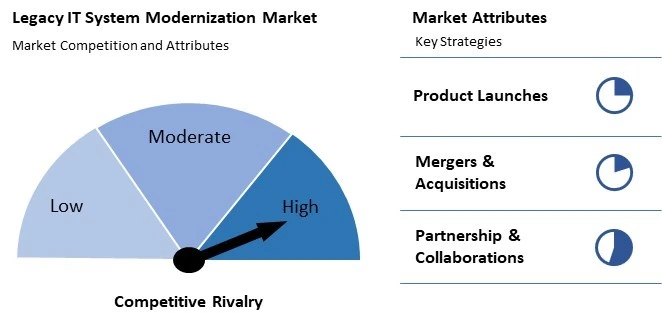
The market for modernizing outdated IT systems is very competitive and driven by new ideas, as different industries' digital transformation priorities change. Providers compete by offering different ways to modernize, expertise in moving to the cloud, automation tools, cybersecurity integration, and solutions that are specific to their industry. Focusing on reducing operational disruption while improving scalability and performance makes competition even stronger. Strategic partnerships, platform-based approaches, and service models that focus on outcomes also have an effect on positioning. As businesses put more value on being flexible and strong, the competition is all about providing cost-effective, safe, and future-proof modernization paths that are tailored to complicated legacy environments.
| Report Attribute | Details |
|---|---|
| Market size value in 2025 | USD 16.58 Billion |
| Market size forecast in 2032 | USD 50.32 Billion |
| Base Year | 2024 |
| Historical period | 2021 to 2023 |
| Forecast Period | 2025 to 2032 |
| Revenue Growth Rate | CAGR of 17.2% from 2025 to 2032 |
| Number of Pages | 680 |
| Tables | 568 |
| Report Coverage | Market Trends, Revenue Estimation and Forecast, Segmentation Analysis, Regional and Country Breakdown, Competitive Landscape, Market Share Analysis, Porter’s 5 Forces Analysis, Company Profiling, Companies Strategic Developments, SWOT Analysis, Winning Imperatives |
| Segments Covered | Component, Deployment Type, Enterprise Size, Modernization Approach, End-User Industry, Region |
| Country Scope |
|
| Companies Included | Accenture PLC, IBM Corporation, Cognizant Technology Solutions Corporation, Infosys Limited, Tata Consultancy Services Ltd., Deloitte Touche Tohmatsu Limited, Capgemini SE, Wipro Limited, HCL Technologies Ltd. (HCL Enterprises), and DXC Technology Company |
By Component
By Deployment Type
By Enterprise Size
By Modernization Approach
By End-User Industry
By Geography
Our team of dedicated experts can provide you with attractive expansion opportunities for your business.






 Unique Offerings