“Global Learning Management System Market to reach a market value of USD 108.30 Billion by 2032 growing at a CAGR of 19.9%”
The Global Learning Management System Market size is expected to reach USD 108.30 billion by 2032, rising at a market growth of 19.9% CAGR during the forecast period.
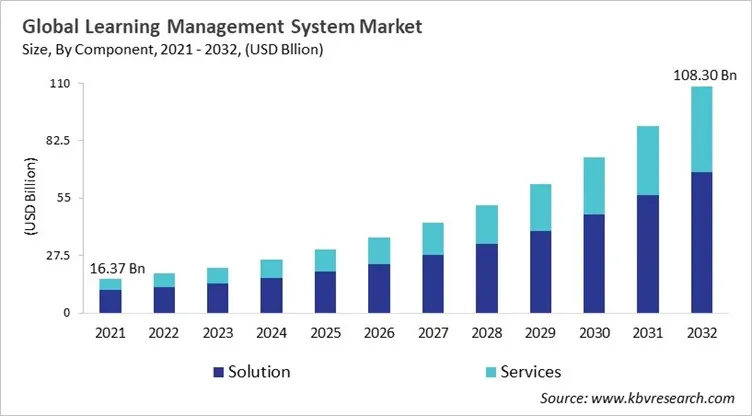
The learning management system market has recently developed into sophisticated, interactive platforms that support customized, data-driven learning for both enterprises as well as educational institutions. LMS platforms focus on assessment tracking, document sharing, and course hosting, supported by early digitization initiatives in Europe and North America. Government-supported programs promoting workforce development, online education, and digital literacy have surged the adoption of LMS platforms. Further, OEMs and technology providers have expanded solutions to accommodate mobile accessibility, remote learning, and cloud-based delivery. Learning management system (LMS) platforms incorporated features like multi-format content support, gamification, and real-time analytics, allowing employees, trainers, and students to engage in flexible and efficient learning experiences. The growth of adaptive learning, AI and integration with enterprise systems has evolved LMS into a critical tool for competency tracking, performance optimization, and skill development across several industries.
The learning management system market is growing substantially, supported by market trends including hybrid & remote learning ecosystems, AI-driven adaptive learning, and integration with wider digital infrastructures. Providers now offer predictive analytics, automated assessment tools, and smart recommendation engines, improving learning personalization and efficiency. Nowadays, hybrid learning models combining online content, virtual classrooms, and mobile apps with hybrid learning models have become standard, while HR systems, productivity tools, and content libraries enable enterprises and institutions to create unified learning environments. Market players are opting for strategies including cloud-based deployment, continuous platform innovation, strategic partnerships with tech companies and educational institutions, and regional customization to meet regional regulatory and language requirements. Competition in the learning management system market is driven by content versatility, service support, user experience, and innovation, with providers differentiating themselves through modular pricing, integration capabilities, and accessibility, thereby resulting in a rapidly developing ecosystem for corporate training and digital education.
The major strategies followed by the market participants are Product Launches as the key developmental strategy to keep pace with the changing demands of end users. For instance, Two news of any two random companies apart from leaders and key innovators. In October, 2024, Udemy, Inc. unveiled AI-driven features, including AI Assistant and Skills Mapping, to enhance personalized learning. These tools help enterprises identify key skills, streamline training, and boost workforce readiness. With AI-powered guidance and automation, Udemy accelerates upskilling, improving productivity and engagement for its 16,000 enterprise customers worldwide. Additionally, In October, 2024, Moodle Pty Ltd unveiled Moodle LMS 4.5 with 250+ new features, it enhances learning through AI, refined course organization, and improved tools. The new AI subsystem integrates with multiple providers, ensuring flexibility, security, and accessibility. AI-powered text/image generation streamlines content creation, while learners gain control, transparency, and digital literacy skills.
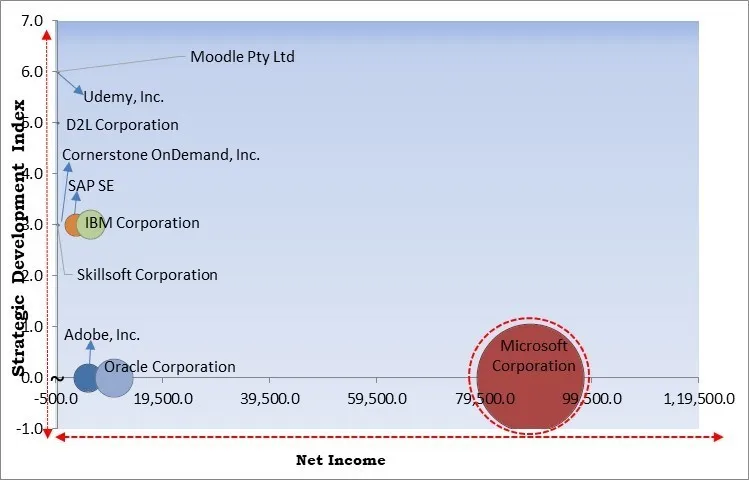
Based on the Analysis presented in the KBV Cardinal matrix; Microsoft Corporation is the forerunners in the Learning Management System Market. Companies such as Oracle Corporation, IBM Corporation, and Adobe, Inc. are some of the key innovators in Learning Management System Market. In October, 2023, IBM Corporation unveiled a refined IBM Learning Subscription, integrating certification vouchers, a modernized interface, and an expanded content library for seamless skill development. Designed from client insights, it enhances accessibility and usability.
The COVID-19 pandemic sped up the LMS market in a good way by making people quickly use remote and digital learning during lockdowns. Schools and other educational organizations used LMS platforms to keep learning even when they were closed. There was a rise in demand for cloud-based, scalable solutions that could support virtual classrooms, tests, and content delivery. More people using the platform led to more money being spent on advanced features like learning analytics and tools for working together. As companies focused on remote upskilling and compliance, corporate training programs grew. Across all industries, LMS platforms helped keep workers productive. The pandemic also sped up the long-term shift to digital technology, making LMS solutions a key part of modern education and corporate training systems.

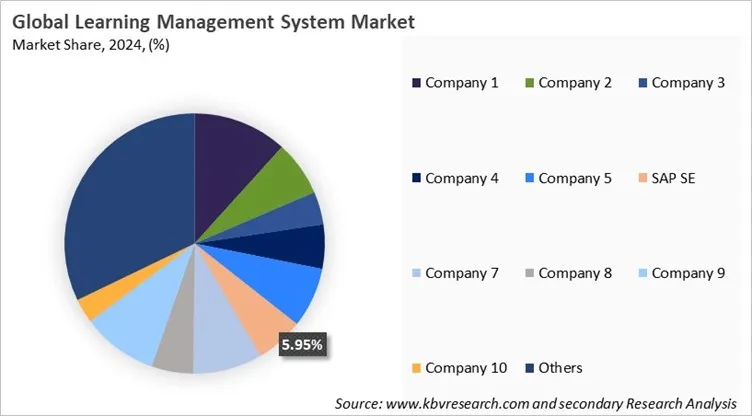
The leading players in the market are competing with diverse innovative offerings to remain competitive in the market. The above illustration shows the percentage of revenue shared by some of the leading companies in the market. The leading players of the market are adopting various strategies in order to cater demand coming from the different industries. The key developmental strategies in the market are Acquisitions, and Partnerships & Collaborations.
Free Valuable Insights: Learning Management System Market size to reach USD 108.30 Billion by 2032
Based on component, the learning management system market is characterized into solution and services. The services segment attained 34% revenue share in the learning management system market in 2024. This is supporting the successful deployment and ongoing optimization of LMS platforms. These services include consulting, implementation, system integration, training, and technical support, helping organizations tailor learning systems to specific operational and educational objectives. Service providers play a critical role in ensuring smooth adoption, high user engagement, and long-term platform performance.
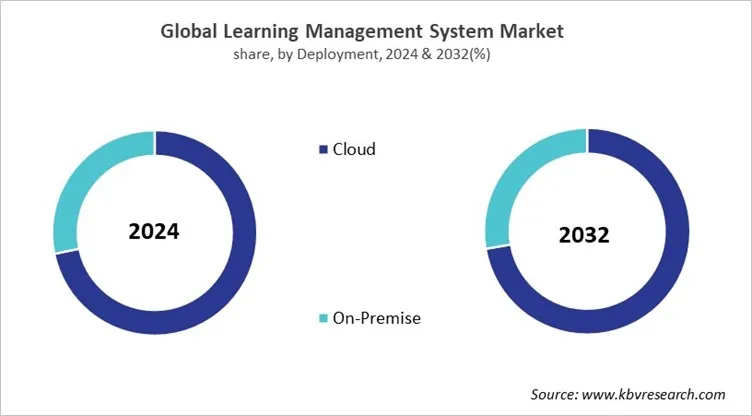
On the basis of deployment, the learning management system market is classified into cloud and on-premise. The on-premise segment recorded 28% revenue share in the learning management system market in 2024. This is driven by organizations that prioritize data security, customization, and control over internal infrastructure. This deployment model is commonly used by government agencies, defense organizations, and enterprises operating in regulated industries. On-premise LMS solutions allow organizations to manage sensitive information internally while tailoring system functionalities to specific operational and compliance requirements.
Region-wise, the Learning management system market is analyzed across North America, Europe, Asia Pacific, and LAMEA. The North America segment recorded 36% revenue share in the Learning management system market in 2024. In the North America and Europe regions, the learning management system (LMS) market is predicted to grow at a substantial rate. The market is driven by early adoption of online education, strong government initiatives promoting digital learning, and widespread digital infrastructure. Enterprises and educational institutions in these regions leverage learning management system platforms for compliance training, remote education, interactive learning, and workforce upskilling. Governments have supported the usage of cloud-based, AI-driven, and mobile-accessible LMS solutions through policies promoting lifelong learning, hybrid education models, and digital literacy. Technology providers and OEMs partner with enterprises, universities, and public-sector agencies to deliver secure, scalable, and interoperable LMS solutions. The market is intensively competitive with providers emphasizing on customized learning paths, advanced features, improved analytics capabilities, and integration with enterprise systems.
The learning management system market is witnessing substantial growth across the Asia Pacific and LAMEA region. This is because of rising digital adoption in enterprise training and education, government-led initiatives to improve digital learning infrastructure, and rising mobile connectivity. Nations like Brazil, South Africa, China, and India are actively promoting skill development, remote training programs, and e-learning, thereby creating demand for cloud-based, flexible, and multilingual LMS platforms. Enterprises are integrating LMS solutions to support compliance, workforce training, and employee engagement, while educational institutions use them for hybrid education models and remote learning. OEMs focus on scalable, cost-effective, and regionally personalized solutions that comply with regional regulations and language requirements. The market competition is driven by both global and regional vendors, with an emphasize on integration capabilities, usability, and regional support networks to expand adoption across the diverse professional and educational landscape.
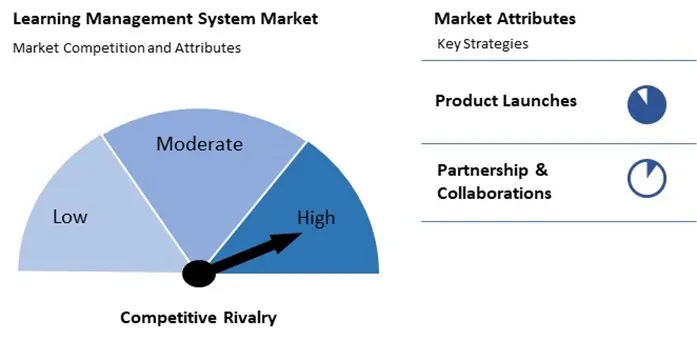
Competition in the Learning Management System (LMS) market is intense, driven by increasing demand for innovative, scalable, and user-friendly solutions. Vendors compete on features such as ease of use, customization, analytics, mobile access, and integration capabilities. Price and customer support also influence buyer decisions, with organizations seeking cost-effective yet robust platforms. Rapid technological advancements, including AI and adaptive learning, further fuel competitive differentiation. As digital learning continues to grow, market rivalry remains strong with ongoing innovation and service enhancements.
| Report Attribute | Details |
|---|---|
| Market size value in 2025 | USD 30.42 Billion |
| Market size forecast in 2032 | USD 108.30 Billion |
| Base Year | 2024 |
| Historical Period | 2021 to 2023 |
| Forecast Period | 2025 to 2032 |
| Revenue Growth Rate | CAGR of 19.9% from 2025 to 2032 |
| Number of Pages | 638 |
| Number of Tables | 463 |
| Report coverage | Market Trends, Revenue Estimation and Forecast, Segmentation Analysis, Regional and Country Breakdown, Competitive Landscape, Market Share Analysis, Porter’s 5 Forces Analysis, Company Profiling, Companies Strategic Developments, SWOT Analysis, Winning Imperatives |
| Segments covered | Component, Deployment, Enterprise Size, Delivery Mode, End-use, Region |
| Country scope |
|
| Companies Included | Cornerstone OnDemand, Inc. (Clearlake Capital Group, L.P.), D2L Corporation, Adobe, Inc., Microsoft Corporation, Oracle Corporation, SAP SE, Skillsoft Corporation, Udemy, Inc., Moodle Pty Ltd, IBM Corporation |
By Component
By Deployment
By Enterprise Size
By Delivery Mode
By End-use
By Geography
This Market size is expected to reach USD 108.30 billion by 2032.
The learning management system market is projected to grow at a CAGR of 19.9% between 2025 and 2032.
Growing digitalization of education and training ecosystems, driving the need for continuous workforce skill development.
Cornerstone OnDemand, Inc. (Clearlake Capital Group, L.P.), D2L Corporation, Adobe, Inc., Microsoft Corporation, Oracle Corporation, SAP SE, Skillsoft Corporation, Udemy, Inc., Moodle Pty Ltd, IBM Corporation
The Cloud segment led the Global Learning Management System Market by Deployment in 2024; thereby, achieving a market value of $78.27 billion by 2032.
The North America region dominated the Global Learning Management System Market by Region in 2024, and would continue to be a dominant market till 2032; thereby, achieving a market value of $36.99 billion by 2032.
Our team of dedicated experts can provide you with attractive expansion opportunities for your business.
















 Unique Offerings