“Global LCP Based Molded Interconnect Devices Market to reach a market value of USD 2.33 Billion by 2032 growing at a CAGR of 17%”
The Global LCP Based Molded Interconnect Devices Market size is expected to reach USD 2.33 billion by 2032, rising at a market growth of 17.0% CAGR during the forecast period.
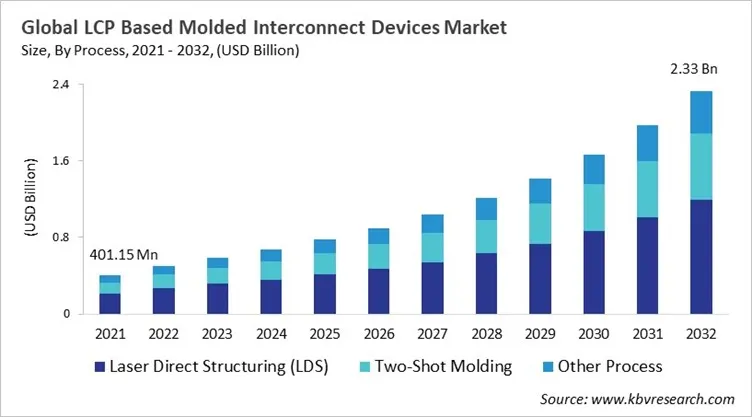
Molded Interconnect Devices (MIDs) have shifted modern electronics by deploying mechanical and electrical functions into a single 3D structure, eliminating the requirement of separate circuit boards and connectors. The advent of Liquid Crystal Polymer as a base material marked a substantial milestone, offering better chemical, thermal, and dimensional properties perfect for high-precision manufacturing. The integration of Laser Direct Structuring has also revolutionized production, enabling scalable and intricate metallization on complex surfaces. As the partnership between material scientists, engineers, and polymer chemists deepened, LCP-driven MIDs developed into essential components across various sectors-allowing miniaturized, high-performance devices in telecommunications, medical technologies, and automotive systems.
The LCP-based molded interconnect devices market is anticipated to grow, supported by elements including rising industrial adoption, rapid technological advancement, and strategic partnerships. Furthermore, trends like design automation, structuring, precision laser, and the usage of LCP in high-reliability industries such as aerospace, healthcare, and automotive are expanding the LCP-based molded interconnect devices market’s growth. Key players are pursuing intensive R&D partnerships, customer-centric strategies, and vertical integration to improve streamline design, material performance, and assure quality consistency. The competition in the market is intensifying with large companies acquiring regional specialists. Reliability, innovation, and cross-sector partnerships are transforming LCP-based MIDs into an essential technology for the next generation of durable, compact, and smart electronic systems.
The COVID-19 pandemic severely disrupted the LCP-based molded interconnect devices (MID) market due to supply chain breakdowns, factory shutdowns, and shortages of key raw materials like high-performance LCP polymers. Production slowdowns, transportation delays, and increased costs affected manufacturers across consumer electronics, automotive, and industrial sectors. Demand from these industries declined sharply as lockdowns reduced production and consumer spending, leading to postponed projects and investments. R&D activities were hindered by travel restrictions and remote work, slowing innovation and product development. The crisis exposed supply chain vulnerabilities and overdependence on specific regions, resulting in long-term challenges in procurement, quality control, and inventory management, even as the market gradually recovered with resumed operations. Thus, the COVID-19 pandemic had a negative impact on the market.

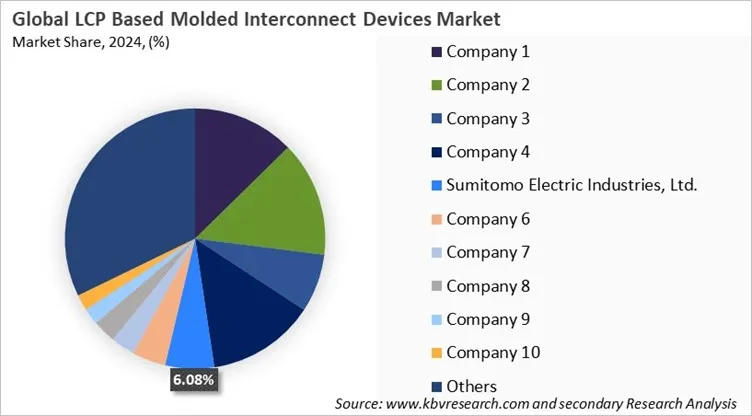
The leading players in the market are competing with diverse innovative offerings to remain competitive in the market. The above illustration shows the percentage of revenue shared by some of the leading companies in the market. The leading players of the market are adopting various strategies in order to cater demand coming from the different industries. The key developmental strategies in the market are Acquisitions, and Partnerships & Collaborations.
Based on process, the LCP based molded interconnect devices market is characterized into laser direct structuring (LDS, two-shot molding, and others. The two-shot molding segment attained 29% revenue share in the LCP Based Molded Interconnect Devices Market in 2024. The two-shot molding segment contributes significantly to the market through its versatile and efficient manufacturing approach. This process involves injecting two distinct materials in sequence within a single mold, enabling the formation of components with multiple functions and enhanced structural integrity.
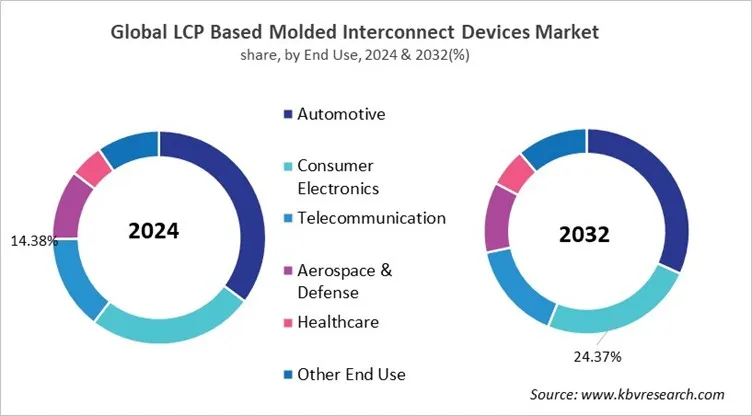
By end use, the LCP based molded interconnect devices market is divided into automotive, consumer electronics, telecommunication, aerospace & defense, healthcare, and others. The consumer electronics segment gained 25% revenue share in the LCP based molded interconnect devices market in 2024. LCP-based molded interconnect components offer excellent electrical insulation, dimensional stability, and design flexibility, which are essential for producing sleek and reliable devices. The trend toward miniaturization and multifunctionality further amplifies the use of these components, helping manufacturers meet consumer expectations for performance and durability.
Free Valuable Insights: Global LCP Based Molded Interconnect Devices Market size to reach USD 2.33 Billion by 2032
Region-wise, the LCP Based Molded Interconnect Devices Market is analyzed across North America, Europe, Asia Pacific, and LAMEA. The Asia Pacific segment gained 36% revenue share in the LCP Based Molded Interconnect Devices Market in 2024. The LPC-based molded interconnect devices market is predicted to experience prominent growth in the upcoming years. This is driven by 5G RF modules, medical/industrial miniaturization, and automotive electrification. The North America region is anticipated to lead the market with the increased adoption of laser-direct-structuring (LDS) and other MID processes across the aerospace, automobile, and telecom industries. In addition to this, the European market is expanding due to strong OEM investments in Germany and the UK. Further, the surging demand for medical devices is supporting expansion in the region.
In the Asia Pacific and LAMEA regions, the LCP-based Molded Interconnect Devices Market is predicted to experience significant growth. The market is led by Japan, South Korea, and China, where 5G infrastructure rollout, electronics manufacturing, and a large automotive supply chain surge demand for MID. Furthermore, in LAMEA, the market is driven by auto electrification, regional electronics sourcing, and infrastructure upgrades. Also, opportunities in the GCC market and South Africa are favourable, backed by the automotive and telecom industries.
| Report Attribute | Details |
|---|---|
| Market size value in 2025 | USD 776.68 Million |
| Market size forecast in 2032 | USD 2.33 Billion |
| Base Year | 2024 |
| Historical Period | 2021 to 2023 |
| Forecast Period | 2025 to 2032 |
| Revenue Growth Rate | CAGR of 17.0% from 2025 to 2032 |
| Number of Pages | 548 |
| Number of Tables | 391 |
| Report coverage | Market Trends, Revenue Estimation and Forecast, Segmentation Analysis, Regional and Country Breakdown, Competitive Landscape, Market Share Analysis, Porter’s 5 Forces Analysis, Company Profiling, Companies Strategic Developments, SWOT Analysis, Winning Imperatives |
| Segments covered | Process, Product, End Use, Region |
| Country scope |
|
| Companies Included | Molex, LLC (Koch Industries, Inc.), TE Connectivity Ltd., Kyocera Corporation, Amphenol Corporation, Sumitomo Electric Industries, Ltd., Taoglas, HARTING Technology Group, LPKF Laser & Electronics SE, Celanese Corporation and Solvay SA |
By Process
By Product
By End Use
By Geography
This Market size is expected to reach USD 2.33 billion by 2032.
The LCP based molded interconnect devices market is projected to grow at a CAGR of 17% between 2025 and 2032.
Growing demand for miniaturization and high-density electronics is accelerated by the rising adoption of 5G and high-frequency communication devices.
Molex, LLC (Koch Industries, Inc.), TE Connectivity Ltd., Kyocera Corporation, Amphenol Corporation, Sumitomo Electric Industries, Ltd., Taoglas, HARTING Technology Group, LPKF Laser & Electronics SE, Celanese Corporation and Solvay SA
The Automotive segment is generating maximum revenue share in the Global LCP Based Molded Interconnect Devices Market by End Use in 2024, growing at a CAGR of 15.5 % during the forecast period.
The Asia Pacific region dominated the Global LCP Based Molded Interconnect Devices Market by Region in 2024, and would continue to be a dominant market till 2032; thereby, achieving a market value of $858.3 million by 2032.
Our team of dedicated experts can provide you with attractive expansion opportunities for your business.












 Unique Offerings