The Latin America, Middle East and Africa Web Filtering Market would witness market growth of 13.2% CAGR during the forecast period (2025-2032).
The Brazil market dominated the LAMEA Web Filtering Market by Country in 2024, and would continue to be a dominant market till 2032; thereby, achieving a market value of $304 million by 2032. The Argentina market is showcasing a CAGR of 13.7% during (2025 - 2032). Additionally, The UAE market would register a CAGR of 11.7% during (2025 - 2032). The Brazil and UAE led the LAMEA Web Filtering Market by Country with a market share of 28.9% and 10.5% in 2024.The Saudi Arabia market is expected to witness a CAGR of 14.5% during throughout the forecast period.
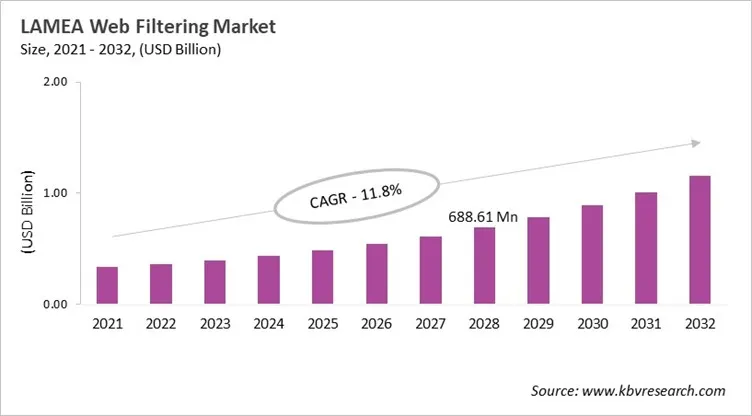
As digital transformation, cloud adoption, and remote work grow in the LAMEA region, the web filtering market has gone from basic content-blocking tools to an important part of cybersecurity. More people are using the internet, and there are more cyber threats, especially ransomware, phishing, and malware. This has led businesses to use advanced filtering tools like encrypted traffic inspection, real-time threat intelligence, and AI-based URL classification. Regulatory frameworks and national cybersecurity strategies in places like the UAE and Chile are driving up demand. This means that filtering is no longer an option; it is now necessary for compliance and governance. As more businesses use the cloud, they are more likely to choose SaaS-based, hybrid, or SASE-integrated filtering architectures to make sure that policies are enforced in all their distributed environments.
In the region, there are both global cybersecurity companies and new regional companies that focus on localization, regulatory compliance, and vertical-specific deployments. To deal with differences in costs and infrastructure across markets, vendors are putting more emphasis on channel partnerships, regional cloud nodes, managed services, and subscription-based delivery models. Government, BFSI, education, and critical infrastructure are some of the first industries to adopt these technologies because of strict rules and a high need for security. SMEs are also becoming a growing market, using scalable managed filtering to make up for not having enough cybersecurity resources. As digital ecosystems continue to grow, web filtering is now seen as a key part of enterprise security stacks instead of just a tool for productivity or access control.
Based on Filtering Type, the market is segmented into URL Filtering, DNS Filtering, Keyword Filtering and File-Type & Other Filtering. The URL Filtering market segment dominated the Brazil Web Filtering Market by Filtering Type is expected to grow at a CAGR of 11.3 % during the forecast period thereby continuing its dominance until 2032. Also, The Keyword Filtering market is anticipated to grow as a CAGR of 12.9 % during the forecast period during (2025 - 2032).
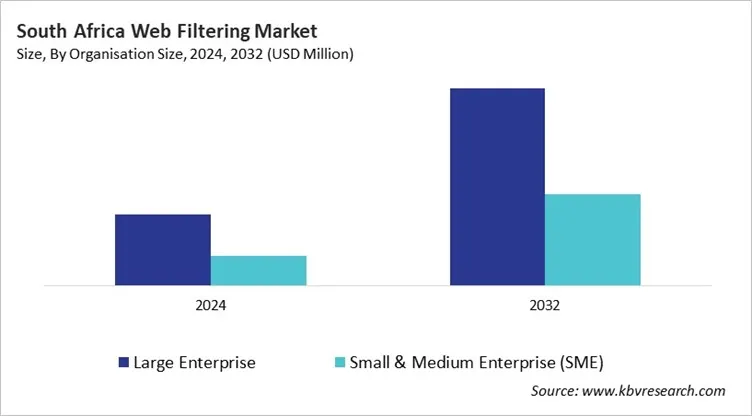
Based on Organization Size, the market is segmented into Large Enterprise and Small & Medium Enterprise (SME). With a compound annual growth rate (CAGR) of 13.8% over the projection period, the Large Enterprise Market, dominate the South Africa Web Filtering Market by Organisation Size in 2024 and would be a prominent market until 2032. The Small & Medium Enterprise (SME) market is expected to witness a CAGR of 15.2% during (2025 - 2032).
Free Valuable Insights: The Worldwide Web Filtering Market is Projected to reach USD 10.26 Billion by 2032, at a CAGR of 11.7%
Brazil's web filtering market is growing quickly because more companies are adopting digital transformation, remote work, and cyber threats, which are making them want to have more control over who can access the web and what they can see. The LGPD and other laws are putting pressure on businesses, government agencies, and schools to use more advanced filtering tools than just blocking URLs. This is because phishing and ransomware attacks are on the rise. Some important trends are moving toward filtering that works in the cloud and with AI, inspecting encrypted traffic, and having one set of rules for mobile and remote users. There is also a growing need for support in Portuguese, compliance with local laws, and managed service delivery, especially among small and medium-sized businesses that have limited budgets and skills. The competitive landscape includes big global cybersecurity companies and smaller regional service-oriented companies. There are many chances for companies that offer scalable and affordable solutions. Brazil is a high-growth market overall, and web filtering is becoming increasingly important as a basic cybersecurity tool.

By Organization Size
By Industry Vertical
By Component
By Deployment Mode
By Filtering Type
By Country
Our team of dedicated experts can provide you with attractive expansion opportunities for your business.








 Unique Offerings