The Latin America, Middle East and Africa Web Application Firewall Market would witness market growth of 16.2% CAGR during the forecast period (2025-2032).
The Brazil market dominated the LAMEA Web Application Firewall Market by Country in 2024, and would continue to be a dominant market till 2032; thereby, achieving a market value of $364.7 million by 2032. The Argentina market is showcasing a CAGR of 16.8% during (2025 - 2032). Additionally, The UAE market would register a CAGR of 15% during (2025 - 2032). The Brazil and Saudi Arabia led the LAMEA Web Application Firewall Market by Country with a market share of 19.8% and 16.9% in 2024. The Nigeria market is expected to witness a CAGR of 17.8% during throughout the forecast period.
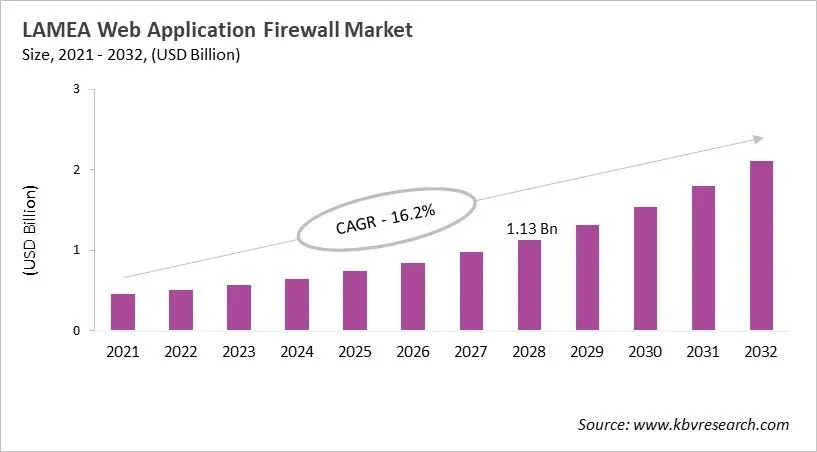
The LAMEA Web Application Firewall market has grown along with the region's quick growth of cloud platforms, web-based services, and digital public infrastructure. More and more, governments and businesses in Latin America, the Middle East, and Africa rely on web apps for things like e-government, healthcare, digital commerce, and financial services. This makes application-layer security a top priority. Early WAF adoption was led by multinational companies and regulated industries. Now that more people are using the cloud, the shift to cloud-based and software-defined WAF models has sped up. WAFs are no longer just tools for compliance; they are now seen as important parts of national and business cybersecurity frameworks.
The current state of the market is shaped by the need for cloud-based and managed WAF services, better security for APIs and mobile apps, and stricter rules and requirements for cybersecurity. To deal with rising costs, skills gaps, and changing threat landscapes, market leaders focus on scalable, subscription-based services, partnerships with companies in other regions, and automation. Competition is still moderate and driven by new ideas. Instead of price, companies are competing based on how easy it is to deploy, how well they follow regulations, and how easy it is to manage. As digital services grow in LAMEA, WAF solutions that are flexible, compliant, and based on intelligence will continue to be important for protecting new digital ecosystems.
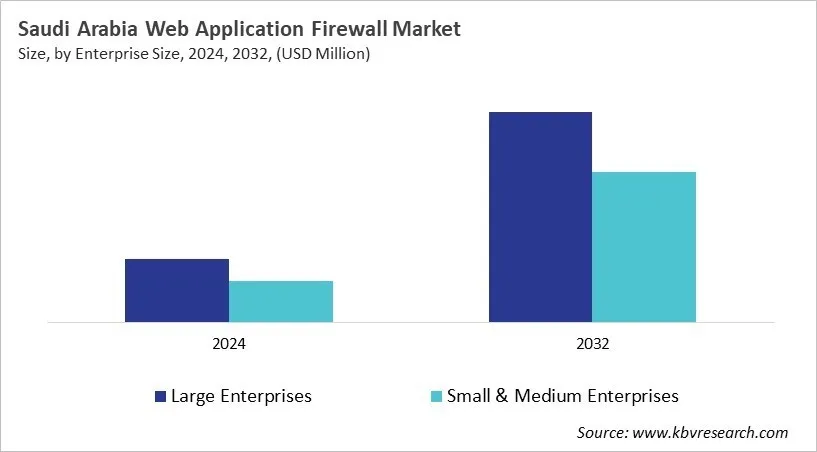
Based on Enterprise Size, the market is segmented into Large Enterprises and Small & Medium Enterprises. With a compound annual growth rate (CAGR) of 16.5% over the projection period, the Large Enterprises Market, dominate the Saudi Arabia Web Application Firewall Market by Enterprise Size in 2024 and would be a prominent market until 2032. The Small & Medium Enterprises market is expected to witness a CAGR of 17.7% during (2025 - 2032).
Based on Component, the market is segmented into Solutions and Services. The Solutions market segment dominated the Brazil Web Application Firewall Market by Component is expected to grow at a CAGR of 13.8 % during the forecast period thereby continuing its dominance until 2032. Also, The Services market is anticipated to grow as a CAGR of 15.1 % during the forecast period during (2025 - 2032).
Free Valuable Insights: The Worldwide Web Application Firewall Market is Projected to reach USD 28.28 Billion by 2032, at a CAGR of 14.7%
Web apps are a big part of Brazil's advanced digital economy, which includes banking, retail, government, and healthcare. This makes it more vulnerable to cyber threats at the application layer, which is why Web Application Firewalls (WAFs) are so important for security. More and more attacks are happening on customer-facing platforms, and Brazil's General Data Protection Law has strict rules that businesses must follow. This is making businesses use WAF solutions to protect sensitive data and avoid fines. The need for application-level security beyond traditional network defenses has grown even more because of the rapid growth of cloud, hybrid, and multi-cloud deployments and the rise of API-based services. Because of this, cloud-based and managed WAF services are becoming more popular because they can automatically find threats, stop bots, and work with DevSecOps. The competitive landscape is shaped by global vendors that work with large businesses and regulated industries, as well as regional providers and managed service companies that compete by offering customized services, regulatory expertise, and high-quality service.

By Enterprise Size
By Deployment Mode
By Component
By End-User Industry
By Country
Our team of dedicated experts can provide you with attractive expansion opportunities for your business.




 Unique Offerings