The Latin America, Middle East and Africa Virtualized Evolved Packet Core (vEPC) Market would witness market growth of 27.6% CAGR during the forecast period (2025-2032).
The Brazil market dominated the LAMEA Virtualized Evolved Packet Core (vEPC) Market by Country in 2024, and would continue to be a dominant market till 2032; thereby, achieving a market value of $898.2 million by 2032. The Argentina market is showcasing a CAGR of 29.6% during (2025 - 2032). Additionally, The UAE market would register a CAGR of 26.1% during (2025 - 2032). The Brazil and Saudi Arabia led the LAMEA Virtualized Evolved Packet Core (vEPC) Market by Country with a market share of 23.4% and 15.4% in 2024. The Nigeria market is expected to witness a CAGR of 30% during throughout the forecast period.
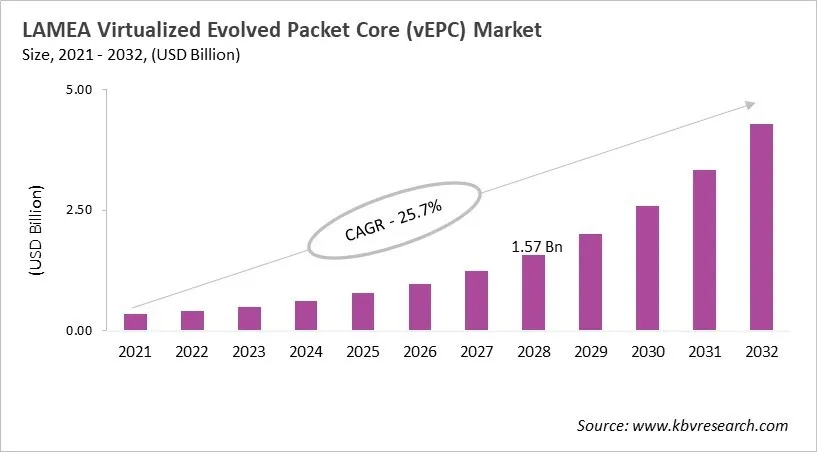
The LAMEA virtualized evolved packet core (vEPC) market has been growing steadily as governments and telecom companies speed up digital transformation, mobile broadband expansion, and the use of next-generation networks. As more people get smartphones and use data-heavy apps and digital services, the old hardware-based EPC has become less useful. This has led to a need for scalable, software-driven architectures. The Middle East has adopted early, Africa is slowly moving to virtualization, and Latin America is moving from LTE to 5G. All of these changes show how different the region's connectivity is. Regulatory modernization and national digital strategies have helped vEPC grow from a way to provide mobile broadband to consumers to a way to support private networks, IoT, and mission-critical business communications.
Cloud-native core deployments, private LTE/5G adoption across industrial sectors, and distributed edge-enabled architectures that improve latency and service quality are all driving key market momentum. Top operators are moving to virtualized and hybrid core models, adding more ways for businesses to connect, and working with standards bodies to make ecosystems that are open and work with each other. As global OEMs, regional operators, and cloud-enabled solution providers all work on making networks more flexible, cost-effective, and ready for business, competition is getting tougher. Overall, the LAMEA vEPC market is moving toward architectures that are more integrated and focused on software, which fits with the larger goals of 5G and the digital economy.
Based on End User, the market is segmented into Telecom Operators, Enterprises & Industrial Applications, MVNE / MVNOs, Government & Public Safety, and Cloud Service Providers. The Telecom Operators market segment dominated the South Africa Virtualized Evolved Packet Core (vEPC) Market by End User is expected to grow at a CAGR of 28 % during the forecast period thereby continuing its dominance until 2032. Also, The Government & Public Safety market is anticipated to grow as a CAGR of 30.4 % during the forecast period during (2025 - 2032).
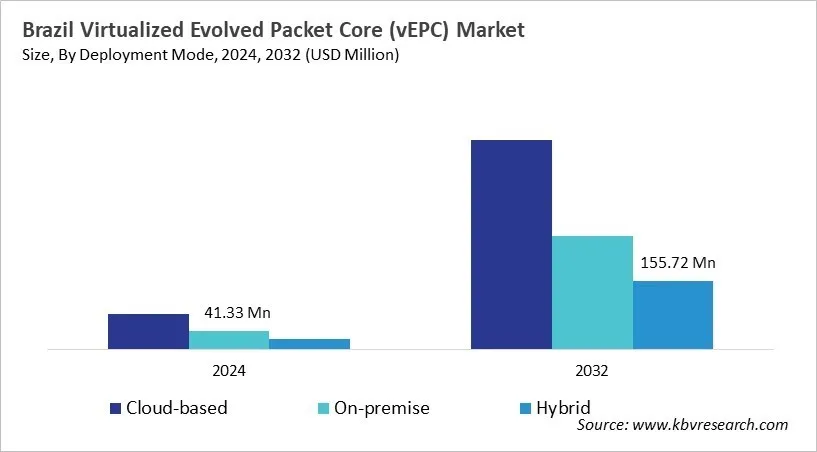
Based on Deployment Mode, the market is segmented into Cloud-based, On-premise, and Hybrid. The Cloud-based market segment dominated the Brazil Virtualized Evolved Packet Core (vEPC) Market by Deployment Mode is expected to grow at a CAGR of 25.3 % during the forecast period thereby continuing its dominance until 2032. Also, The On-premise market is anticipated to grow as a CAGR of 26.1 % during the forecast period during (2025 - 2032).
Free Valuable Insights: The Worldwide Virtualized Evolved Packet Core (vEPC) Market is Projected to reach USD 45.29 Billion by 2032, at a CAGR of 25.7%
Brazil's virtualized evolved packet core (vEPC) market is growing quickly as operators speed up their investments in advanced mobile broadband and nationwide 5G deployments to keep up with the growing demand for data from businesses and consumers. The need for scalable, cloud-native packet core solutions that make networks more flexible and lower the costs of running legacy systems is growing because more people are using mobile internet, the Internet of Things (IoT) is growing, and digital transformation projects are underway. vEPC is very important for 5G standalone readiness, network slicing, edge computing, and latency-sensitive apps in many fields, such as smart cities, agriculture, manufacturing, and logistics. Regulatory support, spectrum auctions, and businesses' need for private 4G/5G networks are all helping to speed up adoption even more. Core network strategies are changing because of technological trends like containerized network functions, AI-driven automation, open architectures, and hybrid cloud deployments. As Brazil moves closer to fully adopting 5G core, vEPC remains an important transitional and complementary technology that supports ongoing market growth.

By End User
By Deployment Mode
By Application
By Country
Our team of dedicated experts can provide you with attractive expansion opportunities for your business.



 Unique Offerings