The Latin America, Middle East and Africa Video as a Sensor Market would witness market growth of 9.5% CAGR during the forecast period (2025-2032).
The Brazil market dominated the LAMEA Video As A Sensor Market by Country in 2024, and would continue to be a dominant market till 2032; thereby, achieving a market value of $2,625.3 million by 2032. The Argentina market is showcasing a CAGR of 10.9% during (2025 - 2032). Additionally, The UAE market would register a CAGR of 8.7% during (2025 - 2032).
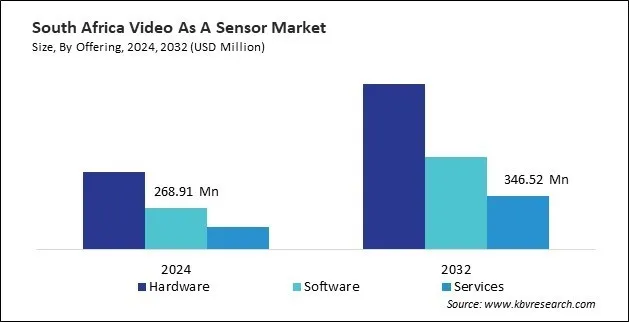
The Video-as-a-Sensor (VaaS) business in LAMEA has grown slowly through projects that focus on public safety, smart cities, and infrastructure surveillance. It has changed from analog systems to smart sensor networks that work in real time. In Latin America, early adoption was driven by rising crime rates in cities. This led to government-supported monitoring systems in countries like Chile, Brazil, and Mexico. This change is shown by Chile's work with Lenovo's AI-powered video surveillance systems.
Free Valuable Insights: The Worldwide Video As A Sensor Market is Projected to reach USD 131.73 Billion by 2032, at a CAGR of 8.1%
The LAMEA region is witnessing increasing adoption of video-as-a-sensor technologies for urban surveillance and public safety initiatives. Governments in countries such as Brazil, the UAE, and South Africa are implementing smart surveillance systems for crime detection, crowd control, and traffic management.
Several LAMEA nations are embedding video sensors in smart city infrastructures. These sensors are integrated with IoT platforms for monitoring urban infrastructure, energy consumption, and environmental conditions.
The LAMEA (Latin America, Middle East, and Africa) Video as a Sensor market is witnessing evolving competition, driven by the intersection of national security imperatives, smart city initiatives, and infrastructural modernization. The region presents a fragmented competitive landscape, with a mix of global surveillance and imaging vendors competing alongside regional integrators and specialized technology firms. The pace of adoption varies widely, with the Middle East leading in investment intensity compared to Latin America and Africa.
Global leaders such as Hikvision, Dahua Technology, Bosch Security Systems, Axis Communications, and Honeywell International maintain a significant presence across the LAMEA region, especially in the Middle East. These firms often operate via partnerships, system integrators, or through government tenders.
The presence of these players is reinforced by local alliances, enabling adaptation to national procurement requirements and standards.
In the Middle East, smart cities like Neom (Saudi Arabia) and Lusail City (Qatar) are driving demand for integrated video analytics. These projects heavily incorporate partnerships with global firms:
In Latin America, innovation is more fragmented but growing. In Brazil, firms like Digifort offer competitive video management systems used in urban and retail monitoring. Startups focusing on AI and behavior analytics, such as Axon, are emerging to address violence detection and public safety challenges.
Based on Offering, the market is segmented into Hardware, Software, and Services.
Trend: Deployment of AI-enhanced surveillance hardware (cameras, vehicles)
For instance, Dubai Police’s “Oyoon” smart city initiative utilizes thousands of AI-powered cameras across the metropolis, integrated with facial recognition and ANPR systems, resulting in the arrest of over 300 suspects in a single year.
Trend: Growth of unified AI-driven video management and analytics systems
Genetec was reaffirmed as a global leader in VMS and VSaaS, particularly highlighting its continued momentum in EMEA, including the Middle East and Africa.
Based on Product, the market is segmented into Video Surveillance, Machine Vision & Monitoring, Thermal Imaging, and Hyperspectral Imaging.
Trend: Expansion of AI-enabled public surveillance systems in urban centers.
In Buenos Aires, facial recognition and AI-driven surveillance—part of the city’s "rebooted" system—have led to the arrest of over 1,600 fugitives, demonstrating both operational impact and rising integration in public safety measures.
The city’s residents and rights groups are engaged in dynamic policy dialogue regarding data privacy and usage—highlighting the technology’s societal implications.
Trend: Adoption of drone- and satellite-based hyperspectral systems in agriculture and environmental monitoring efforts.
the USGS has developed global hyperspectral libraries and is expanding use of airborne and spaceborne hyperspectral sensors in agricultural monitoring—technology increasingly shared with Latin American nations.
Drone-mounted hyperspectral systems are being actively deployed in fields like agriculture, mining, and forestry—across Africa, including LAMEA regions like South Africa.
Based on End-Use, the market is segmented into Commercial, Industrial, Government, and Other End-Use.
Trend: Expansion of Smart City Surveillance Initiatives
Governments across the LAMEA region are increasingly implementing video surveillance systems as part of smart city projects to enhance public safety and urban management.
In March 2025, Rabat, Morocco, launched a smart city project incorporating AI-powered surveillance, including a wide network of smart cameras and the construction of two central control centers to manage the system.
Trend: Adoption of AI-Driven Video Analytics in Commercial Spaces
Businesses in the LAMEA region are integrating AI-powered video analytics to enhance security, customer experience, and operational efficiency.
For instance: In January 2025, Dahua Technology unveiled its comprehensive Smart City solutions in the Middle East and North Africa, integrating AI and IoT technologies to enhance urban security and efficiency.
Based on Application, the market is segmented into Security & Surveillance, Traffic Management, Retail Analytics, Healthcare, Manufacturing, Mapping, and Other Application.
Trend: Retailers and municipalities across LAMEA are deploying video-as-a-sensor systems with AI-powered gesture and behavior recognition, enhancing security while respecting privacy norms.
Trend: Major LAMEA cities are integrating AI-driven traffic cameras and ANPR systems with edge computing for real-time enforcement and safer road management.
Based on Offering, the market is segmented into Hardware, Software, and Services. Based on Product, the market is segmented into Video Surveillance, Machine Vision & Monitoring, Thermal Imaging, and Hyperspectral Imaging. Based on End-Use, the market is segmented into Commercial, Industrial, Government, and Other End-Use. Based on Application, the market is segmented into Security & Surveillance, Traffic Management, Retail Analytics, Healthcare, Manufacturing, Mapping, and Other Application. Based on countries, the market is segmented into Brazil, Argentina, UAE, Saudi Arabia, South Africa, Nigeria, and Rest of LAMEA.

By Offering
By Product
By End-Use
By Application
By Country
Our team of dedicated experts can provide you with attractive expansion opportunities for your business.



 Unique Offerings