The Latin America, Middle East and Africa User Provisioning Market is expected to reach $1.83 billion by 2028 and would witness market growth of 16.0% CAGR during the forecast period (2025-2032).
The Brazil market dominated the LAMEA User Provisioning Market by Country in 2024, and would continue to be a dominant market till 2032; thereby, achieving a market value of $707.1 million by 2032. The Argentina market is registering a CAGR of 17.3% during (2025 - 2032). Additionally, The UAE market would showcase a CAGR of 14.9% during (2025 - 2032). The Brazil and UAE led the LAMEA User Provisioning Market by Country with a market share of 23.3% and 15.1% in 2024.The South Africa market is expected to witness a CAGR of 17.2% during throughout the forecast period.
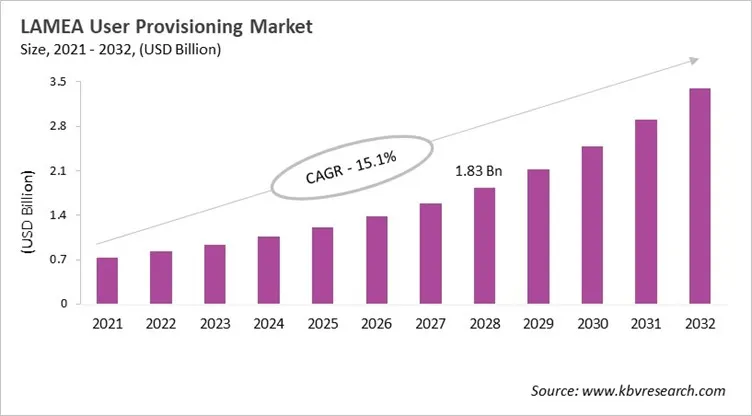
As governments and businesses speed up digital transformation and add more e-government and online services, the LAMEA user provisioning market has changed. As businesses grew and moved their operations online, early manual and decentralized provisioning models didn't work very well. The use of centralized directories and later cloud-based IAM platforms made it possible to manage the identity lifecycle in a more consistent and automated way. Digital identity and cybersecurity programs led by the government in Brazil, the UAE, and South Africa strengthened safe provisioning practices. Adopting the cloud made things even more accurate, scalable, and easy to work together across borders. Today, user provisioning is seen as a strategic security function that helps build digital trust and follow the law.
Current trends stress the importance of a strong public sector, hybrid IT support, and identity management that is based on security. Provisioning systems are more incorporating governance, auditability, and least-privilege controls that are in line with national cybersecurity strategies. Vendors are concentrating on platforms that can be automated, work with other systems, and can be expanded in the cloud. Regulatory alignment, flexibility, and the ability to support different levels of infrastructure maturity drive competition. Leading providers set themselves apart by offering secure, standards-based provisioning that works with other IAM systems.
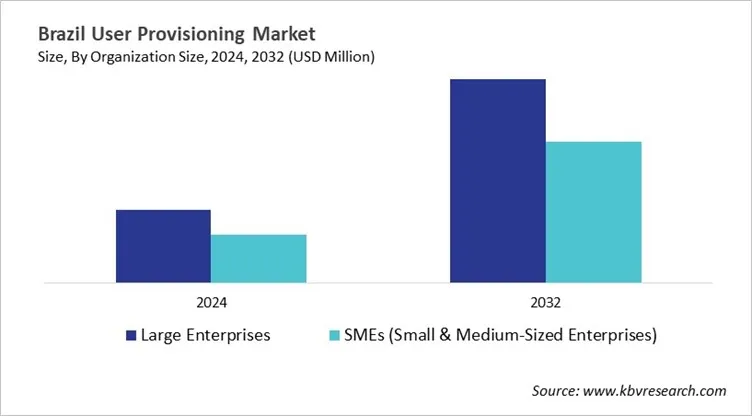
Based on Organization Size, the market is segmented into Large Enterprises and SMEs (Small & Medium-Sized Enterprises). The Large Enterprises market segment dominated the Brazil User Provisioning Market by Organization Size is expected to grow at a CAGR of 13.9 % during the forecast period thereby continuing its dominance until 2032. Also, The SMEs (Small & Medium-Sized Enterprises) market is anticipated to grow as a CAGR of 14.8 % during the forecast period during (2025 - 2032).
Based on Vertical, the market is segmented into Banking, Financial Services, and Insurance (BFSI), Telecom & IT, Healthcare, Government, Manufacturing, Retail and Other Verticals. With a compound annual growth rate (CAGR) of 14.8% over the projection period, the Banking, Financial Services, and Insurance (BFSI) Market, dominate the Argentina User Provisioning Market by Vertical in 2024 and would be a prominent market until 2032. The Retail market is expected to witness a CAGR of 18.9% during (2025 - 2032)
Free Valuable Insights: The Worldwide User Provisioning Market is Projected to reach USD 30.95 Billion by 2032, at a CAGR of 15.0%
Brazil is the biggest and most developed market for user provisioning in Latin America. This is because businesses are going digital, using the cloud, and modernizing in the banking, telecom, manufacturing, and public sectors. Automated provisioning helps businesses manage access in complicated IT environments that use ERP, the cloud, and a mix of both. Adoption is strongly affected by rules and regulations, data protection laws, and a growing awareness of cybersecurity. Cloud-based provisioning, automating the identity lifecycle, and cutting down on manual work are all important trends in the market. Increasingly, cybersecurity monitoring and access governance tools are being integrated with other tools. In the competition, there are both domestic enterprise software companies and global cloud vendors. Vendors that offer good local support, follow the rules, and have platforms that can grow give themselves an edge over their competitors.

By Organization Size
By Deployment Model
By Component
By Vertical
By Country
Our team of dedicated experts can provide you with attractive expansion opportunities for your business.



 Unique Offerings