The Latin America, Middle East and Africa Transformerless UPS Market would witness market growth of 13.6% CAGR during the forecast period (2025-2032).
The Brazil market dominated the LAMEA Transformerless UPS Market by Country in 2024, and would continue to be a dominant market till 2032; thereby, achieving a market value of $84.7 million by 2032. The Argentina market is registering a CAGR of 15.1% during (2025 - 2032). Additionally, The UAE market would showcase a CAGR of 12.1% during (2025 - 2032). The Brazil and Saudi Arabia led the LAMEA Transformerless UPS Market by Country with a market share of 20.2% and 12.4% in 2024.The South Africa market is expected to witness a CAGR of 14.9% during throughout the forecast period.
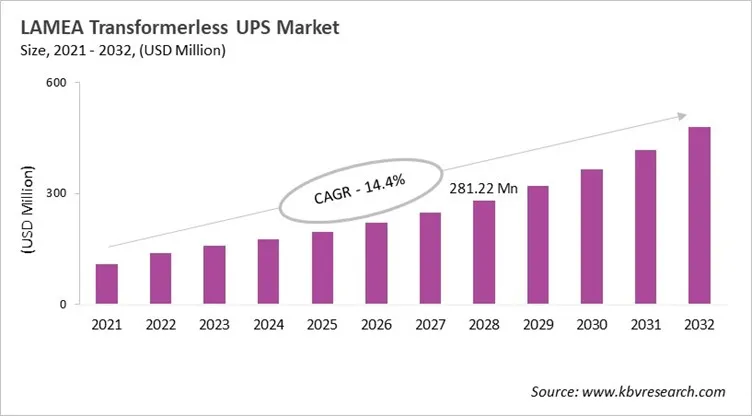
The transformerless UPS market in the LAMEA region is growing quickly because there is a growing need for small, efficient, and reliable power solutions in telecom, data centers, and edge computing. The main reasons for adoption are the growth of digital infrastructure, mandates for energy efficiency, and grid instability. Transformerless UPS systems do away with bulky transformers, which makes them more efficient, takes up less space, and costs less to run. This makes them perfect for installations that don't have a lot of space or money to spend. Investments in sustainability, hybrid energy systems, and digital transformation in places like the UAE, Saudi Arabia, and parts of Africa and Latin America are helping to keep this trend going.
To take advantage of this growth, OEMs are moving production closer to home, adding more modular and lithium-ion compatible UPS products, and adding digital services like monitoring and lifecycle management. Schneider Electric, ABB, Eaton, and Delta are some of the companies that are working on small, energy-efficient systems that fit with the goals of sustainability and infrastructure in their areas. Competition is based on localization, quick service, modular design, and compatibility with hybrid and renewable systems. This makes for a dynamic market where global players and regional integrators compete through new ideas and customized solutions.
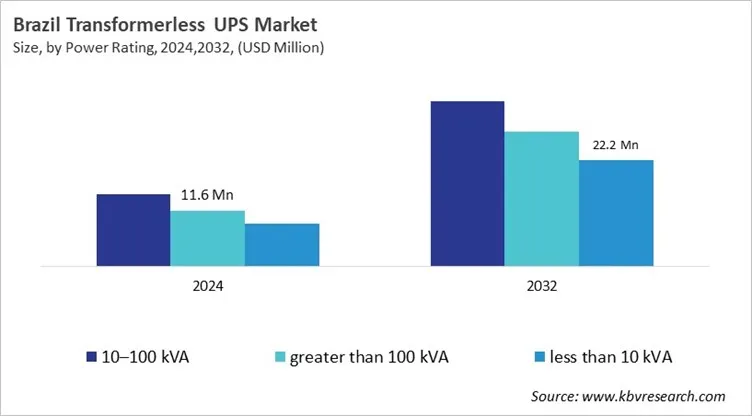
Based on Power Rating, the market is segmented into 10–100 kVA, greater than 100 kVA, and less than 10 kVA. The 10–100 kVA market segment dominated the Brazil Transformerless UPS Market by Power Rating is expected to grow at a CAGR of 11 % during the forecast period thereby continuing its dominance until 2032. Also, The less than 10 kVA market is anticipated to grow as a CAGR of 12.4 % during the forecast period during (2025 - 2032).
Based on End-use Industry, the market is segmented into Data Centers, Telecom, Industrial Manufacturing, Commercial Buildings, Healthcare Facilities, and Other End-use Industry. Among various UAE Transformerless UPS Market by End-use Industry; The Data Centers market achieved a market size of USD $7 Million in 2024 and is expected to grow at a CAGR of 11.3 % during the forecast period. The Commercial Buildings market is predicted to experience a CAGR of 13.1% throughout the forecast period from (2025 - 2032).
Free Valuable Insights: The Worldwide Transformerless UPS Market is Projected to reach USD 4.94 Billion by 2032, at a CAGR of 11.1%
The Brazilian UPS market is growing quickly because of digitalization, the growth of data centers and cloud infrastructure, and the need for reliable power when outages happen often. More people are using transformerless UPS systems because they are smaller, more efficient, and help save energy and protect the environment. The country's unstable power grid and growing use of renewable energy sources make the need for modular, efficient backup solutions even stronger. Schneider Electric, Eaton, and ABB are some of the biggest companies in the world that compete. They have advanced, scalable systems. But there are still problems, like higher upfront costs and a lack of knowledge among smaller businesses. Brazil has a lot of room for growth when it comes to transformerless UPS adoption. This is thanks to improvements in digital infrastructure and trends toward energy efficiency.

By Phase
By Power Rating
By Form Factor
By End-use Industry
By Country
Our team of dedicated experts can provide you with attractive expansion opportunities for your business.




 Unique Offerings