The Latin America, Middle East and Africa Sports Analytics Market would witness market growth of 18.7% CAGR during the forecast period (2025-2032).
The Brazil market dominated the LAMEA Sports Analytics Market by Country in 2024, and would continue to be a dominant market till 2032; thereby, achieving a market value of $278.3 million by 2032. The Argentina market is registering a CAGR of 19.3% during (2025 - 2032). Additionally, The UAE market would showcase a CAGR of 17.5% during (2025 - 2032). The Brazil and Saudi Arabia led the LAMEA Sports Analytics Market by Country with a market share of 26.8% and 17.4% in 2024.The South Africa market is expected to witness a CAGR of 19.7% during throughout the forecast period.
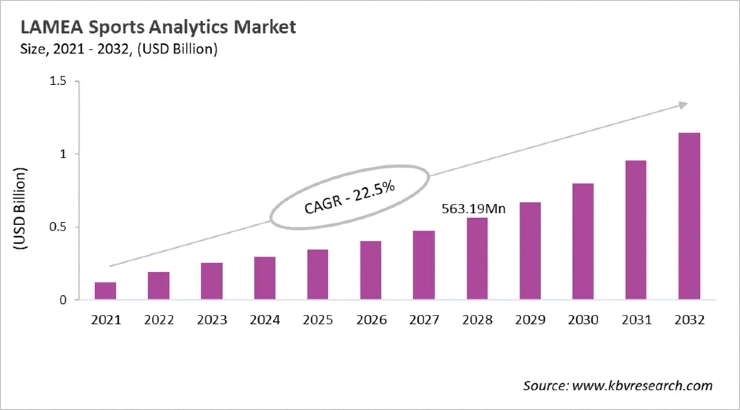
The LAMEA sports analytics market has grown as sports have become more professional and more people have realized that sports can be a way to improve the economy and society. Early adopters were mostly elite clubs and national teams, with help from international governing bodies and big global sporting events. Over time, cloud-based platforms, government-led digital transformation programs, and smart stadium initiatives sped up the adoption of these technologies in Latin America, the Middle East, and Africa. Today, analytics is an important part of performance management, injury prevention, broadcasting, and making business decisions.
Current trends show that AI-driven performance and injury analytics are becoming more popular, that they are being used to engage fans and increase revenue, and that the government is heavily involved in programs to develop talent. To make their products more affordable and scalable, market leaders use platform-based, partnership-driven, and localized strategies. Global OEMs, specialized analytics vendors, and regional startups are all competing in the same space. Competition is shifting away from standalone analytics tools and toward integration, data security, ecosystem alignment, and long-term support.
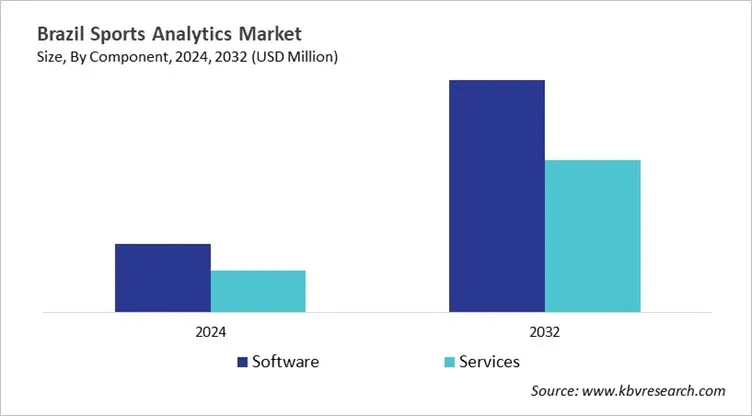
Based on Component, the market is segmented into Software, and Services. The Software market segment dominated the Brazil Sports Analytics Market by Component is expected to grow at a CAGR of 16.8 % during the forecast period thereby continuing its dominance until 2032. Also, The Services market is anticipated to grow as a CAGR of 18 % during the forecast period during (2025 - 2032).
Based on Analysis, the market is segmented into On-Field, and Off-Field. With a compound annual growth rate (CAGR) of 17.1% over the projection period, the On-Field Market, dominate the UAE Sports Analytics Market by Analysis in 2024 and would be a prominent market until 2032. The Off-Field market is expected to witness a CAGR of 17.9% during (2025 - 2032).
Free Valuable Insights: The Worldwide Sports Analytics Market is Projected to reach USD 10.66 Billion by 2032, at a CAGR of 16.8%
Brazil dominates the LAMEA sports analytics market due to its strong sports culture, highly organized professional leagues, and growing commercialization of sports beyond football. Analytics adoption is driven by the need for player development, talent export, injury prevention, and performance optimization across multiple sports. Strong collaboration between clubs, universities, and sports science institutions supports advanced use of biomechanics, physiology, and data analytics. Wearables, GPS tracking, and AI-powered video analysis are widely used for workload management, tactical insights, and rehabilitation. Youth academies increasingly rely on long-term data tracking, while fan and digital engagement analytics are gaining importance. The competitive landscape includes global vendors offering advanced platforms and local providers delivering customized, cost-effective solutions. Competition is intensifying as analytics literacy rises, with differentiation focused on integration, usability, and sport-specific expertise.

By Component
By Analysis
By Deployment
By End-use
By Country
Our team of dedicated experts can provide you with attractive expansion opportunities for your business.








 Unique Offerings