The Latin America, Middle East and Africa Situation Awareness Systems Market would witness market growth of 8.6% CAGR during the forecast period (2025-2032).
The Brazil market dominated the LAMEA Situation Awareness Systems Market by Country in 2024, and would continue to be a dominant market till 2032; thereby, achieving a market value of $835.6 million by 2032, growing at a CAGR of 7.2 % during the forecast period. The Argentina market is expected to witness a CAGR of 9.5% during (2025 - 2032). Additionally, The UAE market is expected to witness a CAGR of 7.8% during (2025 - 2032). The Brazil and UAE led the LAMEA Situation Awareness Systems Market by Country with a market share of 23.9% and 17.6% in 2024. The Nigeria market is expected to witness a CAGR of 10.2% during throughout the forecast period.
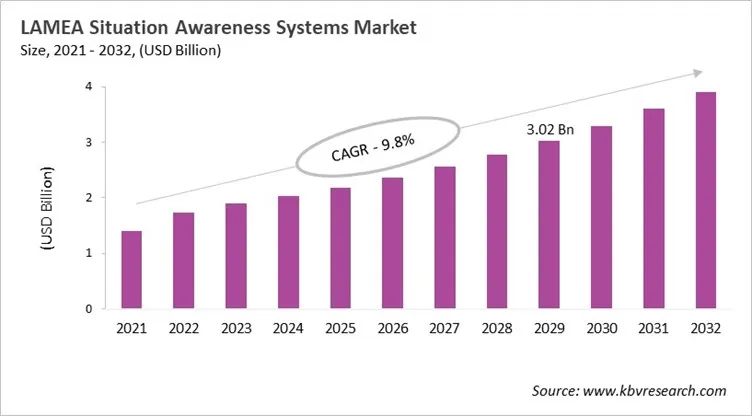
The LAMEA situational awareness systems market has grown because of ongoing security threats, weak infrastructure, and the growing use of digital technology in both defense and civilian areas. Military needs like border surveillance, airspace monitoring, and updating command and control systems drove early adoption. In the Middle East, defense-led investments focused on network-centric warfare and integrated air and missile defense. In Latin America, on the other hand, they focused more on internal security, maritime domain awareness, and disaster management. African countries mainly used situational awareness platforms for peacekeeping, fighting terrorism, and protecting infrastructure. Over time, these systems grew to include not only defense but also smart city projects and transportation management.
Current market trends stress the need for integration across land, air, sea, cyber, and space to create unified operational pictures. Increasingly, civil authorities use situational awareness systems to keep an eye on critical infrastructure, respond to emergencies, and keep the public safe. Cybersecurity and system resilience are now two of the most important things to look for when buying something. They affect how systems are designed and which vendors are chosen. Global defense original equipment manufacturers (OEMs) control large programs by localizing their products and forming long-term partnerships. Regional players, on the other hand, compete in niche applications. Modular, scalable platforms let you add new features over time. Overall, the market is growing steadily because of interoperability, security concerns, and government-led modernization.
Based on Type, the market is segmented into Command & Control Systems, RADAR, Optronics / EO/IR, Vehicle SAS / ADAS, and SONAR. The Command & Control Systems market segment dominated the Brazil Situation Awareness Systems Market by Type is expected to grow at a CAGR of 6.3 % during the forecast period thereby continuing its dominance until 2032. Also, The Vehicle SAS / ADAS market is anticipated to grow as a CAGR of 8.3 % during the forecast period during (2025 - 2032).
Based on End-User Industry, the market is segmented into Defense & Military, Homeland Security & Public Safety, Aviation & Aerospace, Maritime, and Other End-User Industry. With a compound annual growth rate (CAGR) of 8.3% over the projection period, the Defense & Military Market, dominate the Saudi Arabia Situation Awareness Systems Market by End-User Industry in 2024 and would be a prominent market until 2032. From 2025 to 2032 The Maritime market is expected to witness a CAGR of 10.3% during (2025 - 2032).
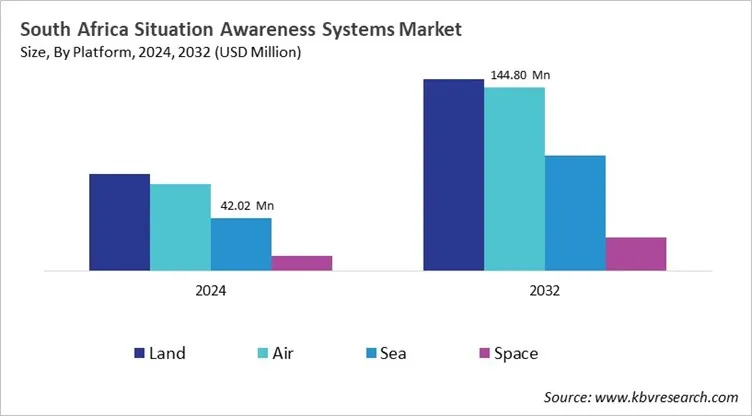
Based on Platform, the market is segmented into Land, Air, Sea, and Space. Among various South Africa Situation Awareness Systems Market by Platform; The Land market achieved a market size of USD $76.7 Million in 2024 and is expected to grow at a CAGR of 9 % during the forecast period. The Space market is predicted to experience a CAGR of 11% throughout the forecast period from (2025 - 2032).
Free Valuable Insights: The Worldwide Situation Awareness Systems Market is Projected to reach USD 44.44 Billion by 2032, at a CAGR of 6.8%
The market for situational awareness systems in Brazil has grown because of defense modernization and big programs to protect borders, the sea, and infrastructure. The government puts a lot of emphasis on integrated C4ISR capabilities to keep track of its large land borders, airspace, and offshore assets. Geographic scale, security risks across borders, and protecting strategic resources all have a big effect on how many people use the system. Border monitoring programs that use sensor fusion, radar networks, and satellite images are driving demand. Market trends show that military and civilian uses are becoming more similar. For example, disaster response and managing maritime traffic are two examples. Increasingly, data analytics and geospatial intelligence are being used to help people make decisions. There are strong domestic OEMs and international partners in the competition. In general, continued government investment and cooperation between agencies help the market grow.

By Type
By Component
By Platform
By End-User Industry
By Application
By Country
Our team of dedicated experts can provide you with attractive expansion opportunities for your business.



 Unique Offerings