The Latin America, Middle East and Africa Sensing Cable Market would witness market growth of 7.7% CAGR during the forecast period (2025-2032).
The Brazil market dominated the LAMEA Sensing Cable Market by Country in 2024, and would continue to be a dominant market till 2032; thereby, achieving a market value of $39.4 million by 2032. The Argentina market is showcasing a CAGR of 8.4% during (2025 - 2032). Additionally, The UAE market would register a CAGR of 6.7% during (2025 - 2032). The Brazil and Saudi Arabia led the LAMEA Sensing Cable Market by Country with a market share of 26.9% and 19.2% in 2024. The South Africa market is expected to witness a CAGR of 8.6% during throughout the forecast period.
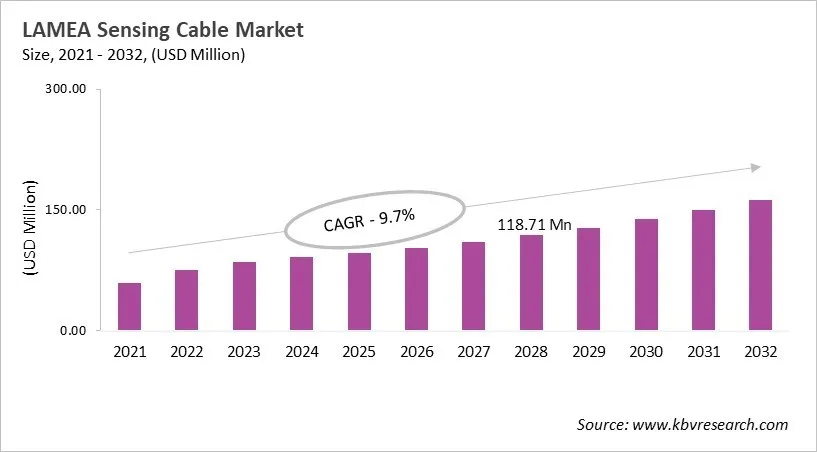
Over the past ten years, the LAMEA sensing-cable market has changed from being used by a small number of people to being a bigger part of infrastructure monitoring. This is because the region has a lot of pipelines, utilities, and cross-continental telecom networks that work in harsh and remote areas. The problems with traditional point sensors and manual inspections have sped up the move toward distributed fiber-optic sensing technologies like DTS, DAS, and DSS. These technologies allow for continuous, long-distance, real-time monitoring. Sensing cables are now a key tool for leak detection, intrusion monitoring, and structural health assessment across LAMEA. This is because more money is being spent on oil and gas, water, power, and submarine cable infrastructure, and people are more aware of safety, environmental protection, and asset integrity.
OEMs and solution providers are helping the market grow by providing strong, ready-to-use sensing systems that are made for deserts, underwater routes, and remote areas, as well as analytics and monitoring services that make it easier to adopt these systems. Market growth is being driven by strategic partnerships with regional operators, governments, and utilities, as well as diversification across pipelines, telecom, industrial facilities, and perimeter security. The competitive landscape is still new, but global sensing specialists are currently in the lead because of their technical knowledge and proven reliability. Regional integrators are also starting to enter niche applications. Overall, LAMEA is moving from pilot deployments to more widespread integration of sensing cables. This is because the infrastructure needs to be strong, safe, and good for the environment.
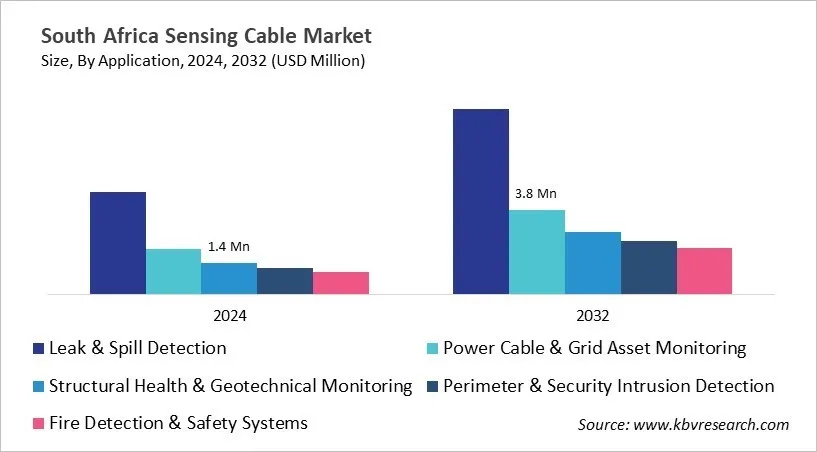
Based on Application, the market is segmented into Leak & Spill Detection, Power Cable & Grid Asset Monitoring, Structural Health & Geotechnical Monitoring, Perimeter & Security Intrusion Detection and Fire Detection & Safety Systems. Among various South Africa Sensing Cable Market by Application; The Leak & Spill Detection market achieved a market size of USD $4.6 Million in 2024 and is expected to grow at a CAGR of 8 % during the forecast period. The Structural Health & Geotechnical Monitoring market is predicted to experience a CAGR of 9.1% throughout the forecast period from (2025 - 2032).
Based on Sensing Technology, the market is segmented into Distributed Temperature Sensing (DTS), Distributed Acoustic Sensing (DAS), Distributed Strain/Pressure Sensing and Hybrid Multi-Parameter Sensing. With a compound annual growth rate (CAGR) of 6% over the projection period, the Distributed Temperature Sensing (DTS) Market, dominate the UAE Sensing Cable Market by Sensing Technology in 2024 and would be a prominent market until 2032. The Distributed Strain/Pressure Sensing market is expected to witness a CAGR of 7.3% during (2025 - 2032).
Free Valuable Insights: The Worldwide Sensing Cable Market is Projected to reach USD 1.68 Billion by 2032, at a CAGR of 6.6%
Brazil is a major market for sensing cables in the LAMEA region because it has a big economy, a strong industrial base, growing urban infrastructure, and a lot of oil and gas activity. Infrastructure modernization, urbanization, and stricter environmental rules are driving demand for applications in power utilities, pipeline monitoring, structural health, and facility safety. The oil and gas industry, especially offshore and pipeline networks, is still a big driver of growth because it needs real-time leak detection and asset integrity monitoring. One big trend is that more and more people are using fiber-optic sensing technologies, like distributed temperature and acoustic sensing, with automation and IIoT platforms. International technology companies mostly serve the market through partnerships with local companies. However, steady growth is expected as investments in energy, infrastructure, and predictive maintenance continue, even though they are difficult to deploy and cost a lot of money.

By Application
By End-Use Industry
By Sensing Technology
By Cable Type
By Country
Our team of dedicated experts can provide you with attractive expansion opportunities for your business.




 Unique Offerings