The Latin America, Middle East and Africa Self-Healing Networks Market is expected to reach $255.26 million by 2028 and would witness market growth of 32.9% CAGR during the forecast period (2025-2032).
The Brazil market dominated the LAMEA Self-Healing Networks Market by Country in 2024, and would continue to be a dominant market till 2032; thereby, achieving a market value of $153 million by 2032. The Argentina market is showcasing a CAGR of 34.9% during (2025 - 2032). Additionally, The UAE market would register a CAGR of 31.7% during (2025 - 2032). The Brazil and UAE led the LAMEA Self-Healing Networks Market by Country with a market share of 21.2% and 15.6% in 2024. The South Africa market is expected to witness a CAGR of 34.2% during throughout the forecast period.
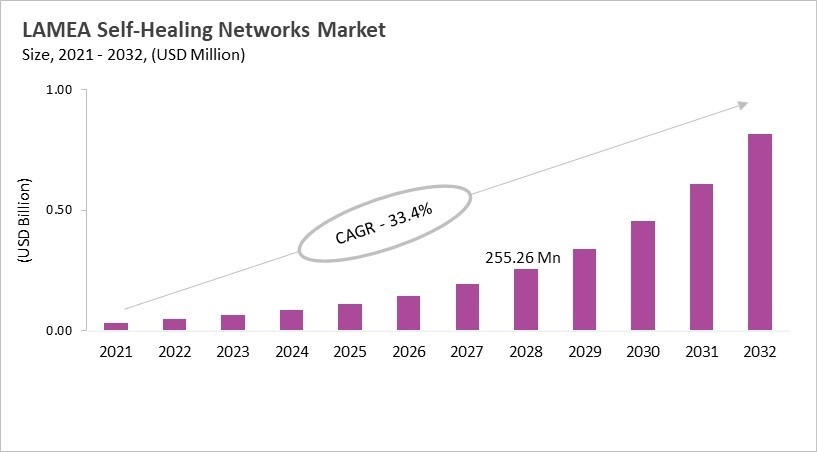
Self-healing networks in the LAMEA region mark a significant transition to self-sufficient, AI-powered network structures capable of identifying faults, redirecting traffic, and restoring performance with minimal human involvement. These networks use AI, machine learning, real-time monitoring, and intent-based automation to make predictive maintenance, dynamic rerouting, and closed-loop operations possible. This makes them more reliable and efficient. Self-healing networks, 5G, edge computing, and cloud-native architectures all work together to give operators low-latency, resilient services in a wide range of connectivity environments. This meets the needs of both businesses and consumers while also supporting national digital transformation goals.
Key strategies that are helping LAMEA adopt these technologies include adding AI and intent-based frameworks to network portfolios, joining standards groups like TM Forum and O-RAN, and gradually automating existing OSS/BSS infrastructures. Cisco, Nokia, Huawei, and Ericsson are some of the world's largest OEMs that offer advanced solutions that combine predictive analytics and autonomous operations. Regional operators, on the other hand, use pilot programs and collaborative initiatives to speed up deployment. These changes, along with policy alignment and ecosystem collaboration, make self-healing networks essential for reliable, scalable, and future-ready connectivity in Latin America, the Middle East, and Africa.
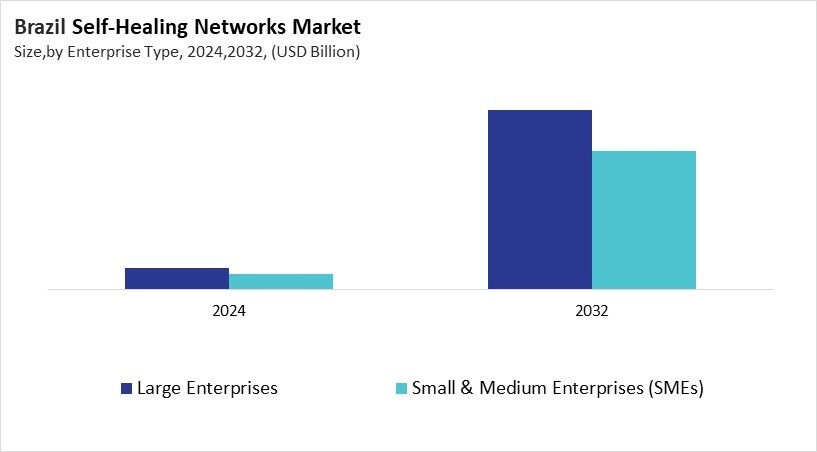
Based on Enterprise Type, the market is segmented into Large Enterprises and Small & Medium Enterprises (SMEs). The Large Enterprises market segment dominated the Brazil Self-Healing Networks Market by Enterprise Type is expected to grow at a CAGR of 30.4 % during the forecast period thereby continuing its dominance until 2032. Also, The Small & Medium Enterprises (SMEs) market is anticipated to grow as a CAGR of 31.3 % during the forecast period during (2025 - 2032).
Based on Application, the market is segmented into Network Traffic Management, Networking Configuration & Provisioning, Root Cause Analysis, Network Access Control and Security Compliance Management & Others. Among various UAE Self-Healing Networks Market by Application; The Network Traffic Management market achieved a market size of USD $3.3 Million in 2024 and is expected to grow at a CAGR of 30.3 % during the forecast period. The Network Access Control market is predicted to experience a CAGR of 32.7% throughout the forecast period from (2025 - 2032).
Free Valuable Insights: Self-Healing Networks Market Size Worth USD 8.46 billion by 2032
Brazil is the biggest and most advanced telecommunications market in Latin America, and it is very important for the LAMEA self-healing networks landscape. The rapid growth of mobile data traffic, the spread of 4G coverage across the country, and the rollout of 5G networks, along with the rise of digitalization in businesses, have made networks more complicated. This means that automated fault detection and recovery are now necessary. Telefônica Vivo and other operators use self-healing networks to manage large, multi-technology infrastructures. This keeps services running and lowers costs. Some important trends are AI-driven analytics to improve radio access, cloud-native functions, and software-defined networking to make recovery faster. Also, the growth of enterprise and industrial connectivity makes network reliability more important, while competition focuses on AI-enabled platforms, support for multiple vendors, and automation that can grow.

By Enterprise Type
By Offering
By Network Type
By Application
By Industry Vertical
By Country
Our team of dedicated experts can provide you with attractive expansion opportunities for your business.



 Unique Offerings