The Latin America, Middle East and Africa Quantum Key Distribution Market would witness market growth of 34.4% CAGR during the forecast period (2025-2032).
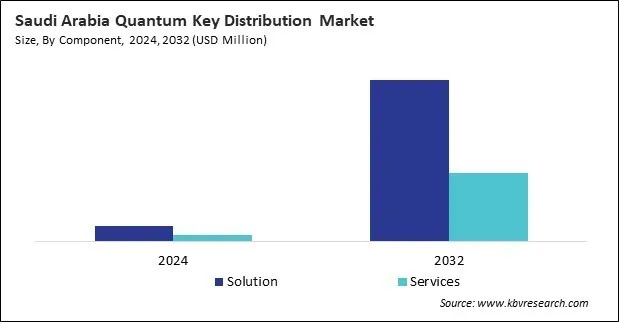
The Brazil market dominated the LAMEA Quantum Key Distribution Market by Country in 2024, and would continue to be a dominant market till 2032; thereby, achieving a market value of $66 million by 2032. The Argentina market is showcasing a CAGR of 35.8% during (2025 - 2032). Additionally, The UAE market would register a CAGR of 33.3% during (2025 - 2032).
A second significant trend is the move toward space-based QKD to overcome terrestrial distance limitations. While fiber-based QKD is constrained by photon loss and noise over long distances, satellites offer line-of-sight transmission with minimal interference. The Chinese Micius satellite was the first to achieve QKD between two ground stations located thousands of kilometers apart. Following this, the European Space Agency (ESA) and national space programs in the UK, Japan, and Canada have initiated their own quantum communication satellite projects. These efforts aim to establish a global quantum-secure communication network that can service defense, diplomatic, and commercial needs.
The realization of a quantum internet that bridges continents would not be possible without the successful integration of satellite-based QKD, highlighting a pivotal transition toward global reach. Another prevailing trend is the intensification of national and supranational funding programs aimed at bolstering domestic capabilities in quantum communication. Governments are no longer viewing QKD as merely a scientific curiosity but as a cornerstone of national security. Programs such as the U.S. Department of Energy’s Quantum Internet Blueprint and Japan’s Moonshot R&D program illustrate this strategic pivot.
Quantum Key Distribution (QKD) in the LAMEA region—comprising Latin America, the Middle East, and Africa—is in a formative stage but steadily gaining momentum. As global awareness around quantum-safe communication rises, nations in this region are beginning to recognize QKD as a vital component in the future of cybersecurity. The slow yet promising uptake is driven by an increasing emphasis on data security, digital transformation, and geopolitical shifts pushing countries to bolster their technological autonomy. In Latin America, Brazil has emerged as a central figure in the early adoption of quantum technologies. Institutions such as the University of Campinas and the National Institute for Space Research (INPE) are exploring quantum communication protocols to strengthen national defense and science initiatives.
Argentina has also expressed interest in QKD, as part of its broader quantum computing research ecosystem. In the Middle East, countries like the United Arab Emirates and Saudi Arabia are embedding quantum technology objectives into national digital agendas. The UAE’s Mohamed bin Zayed University of Artificial Intelligence (MBZUAI) and Saudi Arabia’s King Abdulaziz City for Science and Technology (KACST) are engaging in partnerships and launching pilot projects that include quantum-safe communications, including QKD. One of the most prominent trends shaping the LAMEA QKD market is the growing support from governments for quantum-related research.
Although funding levels vary significantly across countries, there is an increasing policy-level push to integrate quantum communications into national strategies. For example, the UAE's "National Innovation Strategy" and Saudi Arabia’s Vision 2030 include objectives tied to emerging technologies, under which QKD projects are being explored. This top-down interest has stimulated university-level research and attracted foreign technical partners. A second significant trend is the prevalence of academic and international collaborations. Due to resource constraints, many institutions in the LAMEA region are engaging in partnerships with countries like China, Germany, and the United States, where quantum research is more mature.
The state of competition in the LAMEA Quantum Key Distribution market remains relatively underdeveloped compared to other regions like Asia-Pacific or Europe, but it is slowly evolving. The market is currently dominated by government-sponsored research labs and leading academic institutions, while private sector involvement is only beginning to take shape. In the Middle East, government initiatives are laying the groundwork for future commercial QKD applications, with companies such as Etisalat and STC exploring testbeds. Overall, competition in LAMEA remains early-stage, but as infrastructure develops and costs decline, the market is expected to become more dynamic, with a rising number of regional and international players entering the fray.
Free Valuable Insights: Market is Projected to reach USD 3.93 Billion by 2032, at a CAGR of 32.7%
Based on Component, the market is segmented into Solution, and Services. Based on Application, the market is segmented into Secure Communication, Network Security, and Database Encryption. Based on Type, the market is segmented into Extended Range Communication Systems, and Multiplexing Transmission Systems. Based on End Use, the market is segmented into BFSI, Healthcare, Government & Defense, IT & Telecom, Automotive, and Other End Use. Based on countries, the market is segmented into Brazil, Argentina, UAE, Saudi Arabia, South Africa, Nigeria, and Rest of LAMEA.

By Component
By Application
By Type
By End Use
By Country
Our team of dedicated experts can provide you with attractive expansion opportunities for your business.



 Unique Offerings