The Latin America, Middle East and Africa Personal Identity Management Market would witness market growth of 13.1% CAGR during the forecast period (2025-2032).
The Brazil market dominated the LAMEA Personal Identity Management Market by Country in 2024, and would continue to be a dominant market till 2032; thereby, achieving a market value of $1,238.6 million by 2032. The Argentina market is showcasing a CAGR of 14.3% during (2025 - 2032). Additionally, The UAE market would register a CAGR of 12% during (2025 - 2032). The Brazil and UAE led the LAMEA Personal Identity Management Market by Country with a market share of 23.8% and 15.1% in 2024. The South Africa market is expected to witness a CAGR of 14% during throughout the forecast period.
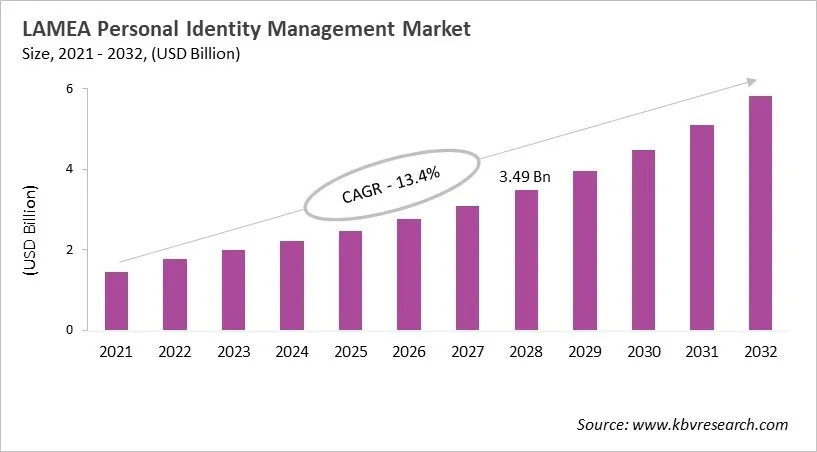
The LAMEA Personal Identity Management Market has grown into an important part of safe digital ecosystems, thanks in large part to government-led efforts in Latin America, the Middle East, and Africa. The quick move to digital public services, financial systems, and telecommunications has sped up the change from separate, paper-based identification to digital identity platforms that work with biometrics, the cloud, and other systems. Governments have made digital identity a key part of e-governance, financial inclusion, social welfare delivery, and following the rules. They have also made sure that national programs are in line with international data protection and digital trust frameworks.
The widespread use of biometric and mobile-based identity solutions, along with strong smartphone penetration and telecom integration, is also helping the market grow. Key leaders are working on strategic partnerships with government agencies, modular platform design, and localization to meet regulatory and sovereignty needs. The competitive landscape is still fairly stable, with global OEMs leading big deployments and regional players offering flexible, low-cost solutions. In the LAMEA market, innovation in security, privacy, and fraud prevention, along with long-term partnerships with the public sector, continues to set companies apart and give them a competitive edge.
Based on Deployment Model, the market is segmented into Cloud-based, and On-premise. With a compound annual growth rate (CAGR) of 12.1% over the projection period, the Cloud-based Market, dominate the UAE Personal Identity Management Market by Deployment Model in 2024 and would be a prominent market until 2032. The On-premise market is expected to witness a CAGR of 11.8% during (2025 - 2032).
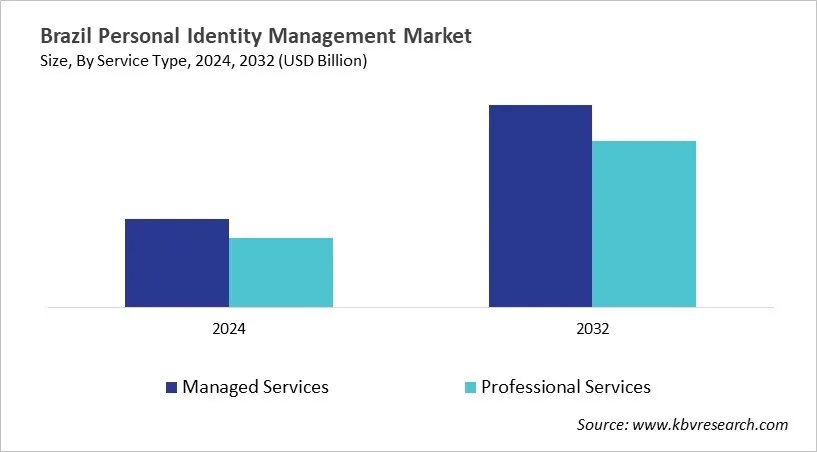
Based on Service Type, the market is segmented into Managed Services, and Professional Services. The Managed Services market segment dominated the Brazil Personal Identity Management Market by Service Type is expected to grow at a CAGR of 11.2 % during the forecast period thereby continuing its dominance until 2032. Also, The Professional Services market is anticipated to grow as a CAGR of 11.8 % during the forecast period during (2025 - 2032).
Free Valuable Insights: The Worldwide Personal Identity Management Market is Projected to reach USD 52.94 Billion by 2032, at a CAGR of 12.1%
Based on Vertical, the market is segmented into Banking Financial Services and Insurance (BFSI), Government, Healthcare, IT & Telecom, Retail, Energy & Utilities, and Other Verticals. With a compound annual growth rate (CAGR) of 12.5% over the projection period, the Banking, Financial Services, and Insurance (BFSI) Market, dominate the Argentina Personal Identity Management Market by Vertical in 2024 and would be a prominent market until 2032. The Energy & Utilities market is expected to witness a CAGR of 16.5% during (2025 - 2032).
Brazil has one of the most advanced personal identity management markets in Latin America. This is because the government is leading the way in digital transformation and modernizing public services through unified digital identity frameworks. Government priorities like openness, efficiency, and cutting down on fraud have sped up the use of technology in welfare, taxes, healthcare, and the legal system. This has made citizens trust the government more and made it work better. At the same time, strict KYC and AML rules, along with the rapid growth of digital banking, open finance, and instant payments, have made it necessary for banks to have secure digital identities. Biometric authentication, mobile-based identity verification, and cloud-based platforms are all examples of how the market is changing to make sure that everything is accurate, scalable, and works with other systems. A strong focus on privacy and data protection has also influenced how systems are built. Competition shows a balance between global technology companies and local companies that follow government and regulatory digital strategies.

By Application
By Deployment Model
By Service Type
By Vertical
By Country
Our team of dedicated experts can provide you with attractive expansion opportunities for your business.



 Unique Offerings