The Latin America, Middle East and Africa Passive Optical Component Market would witness market growth of 14.6% CAGR during the forecast period (2025-2032).
The Brazil market dominated the LAMEA Passive Optical Component Market by Country in 2024, and would continue to be a dominant market till 2032; thereby, achieving a market value of $2,569.3 million by 2032. The Argentina market is showcasing a CAGR of 15.4% during (2025 - 2032). Additionally, The UAE market would register a CAGR of 13.4% during (2025 - 2032). The Brazil and Saudi Arabia led the LAMEA Passive Optical Component Market by Country with a market share of 24.8% and 17.5% in 2024. The South Africa market is expected to witness a CAGR of 15.6% during throughout the forecast period.
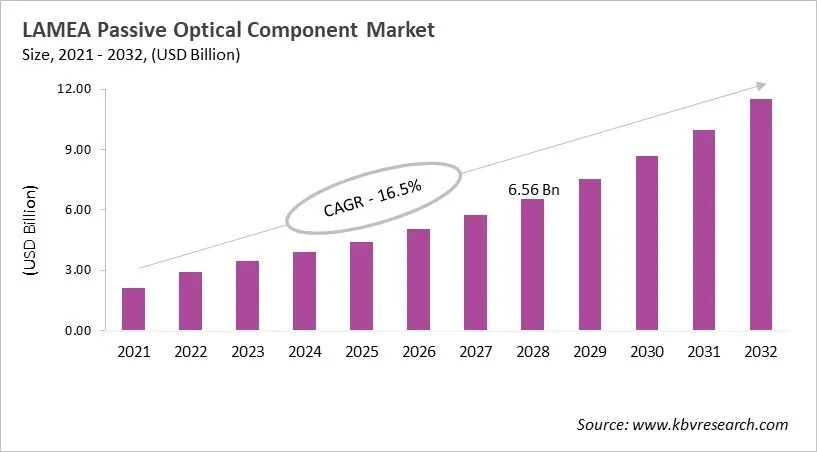
The LAMEA Passive Optical Component Market has been steadily changing because of government-led broadband initiatives, telecom modernization programs, and the growing importance of the digital economy in Latin America, the Middle East, and Africa. In the region, fiber technologies were adopted more slowly than in Asia and Europe. However, national policies in Brazil, Mexico, the UAE, Saudi Arabia, and South Africa have sped up the deployment of fiber for backbone networks, 4G/5G readiness, and smart-city infrastructure. As data centers, cloud platforms, and edge computing grow in LAMEA, the need for passive optical components like splitters, connectors, enclosures, and WDM filters has grown even more. These components help make sure that networks work well in a wide range of terrains and climates.
The market is changing because of things like the growth of fiber-to-the-home/business networks, the growing use of digital services and data-center infrastructure, and the use of new telecom technologies like 5G and smart-city systems that use the Internet of Things. To deal with environmental problems and become more competitive, major companies like Huawei, Nokia, Prysmian Group, and Corning focus on R&D innovation, working with national operators, regional localization, and environmentally friendly production methods. The market is still a mix of competition based on price and competition based on innovation. This is because of government programs, large-scale broadband projects, and deployment needs that vary by region. Passive optical components are a key part of LAMEA's ongoing digital transformation.
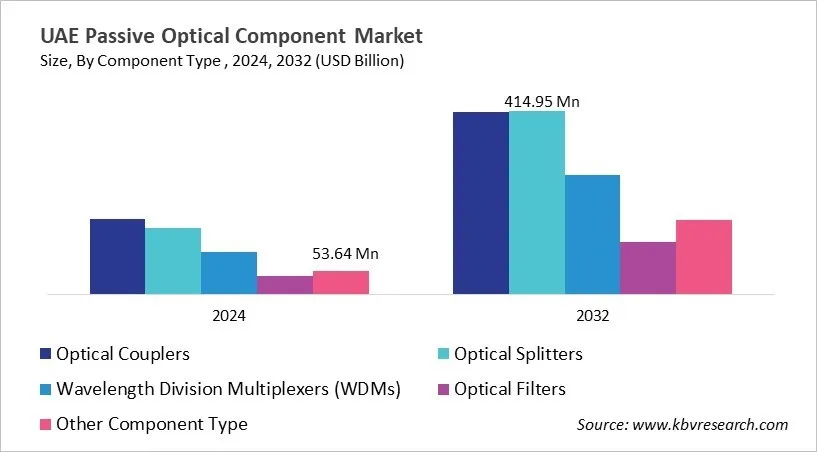
Based on Component Type, the market is segmented into Optical Couplers, Optical Splitters, Wavelength Division Multiplexers (WDMs), Optical Filters and Other Component Type. The Optical Couplers market segment dominated the UAE Passive Optical Component Market by Component Type is expected to grow at a CAGR of 11.8 % during the forecast period thereby continuing its dominance until 2032. Also, The Optical Filters market is anticipated to grow as a CAGR of 14.3 % during the forecast period during (2025 - 2032).
Based on Application, the market is segmented into Telecommunications, Fiber to the Home (FTTH), Data Centers, Cable Television (CATV), Enterprise Networks, Industrial Networking and Other Application. Among various Brazil Passive Optical Component Market by Application; The Telecommunications market achieved a market size of USD $318.7 Million in 2024 and is expected to grow at a CAGR of 11.5 % during the forecast period. The Enterprise Networks market is predicted to experience a CAGR of 13.7% throughout the forecast period from (2025 - 2032).
Free Valuable Insights: The Worldwide Passive Optical Component Market is Projected to reach USD 140.37 Billion by 2032, at a CAGR of 13.3%
Brazil's market for passive optical components has grown a lot in the last 20 years. This is because of government-led digital transformation projects and big investments in broadband and telecommunications infrastructure. Programs like "Programa Norte Conectado" and Telebras backbone projects have made it easier for people in remote areas to connect to the internet. At the same time, more people are using the internet, there are a lot of young people, and more people are using cloud services, fintech, and video-based content. This has led to a rise in demand for high-performance fiber components like splitters, WDM filters, connectors, and enclosures. Operators like Vivo, Oi, and Claro are quickly rolling out FTTH. At the same time, São Paulo's hyperscale data centers are growing, and submarine cable connections are getting better. All of this has sped up market growth even more. In competition, global OEMs provide high-tech parts and local companies offer low-cost solutions and integration services. The market is growing because of things like ongoing digitalization, the rollout of 4G and 5G, and strong investment from both the government and operators.

By Technology
By Component Type
By Application
By Country
Our team of dedicated experts can provide you with attractive expansion opportunities for your business.








 Unique Offerings