The Latin America, Middle East and Africa Passenger Information System Market would witness market growth of 15.4% CAGR during the forecast period (2025-2032).
The Brazil market dominated the LAMEA Passenger Information System Market by Country in 2024, and would continue to be a dominant market till 2032; thereby, achieving a market value of $1,723.2 million by 2032. The Argentina market is showcasing a CAGR of 17.1% during (2025 - 2032). Additionally, The UAE market would register a CAGR of 14.4% during (2025 - 2032). The Brazil and UAE led the LAMEA Passenger Information System Market by Country with a market share of 22.2% and 17.1% in 2024.The South Africa market is expected to witness a CAGR of 16.7% during throughout the forecast period.
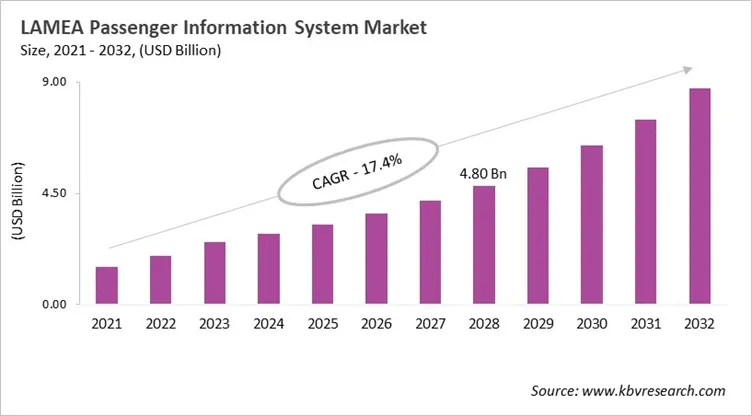
The LAMEA Passenger Information System (PIS) market has grown along with government-led programs to modernize transportation in Latin America, the Middle East, and Africa. Metro and intercity rail projects, especially in GCC countries and big Latin American economies, pushed early adoption. Support from development banks and national governments sped up the use of technologies that give real-time information to passengers. Global OEMs came out with advanced digital platforms that connect to the cloud, let people talk to each other in different languages, and send updates ahead of time. Smart city projects made it easier for PIS to work with rail and bus networks. African markets also started using PIS to make things more reliable and build trust with commuters. PIS is now a key part of smart transportation infrastructure all over the region.
Right now, the LAMEA PIS market is mostly about cloud-based, IoT-enabled, and AI-driven platforms for passenger information. Increasingly, authorities are using centralized systems to send real-time updates to stations, displays on board, and mobile apps. Passengers have a better experience when they can use multimedia-rich interfaces, accessibility features, and emergency communication tools. Leading OEMs stress long-term partnerships with the government, localizing their products, and digital mobility portfolios. Regional players compete with low-cost, tailored solutions, especially in bus and regional rail networks. Telecom and IoT companies are also getting into the game with platforms that work best on mobile devices. Overall, competition is getting stronger as smart mobility investments grow in LAMEA.
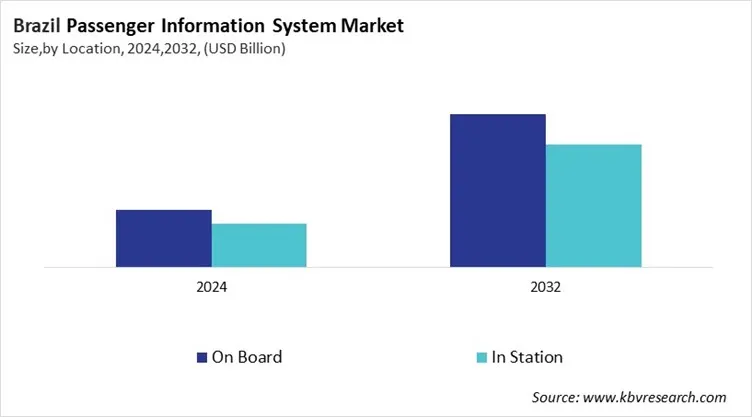
Based on Location, the market is segmented into On Board and In Station. The On Board market segment dominated the Brazil Passenger Information System Market by Location is expected to grow at a CAGR of 13.3 % during the forecast period thereby continuing its dominance until 2032. Also, The In Station market is anticipated to grow as a CAGR of 14.1 % during the forecast period during (2025 - 2032).
Based on Type, the market is segmented into Display Systems, Mobile Applications, Announcement Systems, Video Surveillance System, Infotainment System, Emergency Communication Systems and Other Type. Among various UAE Passenger Information System Market by Type; The Display Systems market achieved a market size of USD $140 Million in 2024 and is expected to grow at a CAGR of 12.6 % during the forecast period. The Emergency Communication Systems market is predicted to experience a CAGR of 16.6% throughout the forecast period from (2025 - 2032).
Free Valuable Insights: The Worldwide Passenger Information System Market is Projected to reach USD 87.05 Billion by 2032, at a CAGR of 13.7%
The Passenger Information System (PIS) market in Brazil has grown along with the country's efforts to upgrade its urban and intercity transportation systems. Real-time passenger information is in high demand in big cities like São Paulo, Rio de Janeiro, and Brasília to make service more reliable and keep people moving. PIS adoption is helped by government mobility plans and Intelligent Transport System projects. The growth of the market is also helped by the growth of metro and BRT networks and the number of people who use them in cities. Partnerships between the public and private sectors encourage people to invest in digital communication technologies for passengers. Cloud-based platforms, mobile integration, and multimodal information delivery are all examples of market trends. Through public tenders, global OEMs and local partners provide advanced PIS solutions. Overall, Brazil's ongoing modernization of its transportation system keeps the demand for PIS high.

By Location
By Component
By Transportation Mode
By Type
By Country
Our team of dedicated experts can provide you with attractive expansion opportunities for your business.




 Unique Offerings