The Latin America, Middle East and Africa Parametric Insurance Market is expected to reach $2.38 billion by 2028 and would witness market growth of 11.3% CAGR during the forecast period (2025-2032).
The Brazil market dominated the LAMEA Parametric Insurance Market by Country in 2024, and would continue to be a dominant market till 2032; thereby, achieving a market value of $795.5 million by 2032. The Argentina market is showcasing a CAGR of 11.9% during (2025 - 2032). Additionally, The UAE market would register a CAGR of 10.3% during (2025 - 2032). The Brazil and UAE led the LAMEA Parametric Insurance Market by Country with a market share of 23.8% and 11.1% in 2024. The Saudi Arabia market is expected to witness a CAGR of 12.3% during throughout the forecast period.
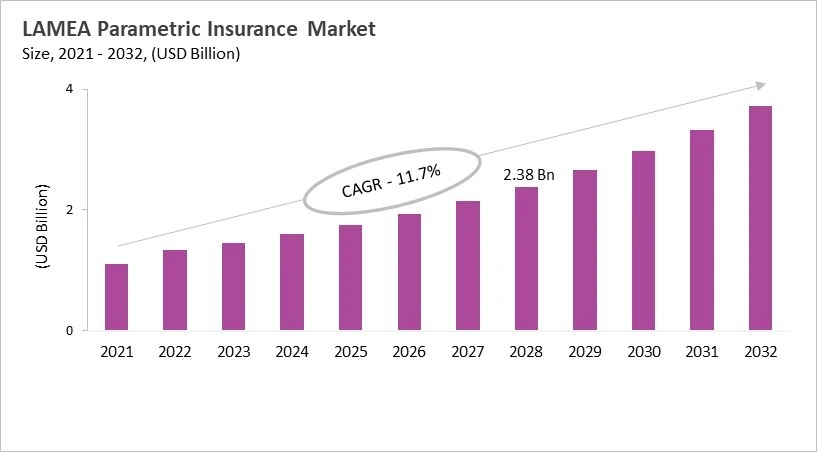
The LAMEA Parametric Insurance Market has changed a lot as more people want new ways to transfer risk that are suited to the changing climate and uncertain economy in Latin America, the Middle East, and Africa. Parametric insurance has become a good alternative to traditional indemnity models, especially in areas that are prone to disasters. This is because it offers set payouts based on objective factors like rainfall, wind speed, or seismic intensity. At first, it was mostly used for agriculture and infrastructure. Now, it is also used for energy, real estate, and events. The market is growing because claims are settled quickly, costs are kept low, risks are assessed clearly, and insurers and governments are working together more to improve disaster risk financing. Improvements in satellite monitoring, the Internet of Things (IoT), and data analytics make modeling even more accurate and boost customer trust, which speeds up adoption across the region.
Key trends that shape the market include using technology to customize products, a strong focus on climate resilience initiatives, and strategic partnerships between insurers, reinsurers, governments, and technology providers. To make their products more accessible and run more smoothly, the top players focus on product innovation, expanding digital distribution, automating claims processing, and working with regulators. Strategic partnerships and a variety of reinsurance arrangements help keep things stable while reaching out to new, underserved markets. Multinational insurers, regional companies, and new insurtech startups are all competing in the analytics, customization, and partnership networks space. In general, the sector shows that LAMEA has a dynamic and innovative environment that helps the economy stay stable and lowers risks.
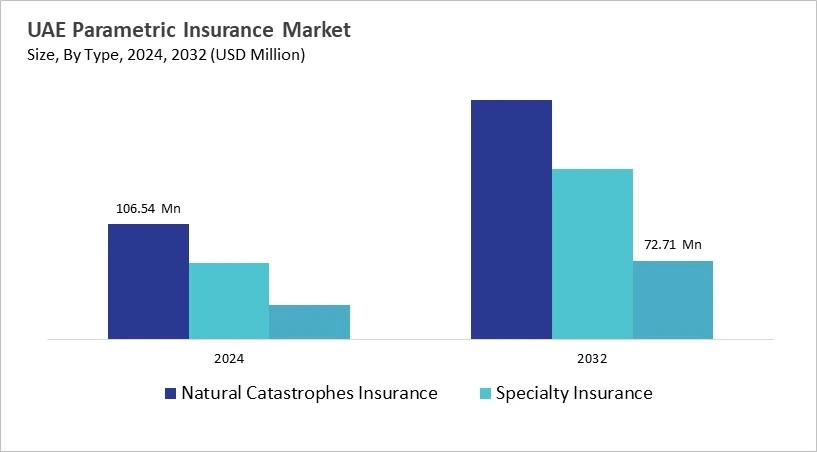
Based on Type, the market is segmented into Natural Catastrophes Insurance, Specialty Insurance, and Other Type. With a compound annual growth rate (CAGR) of 9.7% over the projection period, the Natural Catastrophes Insurance Market, dominate the UAE Parametric Insurance Market by Type in 2024 and would be a prominent market until 2032. The Specialty Insurance market is expected to witness a CAGR of 10.7% during (2025 - 2032).
Based on Vertical, the market is segmented into Agriculture, Energy & Utilities, Construction, Manufacturing, Mining, Aerospace & Defense, and Other Vertical. The Agriculture market segment dominated the Brazil Parametric Insurance Market by Vertical is expected to grow at a CAGR of 9 % during the forecast period thereby continuing its dominance until 2032. Also, The Aerospace & Defense market is anticipated to grow as a CAGR of 12.2 % during the forecast period during (2025 - 2032).
Free Valuable Insights: Parametric Insurance Market Size Worth USD 32.57 billion by 2032
The Brazilian Parametric Insurance Market has grown into a new way for the country's insurance industry to manage risk. It does this by using predefined, data-driven triggers to deal with climate-related risks like floods, droughts, and forest fires instead of the usual claims assessment. The market uses cutting-edge technologies like remote sensing, satellite analytics, machine learning, and blockchain to speed up payments and make things clearer. This makes the financial stability of the agriculture, infrastructure, forestry, and energy sectors stronger. Growth has been helped by more unstable weather, more open regulations, and more people knowing about how to reduce the risk of disasters. The industry is also growing beyond agriculture to include urban and environmental coverage. Product innovation and regional customization are made possible by strategic partnerships between domestic insurers, international reinsurers, technology providers, and government agencies. Overall, the market is marked by strong partnerships, dynamic competition, and a shared focus on Brazil's diverse risk landscape, as well as on sustainability, technological progress, and scalable risk transfer solutions.

By Type
By Vertical
By Country
Our team of dedicated experts can provide you with attractive expansion opportunities for your business.








 Unique Offerings