The Latin America, Middle East and Africa Out-of-band (OOB) Authentication Market would witness market growth of 17.5% CAGR during the forecast period (2025-2032).
The Brazil market dominated the LAMEA Out-of-band (OOB) Authentication Market by Country in 2024, and would continue to be a dominant market till 2032; thereby, achieving a market value of $84.3 Million by 2032. The Argentina market is expected to witness a CAGR of 18.1% during (2025 - 2032). Additionally, The UAE market is expected to witness a CAGR of 16.5% during (2025 - 2032). The Brazil and UAE led the LAMEA Out-of-band (OOB) Authentication Market by Country with a market share of 20.8% and 17.3% in 2024. The South Africa market is expected to witness a CAGR of 18.3% during throughout the forecast period.
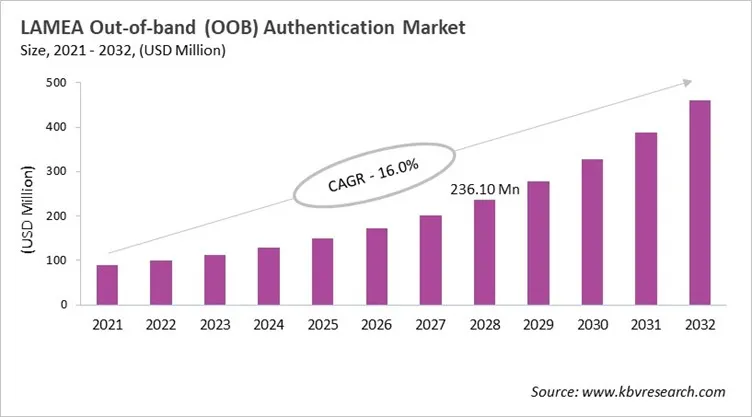
The LAMEA Out-of-Band (OOB) authentication market has grown as digital transformation has happened quickly in Latin America, the Middle East, and Africa. Banks and telecom companies pushed for early adoption to protect online banking, mobile payments, and transactions across borders. Digital identity, e-government, and cybersecurity projects led by the government sped up adoption in both the public and private sectors. Because so many people have mobile phones, SMS, voice, and app-based OOB methods work and can be used on a large scale, even when there isn't much fixed infrastructure. The market has grown from simple OTPs to app-based and push-notification models over the years. Digital trust frameworks in banking, government services, healthcare, and enterprise IT environments across LAMEA now rely on OOB authentication.
The government is putting a lot of emphasis on digital trust and safe digital identities. This is why MFA and OOB authentication are so important. Mobile-centric authentication models are the most popular because so many people use and have access to smartphones. The market is slowly moving away from SMS and toward app-based and encrypted OOB methods that are safer. The best vendors focus on making their products scalable, affordable, and in line with national laws and public sector programs. Designing mobile devices first and making sure that the app works well in a variety of network conditions are two very important strategies. Risk-based and adaptive authentication is becoming more popular to balance security and ease of use. There is a lot of competition, with global vendors, regional providers, and telecom-led services all standing out by being flexible, working with local partners, and being cheap to set up.
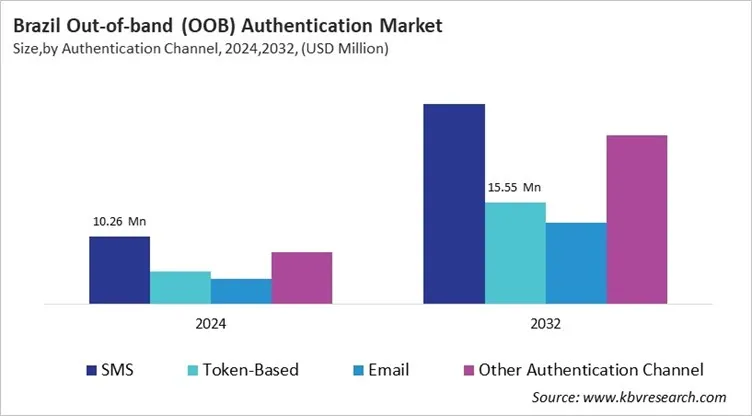
Based on Authentication Channel, the market is segmented into SMS, Token-Based, Email and Other Authentication Channel. The SMS market segment dominated the Brazil Out-of-band (OOB) Authentication Market by Authentication Channel is expected to grow at a CAGR of 14.8 % during the forecast period thereby continuing its dominance until 2032. Also, The Other Authentication Channel market is anticipated to grow as a CAGR of 16.1 % during the forecast period during (2025 - 2032).
Based on Components, the market is segmented into Software and Services. With a compound annual growth rate (CAGR) of 16.2% over the projection period, the Software Market, dominate the UAE Out-of-band (OOB) Authentication Market by Components in 2024 and would be a prominent market until 2032. The Services market is expected to witness a CAGR of 17.2% during (2025 - 2032).
Free Valuable Insights: The Worldwide Out-of-band (OOB) Authentication Market is Projected to reach USD 4.59 Billion by 2032, at a CAGR of 15.8%
Brazil has the biggest Out-of-Band (OOB) authentication market in Latin America because its financial system is very digital, its people are mobile-first, and online banking, instant payments, e-commerce, and digital government services are all very popular. Strong government oversight of the financial sector encourages multi-factor authentication to cut down on fraud and identity theft. This makes OOB authentication a key security layer. High smartphone use makes it possible to deploy mobile-based systems on a large scale, and rising cybercrime speeds up adoption even more. The market is moving away from SMS-based one-time passwords (OTPs) and toward more secure app-based, push-notification, and device-bound authentication methods. Risk-based authentication is possible when real-time fraud detection and behavioral analytics are combined. Cloud-based platforms are becoming more popular because they can grow and be set up more quickly. There is competition from local fintechs, telecom companies, IT providers, and global cybersecurity vendors. Key differences include reliability, compliance, speed, and scalability.

By Components
By Deployment
By Authentication Channel
By End-User Industry
By Country
Our team of dedicated experts can provide you with attractive expansion opportunities for your business.



 Unique Offerings