The Latin America, Middle East and Africa On-device AI Market is expected to reach $1.68 billion by 2028 and would witness market growth of 29.2% CAGR during the forecast period (2025-2032).
The Brazil market dominated the LAMEA On-Device AI Market by Country in 2024, and would continue to be a dominant market till 2032; thereby, achieving a market value of $981.8 million by 2032. The Argentina market is showcasing a CAGR of 31.1% during (2025 - 2032). Additionally, The UAE market would register a CAGR of 27.8% during (2025 - 2032). The Brazil and Saudi Arabia led the LAMEA On-Device AI Market by Country with a market share of 22.8% and 15.3% in 2024.The Nigeria market is expected to witness a CAGR of 31.6% during throughout the forecast period.
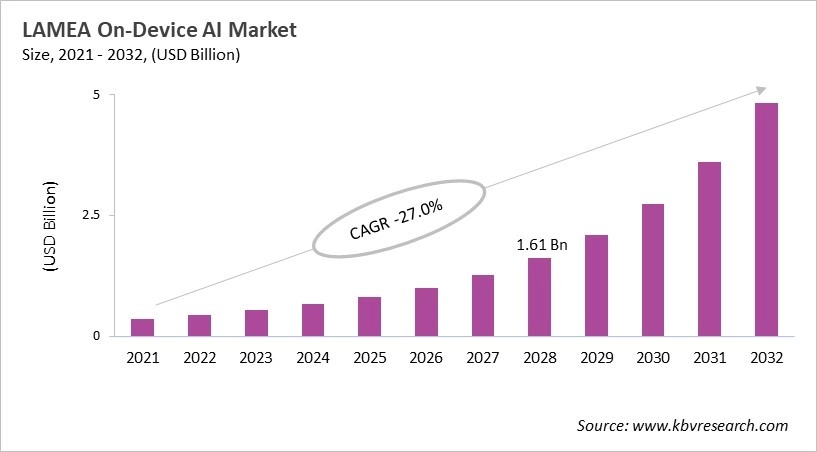
The LAMEA on-device AI market is growing as more regions use localized AI processing on smartphones, IoT devices, industrial equipment, and edge systems to deal with issues like limited connectivity, data sovereignty, and cost sensitivity. Governments supported localized and edge intelligence because early reliance on cloud-based AI caused latency and compliance problems. AI-enabled consumer electronics and the digitization of public infrastructure in the Middle East, Latin America, and Africa helped growth speed up. Portable diagnostics and smart sensors for low-bandwidth environments helped healthcare and agriculture even more. OEMs today make models work better with local languages, rules, and weather. More people see AI on devices as a key part of digital resilience and growth that includes everyone.
Some important trends are stricter compliance with data privacy laws, more AI-enabled consumer devices, and more use of edge AI in public infrastructure and industry. Governments encourage localized processing to lower the risks of data moving across borders. At the same time, OEMs add AI engines to offline translation, vision, and voice apps. Strategies focus on making things more local, working with public institutions, using hardware that uses less energy, and supporting the developer ecosystem. Competition brings together global OEMs and regional integrators that make solutions that fit local needs. In Latin America and Africa, prices are very important, while in parts of the Middle East, high performance is the most important thing. Overall, competition is getting tougher when it comes to efficiency, localization, and scalable deployment.
Based on Vertical, the market is segmented into Consumer Electronics, Automotive, Healthcare, Security & Surveillance, Manufacturing, Retail, and Other Vertical. Among various Brazil On-Device AI Market by Vertical; The Consumer Electronics market achieved a market size of USD $66.2 Million in 2024 and is expected to grow at a CAGR of 26 % during the forecast period. The Retail market is predicted to experience a CAGR of 28.9% throughout the forecast period from (2025 - 2032).
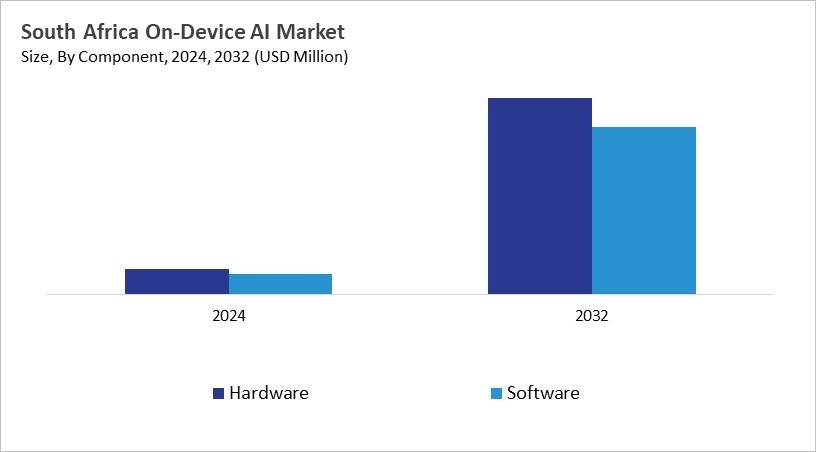
Based on Component, the market is segmented into Hardware, and Software. The Hardware market segment dominated the South Africa On-Device AI Market by Component is expected to grow at a CAGR of 30.1 % during the forecast period thereby continuing its dominance until 2032. Also, The Software market is anticipated to grow as a CAGR of 31.1 % during the forecast period during (2025 - 2032).
Free Valuable Insights: On-device AI Market Size Worth USD 54.79 billion by 2032
Brazil’s on-device AI market is emerging alongside national efforts to make AI a strategic pillar of economic and social development. Government initiatives such as the Brazilian Artificial Intelligence Plan (PBIA) 2024–2028 and the updated EBIA framework promote ethical, transparent, and responsible AI adoption. These policies shape how localized AI solutions are deployed while encouraging public–private collaboration. Industry adoption across agriculture, manufacturing, finance, and public services is driving interest in low-latency and privacy-focused on-device intelligence. Market growth is supported by partnerships with research institutions and global technology firms, although infrastructure gaps and skills shortages remain challenges. Competition involves local startups, innovation hubs, and multinational OEMs providing core platforms and tools. Overall, Brazil is transitioning from cloud-dependent AI toward a hybrid model that includes on-device and edge intelligence.

By Component
By Technology
By Deployment
By Device
By Vertical
By Country
Our team of dedicated experts can provide you with attractive expansion opportunities for your business.



 Unique Offerings