The Latin America, Middle East and Africa Multi-access Edge Computing Market would witness market growth of 49.1% CAGR during the forecast period (2025-2032).
The UAE market dominated the LAMEA Multi-access Edge Computing Market by Country in 2024, and would continue to be a dominant market till 2032; thereby, achieving a market value of $1,932.9 million by 2032. The Argentina market is showcasing a CAGR of 50.2% during (2025 - 2032). Additionally, The Brazil market would register a CAGR of 47.9% during (2025 - 2032). The UAE and Saudi Arabia led the LAMEA Multi-access Edge Computing Market by Country with a market share of 23.8% and 20.9% in 2024. The Nigeria market is expected to witness a CAGR of 51.8% during throughout the forecast period.
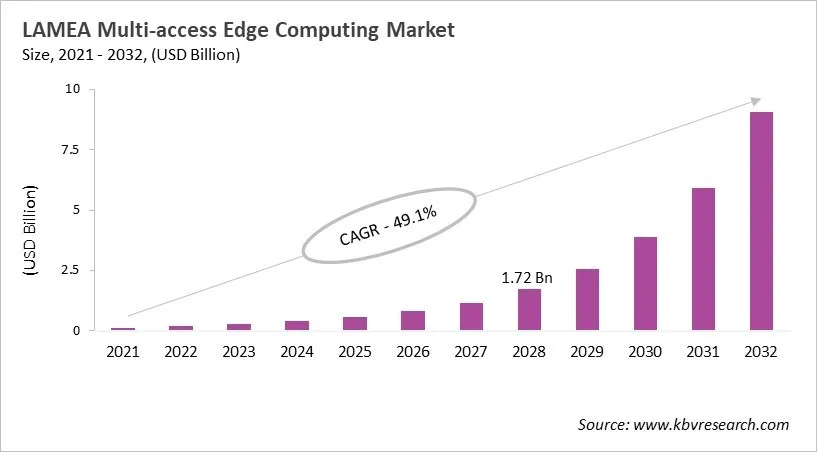
In the LAMEA region, Multi-Access Edge Computing (MEC) has gone from being a niche technology to a key part of 5G and digital transformation projects. MEC makes it possible for low-latency, context-aware services that are important for apps like AR/VR, gaming, industrial automation, and smart city solutions by putting compute, storage, and application services closer to end users, often within or near the radio access network. The fast rollout of 5G, the rising demand for real-time apps, and the need to process data locally to follow data sovereignty rules are all helping MEC grow in Latin America, the Middle East, and Africa. Brazil and the UAE are two examples of countries whose governments are openly supporting MEC through national digital transformation strategies. Meanwhile, telecom companies are working with global cloud providers and OEMs to roll out both consumer and business edge solutions.
Some of the most important trends in the LAMEA MEC market are the merging of MEC with 5G networks, the growth of localized deployments to meet regulatory requirements, and the rise of public-private partnerships and collaborative ecosystems. Etisalat, Nokia, Microsoft, and Huawei are some of the big companies that are using strategic partnerships to offer private 5G and MEC solutions and enterprise-grade edge applications. They are also investing in mini edge data centers to support these efforts. As regional telecom companies, cloud providers, and OEMs compete to build localized infrastructure, and governments encourage the deployment of domestic MEC, competition is heating up. Overall, MEC is becoming a key technology for the region, allowing for new ideas in Industry 4.0, smart cities, the Internet of Things, and other applications that need a lot of data quickly.
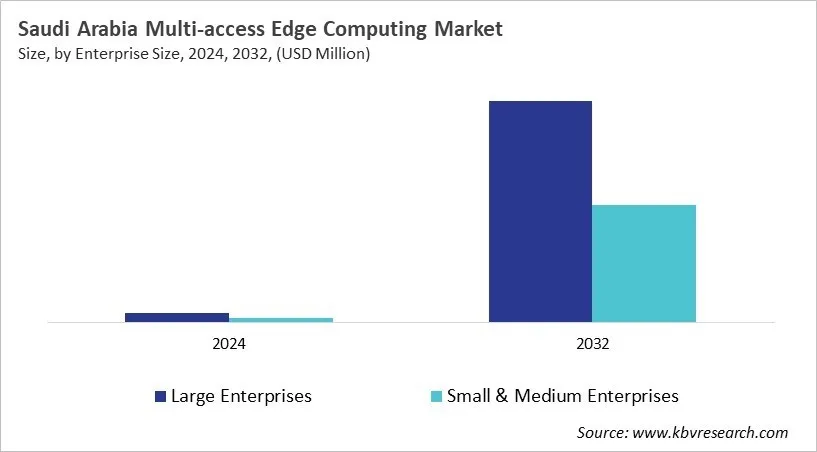
Based on Enterprise Size, the market is segmented into Large Enterprises and Small & Medium Enterprises. With a compound annual growth rate (CAGR) of 49.3% over the projection period, the Large Enterprises Market, dominate the Saudi Arabia Multi-access Edge Computing Market by Enterprise Size in 2024 and would be a prominent market until 2032. The Small & Medium Enterprises market is expected to witness a CAGR of 51% during (2025 - 2032).
Based on Network Type, the market is segmented into Wireless MEC and Wired MEC. The Wireless MEC market segment dominated the UAE Multi-access Edge Computing Market by Network Type is expected to grow at a CAGR of 46.5 % during the forecast period thereby continuing its dominance until 2032. Also, The Wired MEC market is anticipated to grow as a CAGR of 48.3 % during the forecast period during (2025 - 2032).
Free Valuable Insights: The Worldwide Multi-access Edge Computing Market is Projected to reach USD 104.46 Billion by 2032, at a CAGR of 46.6%
The UAE has become the LAMEA region's top user of Multi-Access Edge Computing (MEC) because of its focus on digital transformation, AI integration, and smart-city development. Its early rollout of 5G, strong regulatory framework, and smart investments in cloud and telecom infrastructure make it easier for mission-critical sectors like oil and gas, aviation, logistics, and tourism to do computing in their own areas. MEC makes it possible for ultra-low-latency applications to work in healthcare, transportation, and industrial automation. This is thanks to government programs and strategies for building digital infrastructure. The market is showing strong growth in partnerships between cloud and telecom companies, private 5G networks, and edge-enabled solutions for robotics, computer vision, and remote diagnostics. Telecom companies, global cloud platforms, and OEMs work together to shape competition. In the UAE MEC ecosystem, partnerships and integration that are specific to certain industries drive leadership.

By Enterprise Size
By Solution Type
By Network Type
By End-Use
By Country
Our team of dedicated experts can provide you with attractive expansion opportunities for your business.



 Unique Offerings