The Latin America, Middle East and Africa Mobile Business Management Market is expected to reach $778.11 million by 2028 and would witness market growth of 14.2% CAGR during the forecast period (2025-2032).
The Brazil market dominated the LAMEA Mobile Business Process Management Market by Country in 2024, and would continue to be a dominant market till 2032; thereby, achieving a market value of $273.3 million by 2032. The Argentina market is showcasing a CAGR of 15.4% during (2025 - 2032). Additionally, The UAE market would register a CAGR of 12.8% during (2025 - 2032). The Brazil and UAE led the LAMEA Mobile Business Process Management Market by Country with a market share of 22.8% and 12.1% in 2024. The South Africa market is expected to witness a CAGR of 15.5% during throughout the forecast period.
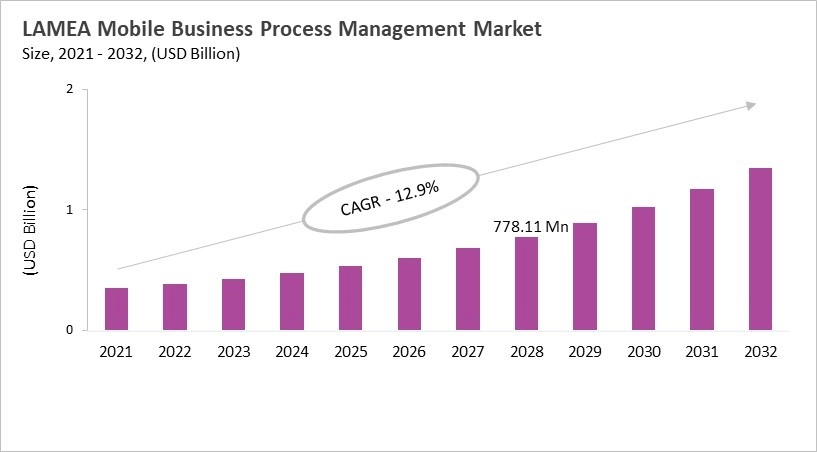
The LAMEA mobile BPM market has grown along with digital transformation projects in the region that aim to make things more efficient, improve service delivery, and make the economy more resilient. The shift from traditional BPM to mobile-enabled workflows happened faster because more people were using smartphones and mobile networks. Cloud computing made it possible for businesses and public institutions to deploy their infrastructure in a way that could grow with them. The COVID-19 pandemic made the need for processes that can be accessed from a mobile device even stronger to support remote work and keep operations going. Mobile-first automation, more use of cloud-based BPM platforms, and connections with low-code and intelligent automation tools are some of the most important trends.
Top companies like IBM, SAP, Microsoft, Oracle, and Appian are working to get more people to use their products in LAMEA markets by focusing on platform integration, cloud-first strategies, and low-code enablement. To build trust between businesses and governments, security, reliability, and following the rules are still very important. The market is somewhat competitive, with differences based on how well the product works on mobile devices, how easily it can be scaled in the cloud, how easily it can be deployed, and how well it works with other products in the ecosystem. In general, mobile BPM is becoming a useful and scalable way to modernize digital technology in Latin America, the Middle East, and Africa.
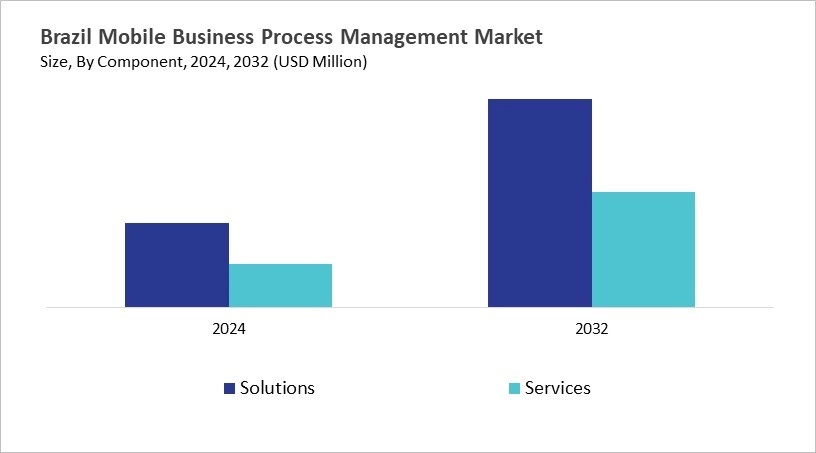
Based on Component, the market is segmented into Solutions and Services. With a compound annual growth rate (CAGR) of 12.1% over the projection period, the Solutions Market, dominate the Brazil Mobile Business Process Management Market by Component in 2024 and would be a prominent market until 2032. The Services market is expected to witness a CAGR of 13.2% during (2025 - 2032).
Based on Deployment Mode, the market is segmented into Cloud and On-Premise. The Cloud market segment dominated the UAE Mobile Business Process Management Market by Deployment Mode is expected to grow at a CAGR of 12.9 % during the forecast period thereby continuing its dominance until 2032. Also, The On-Premise market is anticipated to grow as a CAGR of 12.6 % during the forecast period during (2025 - 2032).
Free Valuable Insights: Mobile Business Process Management Market Size Worth USD 13.35 billion by 2032
Brazil’s mobile BPM market is driven by strong public sector digital transformation initiatives and widespread mobile adoption, led by strategies such as the National Digital Government Strategy 2024–2027 and the E-Digital Strategy that promote mobile-first, integrated digital services and automated workflows. High mobile connectivity and expanding broadband infrastructure support the shift toward mobile-enabled process management across public and private sectors. Enterprises increasingly adopt mobile BPM to streamline approvals, integrate customer service systems, and improve productivity through real-time workflow access and analytics, with growing preference for cloud-native platforms. Competition includes global software vendors offering localized solutions and domestic providers aligned with national digital identity and interoperability requirements, along with startups and telecom-led platforms in sectors like finance, logistics, and utilities. Supported by regulatory focus on efficiency and transparency, rising mobile usage, and continued government backing, mobile BPM is emerging as a key enabler of operational agility and digital governance in Brazil.

By Component
By Deployment Mode
By Enterprise Size
By End-User Industry
By Country
Our team of dedicated experts can provide you with attractive expansion opportunities for your business.



 Unique Offerings