The Latin America, Middle East and Africa Medical Imaging Informatics Market would witness market growth of 7.6% CAGR during the forecast period (2025-2032).
The Brazil market dominated the LAMEA Other Application Market by Country in 2024, and would continue to be a dominant market till 2032; thereby, achieving a market value of $5.5 million by 2032. The Argentina market is showcasing a CAGR of 11.5% during (2025 - 2032). Additionally, The UAE market would register a CAGR of 9.9% during (2025 - 2032). The Brazil and Saudi Arabia led the LAMEA Medical Imaging Informatics Market by Country with a market share of 20.8% and 14.4% in 2024.The Nigeria market is expected to witness a CAGR of 9.8% during throughout the forecast period.
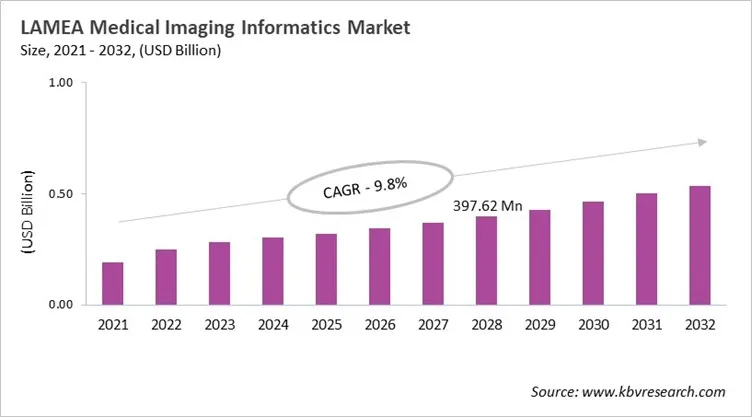
As healthcare systems in Latin America, the Middle East, and Africa work on modernization, digital health adoption, and making more diagnostic tests available, the LAMEA medical imaging informatics market is growing steadily. Through national digital health and cloud initiatives, governments are encouraging the use of PACS, RIS, enterprise imaging, and analytics. The Middle East is the strongest region when it comes to investing in AI-enabled healthcare and cloud infrastructure. Latin America and Africa, on the other hand, focus on expanding telehealth and digitizing imaging. The goal of these efforts is to make workflows more efficient, cut down on diagnostic delays, and make it easier for healthcare networks to share data.
Artificial intelligence is being used increasingly, cloud-based imaging platforms are being used more widely, and tele-radiology services are growing quickly. AI tools help with the lack of radiologists and make diagnoses more accurate in places with a lot of patients. Cloud solutions make it possible to store more data, keep it safe, and work together from anywhere. Global OEMs are the most competitive in the market because they offer advanced, cloud-ready, and AI-enabled enterprise imaging solutions, which are backed by regional partnerships. Interoperability, cybersecurity, scalability, and better clinical efficiency are the main areas of competition.
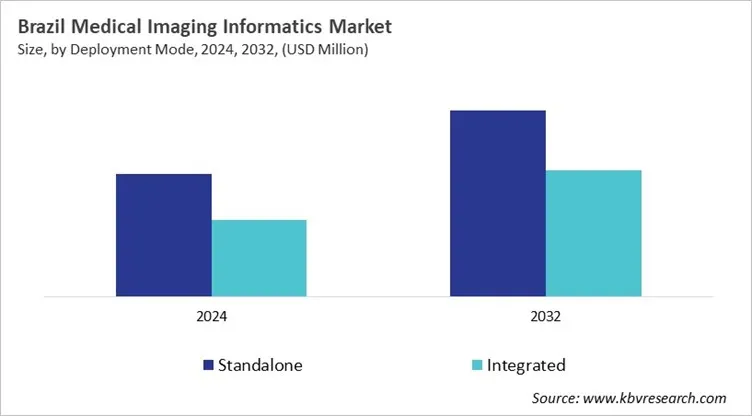
Based on Deployment Mode, the market is segmented into Standalone, and Integrated. The Standalone market segment dominated the Brazil Medical Imaging Informatics Market by Deployment Mode is expected to grow at a CAGR of 5.4 % during the forecast period thereby continuing its dominance until 2032. Also, The Integrated market is anticipated to grow as a CAGR of 6.5 % during the forecast period during (2025 - 2032).
Based on End User, the market is segmented into Hospitals, Specialized Clinics, and Other End User. With a compound annual growth rate (CAGR) of 5.9% over the projection period, the Hospitals Market, dominate the UAE Medical Imaging Informatics Market by End User in 2024 and would be a prominent market until 2032. The Specialized Clinics market is expected to witness a CAGR of 6.8% during (2025 - 2032).
Free Valuable Insights: The Worldwide Medical Imaging Informatics Market is Projected to reach USD 5.42 Billion by 2032, at a CAGR of 6.0%
Brazil has the biggest healthcare market in Latin America. Medical imaging informatics is becoming more popular because people are spending more on healthcare and there is a growing need for diagnostic imaging. Hospitals are using PACS, digital archiving, and decision support tools increasingly to handle the growing number of images from different specialties. The high number of people with chronic diseases and the money spent on new imaging technologies make it even more important to have efficient informatics workflows. Urban areas are leading the way in adoption because they have better infrastructure and more private healthcare investment. However, cost, interoperability, and a lack of workers are holding back wider adoption. Some important trends are PACS that run in the cloud, AI that helps analyze images, and teleradiology services that are growing. Interoperable health records help make sure that care continues. Competition is fueled by global and regional vendors concentrating on AI, cloud adaptability, cybersecurity, and system integration.

By Deployment Mode
By Component
By End User
By Application
By Country
Our team of dedicated experts can provide you with attractive expansion opportunities for your business.



 Unique Offerings