The Latin America, Middle East and Africa Manufacturing Operations Management Software Market would witness market growth of 20.6% CAGR during the forecast period (2025-2032).
The Brazil market dominated the LAMEA Manufacturing Operations Management Software Market by Country in 2024, and would continue to be a dominant market till 2032; thereby, achieving a market value of $2,183 million by 2032. The Argentina market is showcasing a CAGR of 21.2% during (2025 - 2032). Additionally, The UAE market would register a CAGR of 19.2% during (2025 - 2032). The Brazil and UAE led the LAMEA Manufacturing Operations Management Software Market by Country with a market share of 33.8% and 12% in 2024. The Nigeria market is expected to witness a CAGR of 22.8% during throughout the forecast period.
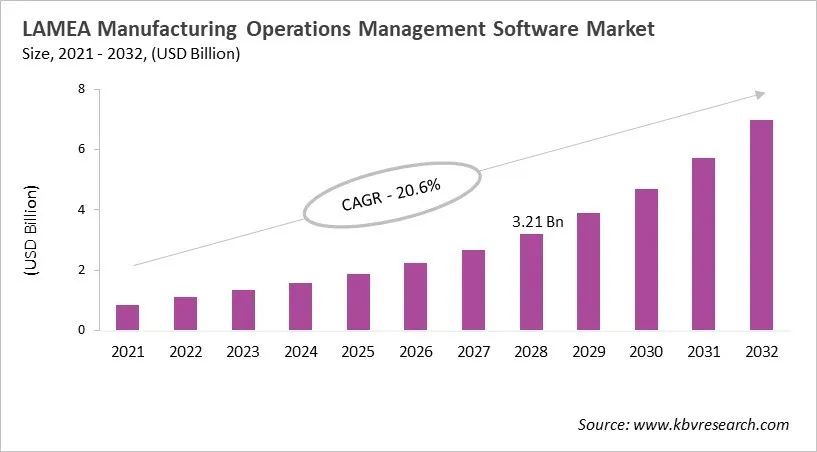
The LAMEA Manufacturing Operations Management (MOM) software market has changed from simple shop-floor control systems to full, integrated platforms that bring together quality assurance, production planning, inventory management, scheduling, and performance analytics. Manufacturers in the region are using more and more connected, data-driven systems. This is happening faster because of government-backed industrial initiatives like Saudi Arabia's Vision 2030, the UAE's Industry 4.0 programs, and Brazil's adoption of digital factories. Modern MOM solutions now include predictive analytics, energy optimization, equipment-health monitoring, and workflow automation. They connect old systems with cloud-ready and modular deployments. These platforms are moving beyond early adopters like oil and gas, automotive, and metals into pharmaceuticals, food processing, chemicals, and consumer goods. They help with operational efficiency, traceability, and compliance with Industry 4.0.
In LAMEA, key market trends include the widespread use of IIoT-enabled smart factories, the ability to see production across the entire company with multi-plant digital standardization, and modular cloud-based solutions for small and medium-sized businesses. Companies like Siemens and ABB are making adoption easier by offering flexible deployment models, advanced analytics, and localized implementation partnerships that take into account differences in the workforce, regulations, and infrastructure in different areas. Competition is when global leaders offer high-end, multi-plant solutions and regional integrators offer low-cost, industry-specific deployments. Cloud-enabled, subscription-based MOM platforms and lifecycle-focused services, such as consulting, training, and sustainability integration, are becoming important strategic differentiators. This is changing the market from digital transformation partnerships based only on features to ones based on value.
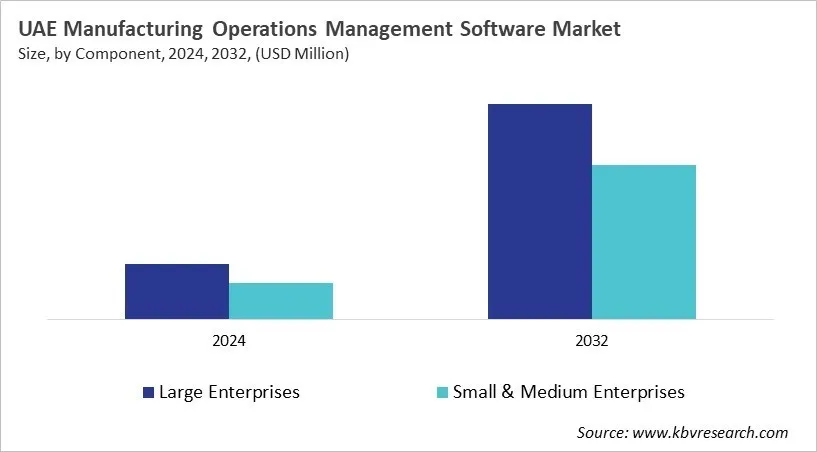
Based on Component, the market is segmented into Software and Services. With a compound annual growth rate (CAGR) of 18.8% over the projection period, the Software Market, dominate the UAE Manufacturing Operations Management Software Market by Component in 2024 and would be a prominent market until 2032. The Services market is expected to witness a CAGR of 20.2% during (2025 - 2032).
Based on Deployment, the market is segmented into Cloud and On-Premise. The Cloud market segment dominated the Brazil Manufacturing Operations Management Software Market by Deployment is expected to grow at a CAGR of 19.7 % during the forecast period thereby continuing its dominance until 2032. Also, The On-Premise market is anticipated to grow as a CAGR of 19.1 % during the forecast period during (2025 - 2032).
Free Valuable Insights: The Worldwide Manufacturing Operations Management Software Market is Projected to reach USD 63.22 Billion by 2032, at a CAGR of 18.7%
Brazil is one of the most important places for manufacturing in Latin America. It has a lot of activity in the automotive, consumer goods, machinery, food processing, and electronics industries. More and more businesses in the country's diverse industrial sector are using Manufacturing Operations Management (MOM) software to improve operational efficiency, real-time visibility, quality consistency, traceability, and integrated production workflows. MOM adoption is driven by the need to boost productivity while costs rise, Industry 4.0 initiatives, and competition from imports from around the world. However, uneven adoption is caused by differences in digital readiness, old systems, and skill gaps. Some of the most important trends are a move toward modular, cloud-enabled solutions, end-to-end visibility, predictive analytics, AI-driven optimization, and monitoring of sustainability. Competition is influenced by global vendors that offer complete platforms and local players that offer cheap, tailored solutions. Success depends on vertical expertise, quick ROI, and the ability to adapt to Brazil's unique manufacturing environment.

By Enterprise Size
By Component
By Deployment
By Application
By End User
By Country
Our team of dedicated experts can provide you with attractive expansion opportunities for your business.



 Unique Offerings