The Latin America, Middle East and Africa Legacy IT System Modernization Market is expected to reach $2.42 billion by 2028 and would witness market growth of 18.3% CAGR during the forecast period (2025-2032).
The Brazil market dominated the LAMEA Legacy IT System Modernization Market by Country in 2024, and would continue to be a dominant market till 2032; thereby, achieving a market value of $1,127.6 million by 2032. The Argentina market is showcasing a CAGR of 19.8% during (2025 - 2032). Additionally, The UAE market would register a CAGR of 17.1% during (2025 - 2032). The Brazil and Saudi Arabia led the LAMEA Legacy IT System Modernization Market by Country with a market share of 25.8% and 15.5% in 2024. The South Africa market is expected to witness a CAGR of 19.5% during throughout the forecast period.
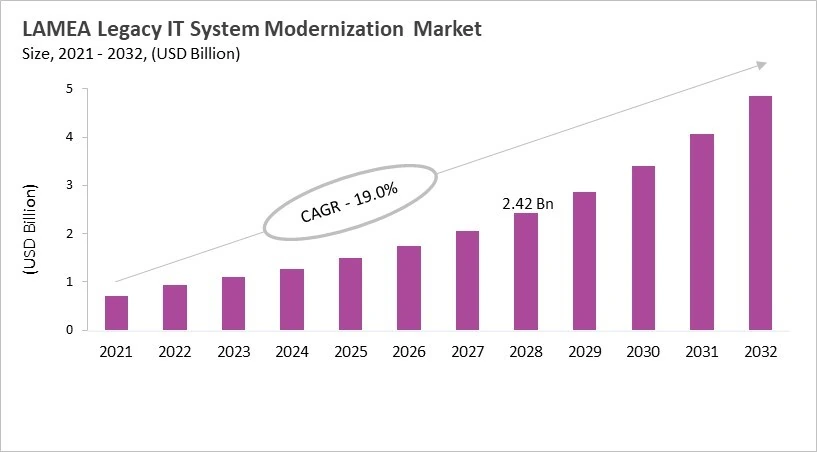
Modernizing outdated IT systems has become a strategic public sector priority in Latin America, the Middle East, and Africa (LAMEA). The goal is to improve service delivery, administrative efficiency, and digital resilience. Many government agencies still use old, monolithic systems that were made decades ago for basic process automation instead of digital services that put citizens first. As the population grows, cities grow, and service expectations rise, these old systems have trouble with scalability, cybersecurity, integration, and maintenance costs. Since the 2010s, national digital transformation plans and international development frameworks have sped up structured, multi-year modernization programs that are in line with long-term goals for governance and the economy. OEM technology providers like IBM, Microsoft, Google Cloud, and AWS have become key partners. They offer secure cloud, hybrid, and application modernization solutions that work in a variety of regulatory and infrastructure settings.
The use of hybrid and cloud-based models that let legacy workloads move over time while keeping sensitive data safe and following the rules is a big trend in LAMEA. Governments are more and more choosing incremental modernization methods like encapsulation, interface upgrades, and selective refactoring to keep services running smoothly and stay within budget. Cybersecurity, operational resilience, and digital trust are important factors in modernization. Security-by-design architectures and better identity management are becoming standard priorities. Leaders in the public sector stress system portfolio assessments, shared platforms, and standardized architectures to get the most out of their investments and make sure that different systems can work together. In the competitive landscape, global OEMs and regional system integrators set themselves apart by offering secure platforms, regulatory expertise, and the ability to gradually modernize critical systems without interrupting important public services.
Based on Component, the market is segmented into Services and Software. The Services market segment dominated the South Africa Legacy IT System Modernization Market by Component is expected to grow at a CAGR of 19.2 % during the forecast period thereby continuing its dominance until 2032. Also, The Software market is anticipated to grow as a CAGR of 19.9 % during the forecast period during (2025 - 2032).
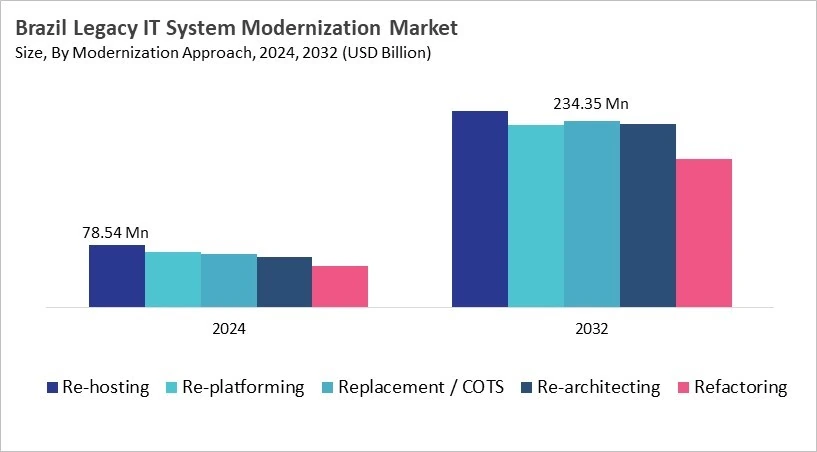
Based on Modernization Approach, the market is segmented into Re-hosting, Re-platforming, Replacement / COTS, Re-architecting and Refactoring. Among various Brazil Legacy IT System Modernization Market by Modernization Approach; The Re-hosting market achieved a market size of USD $78.5 Million in 2024 and is expected to grow at a CAGR of 15.6 % during the forecast period. The Re-architecting market is predicted to experience a CAGR of 17.7% throughout the forecast period from (2025 - 2032).
Based on End-User Industry, the market is segmented into BFSI, IT & Telecommunications, Manufacturing, Healthcare, Retail & E-commerce, Government & Public Sector and Other End-User Industry. With a compound annual growth rate (CAGR) of 18% over the projection period, the BFSI Market, dominate the Argentina Legacy IT System Modernization Market by End-User Industry in 2024 and would be a prominent market until 2032. The Government & Public Sector market is expected to witness a CAGR of 21.7% during (2025 - 2032).
Free Valuable Insights: Legacy IT System Modernization Market Size Worth USD 50.32 billion by 2032
Brazil's plan to modernize its old IT systems is closely linked to its national digital transformation and public service reform agenda, which aims to make government more efficient, open, and focused on citizens. The government is focusing on interoperable platforms, cybersecurity, digital inclusion, and broadband expansion to get around the problems caused by outdated, siloed infrastructures. This is all part of the Digital Transformation Strategy (E-Digital). Brazil is not replacing its entire system at once. Instead, it is using phased, hybrid modernization methods that include moving to the cloud, standardizing data, and creating digital identity frameworks. This change is happening faster because of public-private partnerships and help from organizations like the Inter-American Development Bank and programs like "Brasil Mais Digital." Serpro and other domestic companies, as well as global technology providers, are very important for providing scalable, secure, and integrated digital solutions at the federal, state, and local levels. All of these efforts make legacy IT modernization a key part of Brazil's long-term economic growth and sustainable digital governance.

By Component
By Deployment Type
By Enterprise Size
By Modernization Approach
By End-User Industry
By Country
Our team of dedicated experts can provide you with attractive expansion opportunities for your business.



 Unique Offerings