The Latin America, Middle East and Africa Industrial Edge Market would witness market growth of 15.3% CAGR during the forecast period (2025-2032).
The Brazil market dominated the LAMEA Industrial Edge Market by Country in 2024, and would continue to be a dominant market till 2032; thereby, achieving a market value of $814.1 million by 2032. The Argentina market is showcasing a CAGR of 15.9% during (2025 - 2032). Additionally, The UAE market would register a CAGR of 14.4% during (2025 - 2032). The Brazil and UAE led the LAMEA Industrial Edge Market by Country with a market share of 21.8% and 17% in 2024. The Nigeria market is expected to witness a CAGR of 17.4% during throughout the forecast period.
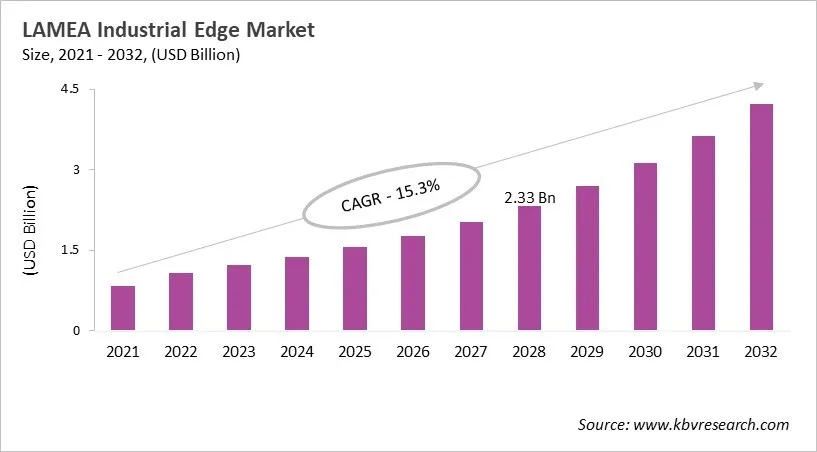
The LAMEA industrial edge market has grown steadily as Latin American, Middle Eastern, and African countries worked to modernize their industries. This was driven by government programs, digital transformation policies, and the need for localized, real-time operational intelligence. Industries like manufacturing, oil and gas, energy, mining, and logistics pushed for faster adoption by looking for low-latency analytics, predictive maintenance, and better equipment performance. Global OEMs like Siemens, ABB, Schneider Electric, and Mitsubishi Electric were very important because they set up edge-enabled automation platforms, ruggedized gateways, and hybrid cloud-edge architectures that were made for different types of industrial settings around the world. The introduction of 4G and 5G made this evolution even stronger by making it possible to set up scalable and reliable multi-site industrial edge deployments.
Some important trends in the market are the growing need for real-time edge analytics, the growing use of hybrid architectures that combine local processing with cloud orchestration, and the quick merging of IT and OT in modernized industrial facilities. Manufacturers in LAMEA are adding AI-ready controllers, distributed analytics, and digital twins to their systems to make automation and operations more resilient. To speed up adoption, top OEMs are using strategies that include integrated platforms, solutions tailored to specific industries, strong partnerships in the ecosystem, and service-led support. In the competitive landscape, there are global automation leaders, regional integrators, and telecom operators. Companies set themselves apart by their ability to scale, work with other systems, be secure, and align with the digital transformation priorities of their industry.
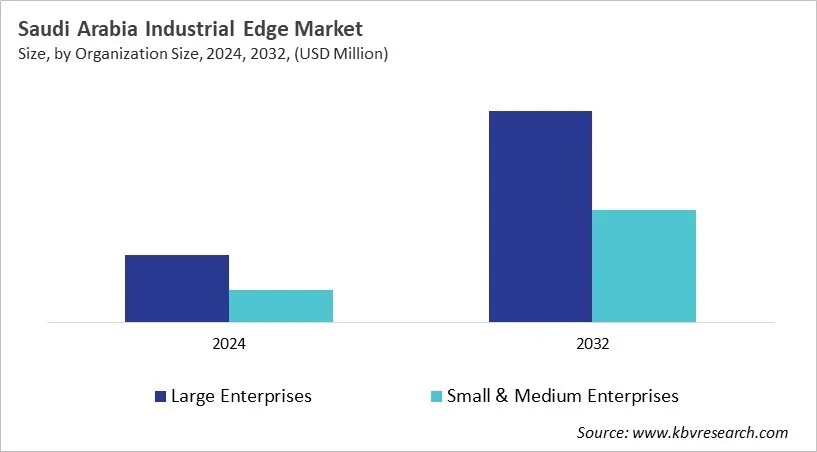
Based on Organization Size, the market is segmented into Large Enterprises, and Small & Medium Enterprises. With a compound annual growth rate (CAGR) of 15.7% over the projection period, the Large Enterprises Market, dominate the Saudi Arabia Industrial Edge Market by Organization Size in 2024 and would be a prominent market until 2032. The Small & Medium Enterprises market is expected to witness a CAGR of 17.1% during (2025 - 2032).
Based on Deployment Mode, the market is segmented into On-Premise, and Cloud. The On-Premise market segment dominated the Brazil Industrial Edge Market by Deployment Mode is expected to grow at a CAGR of 13.1 % during the forecast period thereby continuing its dominance until 2032. Also, The Cloud market is anticipated to grow as a CAGR of 14.3 % during the forecast period during (2025 - 2032).
Free Valuable Insights: The Worldwide Industrial Edge Market is Projected to reach USD 55.07 Billion by 2032, at a CAGR of 13.1%
Brazil's industrial edge computing scene is growing as part of the country's larger "neo-industrialization" plan, which is based on the Nova Indústria Brasil policy. This policy gives a lot of money to modernize the industry and make it more competitive until 2033. Even though industrial output is flat, and the economy is facing some challenges, the large manufacturing base and government incentives, such as tax breaks for IT infrastructure and new procurement rules, make it easier for edge adoption to happen. Interest in IIoT, industrial digitalization, real-time analytics, and sustainability is growing in all 23 targeted sectors. However, high interest rates and complicated regulations may make it harder to invest. Because of this, Brazil's industrial edge market will have a lot of participation from global OEMs backed by local integrators. Success will depend on the ability to provide local service, align with data sovereignty, and work with existing operational environments.

By Organization Size
By Component
By Deployment Mode
By End-use
By Application
By Country
Our team of dedicated experts can provide you with attractive expansion opportunities for your business.








 Unique Offerings