The Latin America, Middle East and Africa Industrial Automation Services Market would witness market growth of 11.4% CAGR during the forecast period (2025-2032).
The Brazil market dominated the LAMEA Industrial Automation Services Market by Country in 2024, and would continue to be a dominant market till 2032; thereby, achieving a market value of $7,136 million by 2032. The Argentina market is showcasing a CAGR of 12.3% during (2025 - 2032). Additionally, The UAE market would register a CAGR of 10.1% during (2025 - 2032). The Brazil and Saudi Arabia led the LAMEA Industrial Automation Services Market by Country with a market share of 20.8% and 15.4% in 2024. The Nigeria market is expected to witness a CAGR of 13.5% during throughout the forecast period.
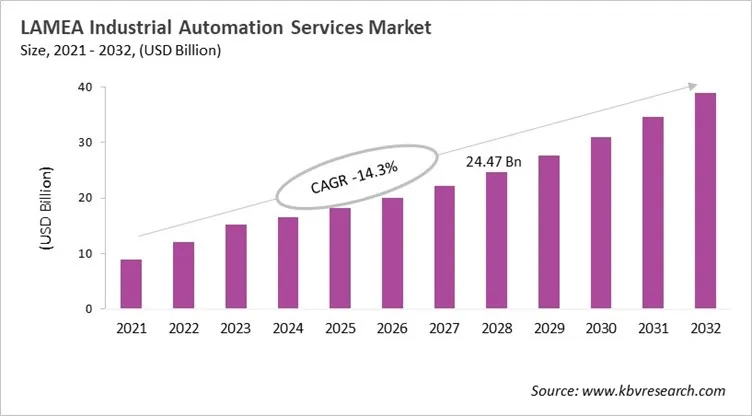
The LAMEA industrial automation services market has grown slowly over time because of government-led efforts to modernize industry, programs to diversify the economy, and more people in Latin America, the Middle East, and Africa using digital technology. Automation was limited in the past because people had to do a lot of work by hand. But starting in the 1990s, countries like Brazil, Mexico, South Africa, and the Gulf states began to invest in robotics, control systems, and process automation. National programs like Saudi Vision 2030 and the UAE's Industry 4.0 strategies sped up the need for services like integration, maintenance, and lifecycle management of automation systems. Energy, mining, manufacturing, and utilities have all grown a lot, thanks to investments from multinational OEMs and local engineering hubs.
Digital transformation, energy efficiency, and sustainability are the most important things that drive the market today. More people are using IIoT, AI-based predictive maintenance, cloud monitoring, and remote operations, especially since the pandemic. Automation is very important for the oil and gas, mining, water, and infrastructure industries to make things safer, more reliable, and more productive. To meet the needs of different regions, top OEMs focus on digital services, localization, and partnerships. Competition is still strong, with global leaders and regional integrators fighting for business based on price, customization, and advanced digital automation features.
Based on Service Type, the market is segmented into Project Engineering and Installation, Maintenance & Support, Consulting Services, Operational Services and Other Service Type. With a compound annual growth rate (CAGR) of 8.3% over the projection period, the Project Engineering and Installation Market, dominate the Brazil Industrial Automation Services Market by Service Type in 2024 and would be a prominent market until 2032. From 2025 to 2032 The Operational Services market is expected to witness a CAGR of 10.7% during (2025 - 2032).
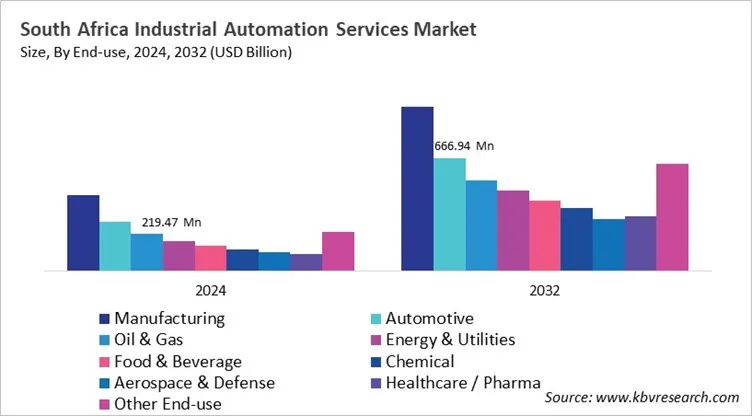
Based on End-use, the market is segmented into Manufacturing, Automotive, Oil & Gas, Energy & Utilities, Food & Beverage, Chemical, Aerospace & Defense, Healthcare / Pharma and Other End-use. Among various South Africa Industrial Automation Services Market by End-use; The Manufacturing market achieved a market size of USD $446.1 Million in 2024 and is expected to grow at a CAGR of 10.4 % during the forecast period. The Aerospace & Defense market is predicted to experience a CAGR of 13.5% throughout the forecast period from (2025 - 2032).
Free Valuable Insights: The Worldwide Industrial Automation Services Market is Projected to reach USD 373.92 Billion by 2032, at a CAGR of 10.4%
Brazil is a key industrial automation services market in Latin America, supported by strong automotive, food processing, mining, energy, and heavy machinery industries. The need to modernize legacy plants and improve global competitiveness is accelerating automation adoption. Rising focus on digital transformation, robotics, and predictive maintenance is boosting demand for automation services. Economic volatility, cost pressures, and skilled labor shortages further push manufacturers toward efficiency-driven automation. Automation opportunities are also expanding across Brazil’s agricultural and food supply chains, logistics, and quality control operations. Key trends include smart factories, IoT-based monitoring, machine vision, and cloud-enabled remote support. Strong demand exists in mining, steel, and oil & gas due to safety and continuity needs. The market remains competitive, with global OEMs and local integrators offering increasingly customized automation solutions.

By Service Type
By End Use
By Product Type
By Country
Our team of dedicated experts can provide you with attractive expansion opportunities for your business.




 Unique Offerings