The Latin America, Middle East and Africa HMI Sensors In Wearables Market is expected to reach $439.28 million by 2028 and would witness market growth of 14.9% CAGR during the forecast period (2025-2032).
The Brazil market dominated the LAMEA HMI Sensors In Wearables Market by Country in 2024, and would continue to be a dominant market till 2032; thereby, achieving a market value of $200.5 million by 2032. The Argentina market is registering a CAGR of 15.4% during (2025 - 2032). Additionally, The UAE market would showcase a CAGR of 13.8% during (2025 - 2032). The Brazil and UAE led the LAMEA HMI Sensors In Wearables Market by Country with a market share of 27.9% and 14.4% in 2024. The South Africa market is expected to witness a CAGR of 15.7% during throughout the forecast period.
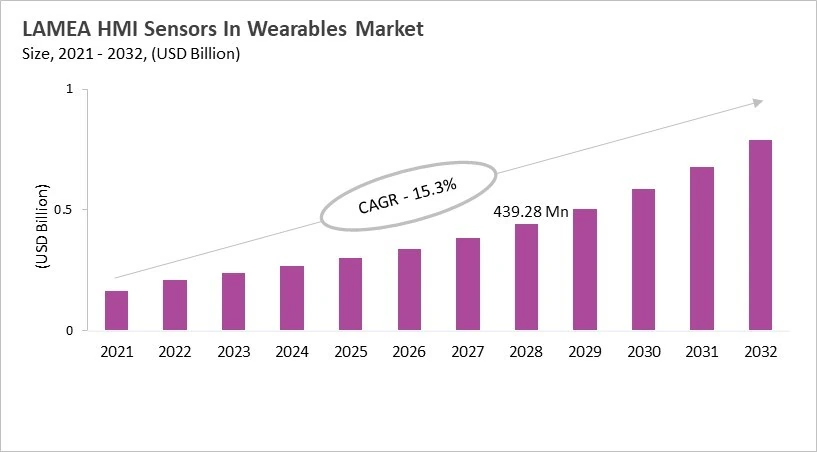
More people in the LAMEA region are using wearable devices because of better digital connectivity, more awareness of health issues, and a need for remote monitoring solutions. Smartwatches, fitness bands, and hearables can be used in a natural way thanks to HMI sensors like touch interfaces, motion sensors, and optical biosensors. Wearables are being used more for preventive health care, fitness tracking, and safety at work, especially when access to regular health care is limited. As telemedicine and community health programs grow, countries like Brazil and Mexico in Latin America are seeing strong growth. In the Middle East and Africa, more people are moving to cities and their incomes are going up, which is driving up demand for health-focused wearables. In general, HMI sensors are moving from basic activity tracking to more advanced biometric and connected health platforms. This is part of a bigger trend in LAMEA toward smart, real-time, and user-centered wearable ecosystems.
Companies that make technology, like Infineon and STMicroelectronics, are very important because they make low-power, multi-modal sensor platforms that work best with wearable devices. Their plans are to improve battery life and form factors while combining motion, environmental, and biometric sensing. Working together with software and smartphone ecosystems makes it easier to see data and get personalized insights. Developer support, design kits, and partnerships with other companies in the ecosystem make it easier for regional OEMs to get started. Sensor accuracy, power optimization, and compact integration are what drive competition. In Brazil, South Africa, and the UAE, new ideas are coming up for health and industrial uses. As governments push for digital health and telemedicine, wearables with HMI sensors are becoming a key part of healthcare and IoT ecosystems in LAMEA.
Based on Device Type, the market is segmented into Smartwatches & Fitness Bands, Hearables / Earbuds, Smart Glasses / AR Glasses, Head-Mounted Displays (HMDs), Smart Rings / Wristbands, Smart Clothing, and Other Device Type. The Smartwatches & Fitness Bands market segment dominated the Brazil HMI Sensors In Wearables Market by Device Type is expected to grow at a CAGR of 12.2 % during the forecast period thereby continuing its dominance until 2032. Also, The Smart Clothing market is anticipated to grow as a CAGR of 16.3 % during the forecast period during (2025 - 2032).
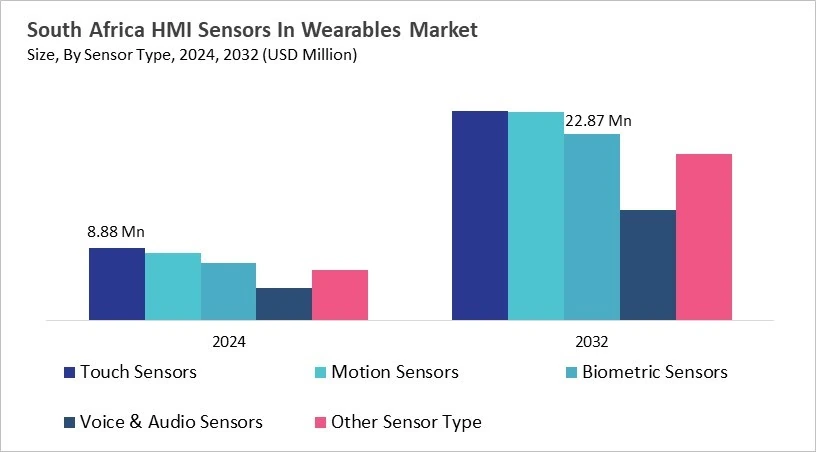
Based on Sensor Type, the market is segmented into Touch Sensors, Motion Sensors, Biometric Sensors, Voice & Audio Sensors, and Other Sensor Type. Among various South Africa HMI Sensors In Wearables Market by Sensor Type; The Touch Sensors market achieved a market size of USD $8.9 Million in 2024 and is expected to grow at a CAGR of 14.6 % during the forecast period. The Voice & Audio Sensors market is predicted to experience a CAGR of 16.9% throughout the forecast period from (2025 - 2032).
Free Valuable Insights: HMI Sensors In Wearables Market Size Worth USD 9.16 billion by 2032
Brazil is the largest wearable market in Latin America, driven by high smartphone penetration and strong consumer use of connected technologies. Smartwatches and fitness trackers with motion sensors, optical heart-rate monitors, and touch interfaces are widely adopted in urban areas. Expanding 4G coverage and ongoing 5G rollout support cloud-based health tracking and device synchronization. Rising awareness of preventive healthcare and fitness further boosts demand for biometric monitoring wearables. Consumers increasingly prefer multifunctional devices that combine communication, fitness tracking, and contactless payments. Competition is led by global brands such as Apple, Samsung, and Xiaomi, alongside affordable regional offerings. Price sensitivity shapes product tiers, while future growth will be supported by miniaturized sensors and AI-driven health analytics.

By Sensor Type
By Application
By End Use
By Device Type
By Country
Our team of dedicated experts can provide you with attractive expansion opportunities for your business.



 Unique Offerings